Department of Biological Sciences, Faculty of Science, National University of Singapore, Singapore.
Protein Sci. 2022 Feb;31(2):345-356. doi: 10.1002/pro.4221. Epub 2021 Nov 22.
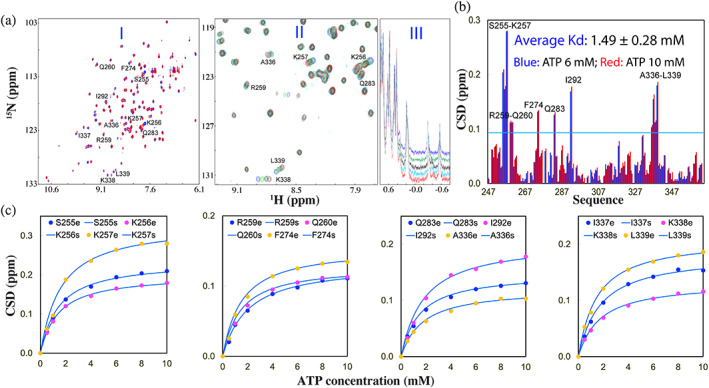
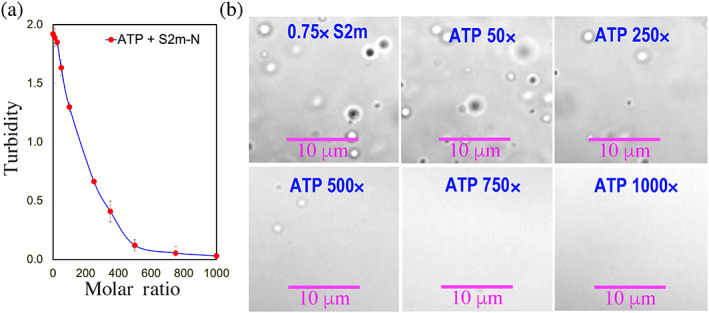
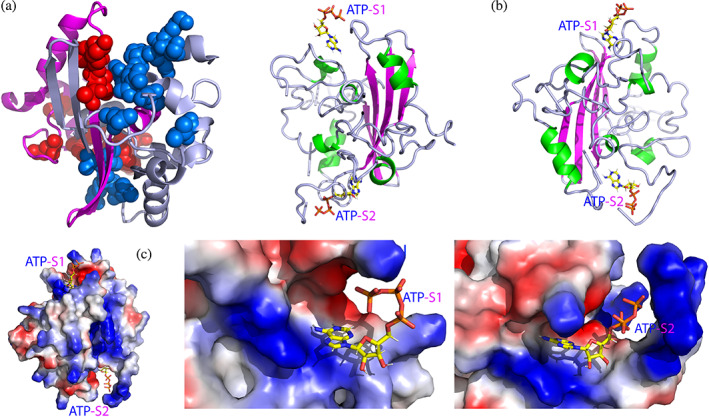
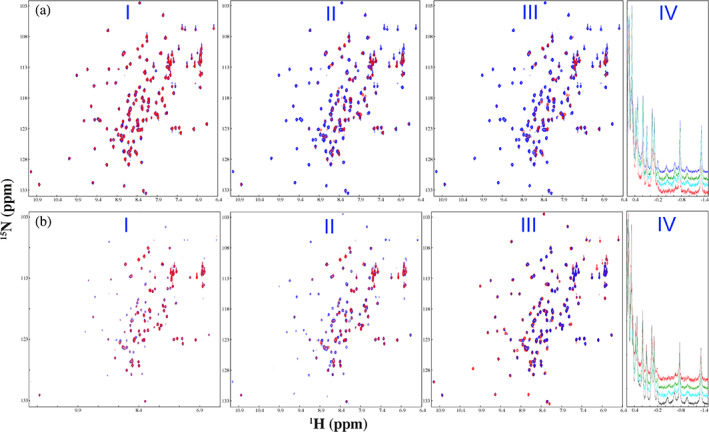
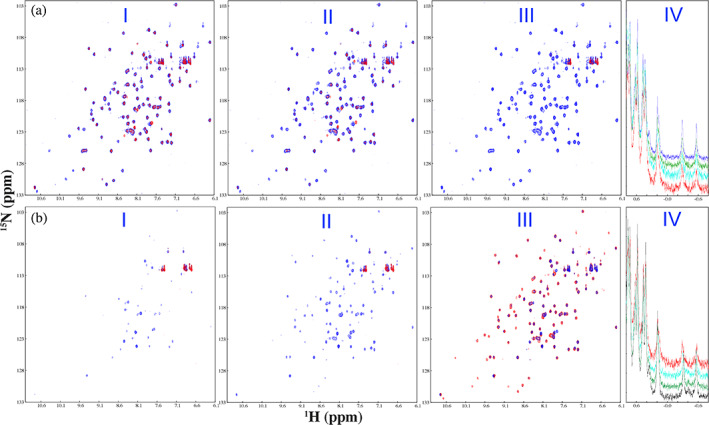
SARS-CoV-2 nucleocapsid (N) protein plays essential roles in many steps of the viral life cycle, thus representing a key drug target. N protein contains the folded N-/C-terminal domains (NTD/CTD) and three intrinsically disordered regions, while its functions including liquid-liquid phase separation (LLPS) depend on the capacity in binding various viral/host-cell RNA/DNA of diverse sequences. Previously NTD was established to bind various RNA/DNA while CTD to dimerize/oligomerize for forming high-order structures. By NMR, here for the first time we decrypt that CTD is not only capable of binding S2m, a specific probe derived from SARS-CoV-2 gRNA but with the affinity even higher than that of NTD. Very unexpectedly, ATP, the universal energy currency for all living cells with high cellular concentrations (2-16 mM), specifically binds CTD with Kd of 1.49 ± 0.28 mM. Strikingly, the ATP-binding residues of NTD/CTD are identical in the SARS-CoV-2 variants while ATP and S2m interplay in binding NTD/CTD, as well as in modulating LLPS critical for the viral life cycle. Results together not only define CTD as a novel binding domain for ATP and nucleic acid, but enforce our previous proposal that ATP has been evolutionarily exploited by SARS-CoV-2 to complete its life cycle in the host cell. Most importantly, the unique ATP-binding pockets on NTD/CTD may offer promising targets for design of specific anti-SARS-CoV-2 molecules to fight the pandemic. Fundamentally, ATP emerges to act at mM as a cellular factor to control the interface between the host cell and virus lacking the ability to generate ATP.
SARS-CoV-2 核衣壳 (N) 蛋白在病毒生命周期的许多步骤中发挥着重要作用,因此是一个关键的药物靶点。N 蛋白包含折叠的 N-/C-末端结构域(NTD/CTD)和三个固有无序区域,而其功能包括液-液相分离(LLPS)取决于结合各种具有不同序列的病毒/宿主细胞 RNA/DNA 的能力。以前,NTD 被确定为结合各种 RNA/DNA,而 CTD 则用于二聚化/寡聚化以形成高级结构。通过 NMR,我们首次解密 CTD 不仅能够结合 SARS-CoV-2 gRNA 衍生的特定探针 S2m,而且其亲和力甚至高于 NTD。非常出人意料的是,作为所有活细胞通用的能量货币,细胞内浓度很高(2-16mM)的 ATP 特异性结合 CTD,其 Kd 为 1.49±0.28mM。引人注目的是,SARS-CoV-2 变体中 NTD/CTD 的 ATP 结合残基相同,而 ATP 和 S2m 在结合 NTD/CTD 以及调节对病毒生命周期至关重要的 LLPS 方面相互作用。这些结果不仅定义了 CTD 是 ATP 和核酸的新结合域,而且还强化了我们之前的观点,即 ATP 已被 SARS-CoV-2 进化利用来完成其在宿主细胞中的生命周期。最重要的是,NTD/CTD 上独特的 ATP 结合口袋可能为设计针对 SARS-CoV-2 的特定分子提供有希望的靶点,以对抗这一大流行。从根本上讲,ATP 以 mM 为细胞因子发挥作用,以控制缺乏产生 ATP 能力的宿主细胞与病毒之间的界面。