Lichter Yael, Badelbayov Tanya, Shalev Irina, Schvartz Reut, Szekely Yishay, Benisty Dan, Goldiner Ilana, Kagarlyk Maxim, Asraf Keren, Doolman Ram, Luttwak Efrat, Kirgner Ilya, Avivi Irit, Adi Nimrod, Katz Ben-Zion
The Intensive Care Unit, Tel Aviv Sourasky Medical Center, Tel Aviv, Israel.
The Hematology Institute, Tel Aviv Sourasky Medical Center, 6 Weizman St, Tel Aviv, Israel.
Thromb J. 2021 Nov 4;19(1):79. doi: 10.1186/s12959-021-00333-3.
COVID-19 infection is associated with a hypercoagulable state. Severe COVID-19 patients present with high plasma fibrinogen levels, continuous deposition of fibrin and the presence of microthrombi in their lungs, accompanied by significant fibrinolysis, resulting in high D-dimer levels. Due to the role of FXIII in fibrin crosslinking and clot stabilization, we analyzed its activity levels and dynamics in COVID-19 patients hospitalized in the intensive care unit (ICU).
FXIII levels were measured in thirty four COVID-19 patients hospitalized in the ICU and in fourteen non-severe COVID-19 patients. FVIII levels were measured for comparison. Laboratory data and clinical variables were recorded.
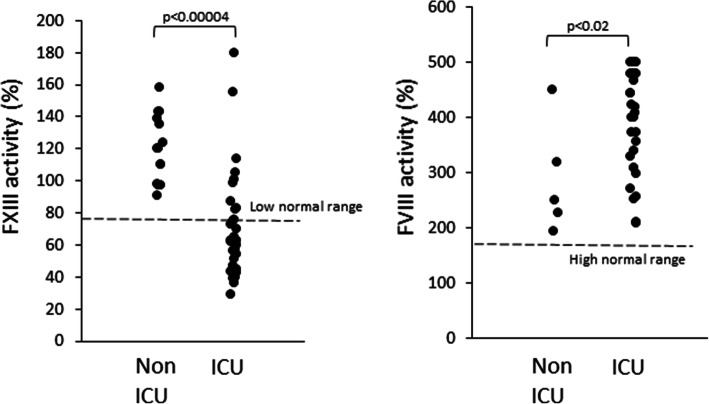
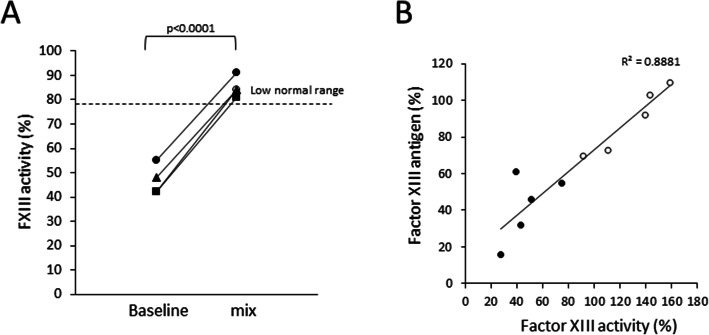
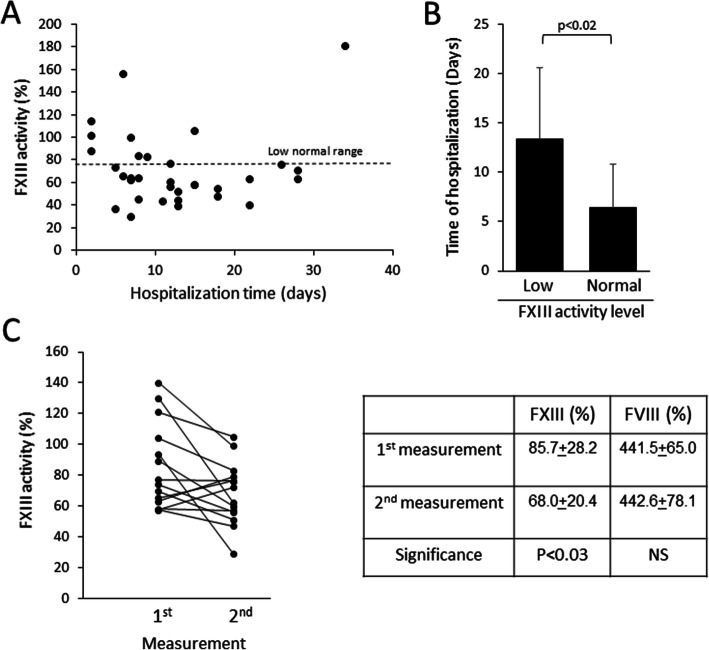
The average FXIII activity level in 34 ICU hospitalized COVID-19 patients was 69.9±33 %, significantly lower compared to an average of 120±20.9 % FXIII activity in 14 non-severe COVID-19 patients. FXIII activity levels were below the low normal value (< 79 % FXIII activity) in 74 % of the ICU hospitalized COVID-19 patients. In contrast, high FVIII activity was measured among all severe COVID-19 patients. Consecutive measurements, performed in fourteen ICU hospitalized COVID-19 patients, pointed to a significant decrease in FXIII activity from the average of 85.7±28.2 %, (which is in the normal range), to an average of 68.0±20.4 %, below the low normal range, within 6.4±3.4 days of ICU hospitalization. Liver functions did not differentiate between patients with low and normal FXIII activity. No inhibitor to FXIII activity was found in the plasma of severe COVID-19 patients. Levels of FXIII-A antigen correlated with FXIII activity, and were low in severe COVID-19 patients.
Low FXIII activity levels were found in COVID-19 patients hospitalized in the ICU, with gradual decline during their hospitalization. A mechanism of consumption may account for the low FXIII activity in these patients.
新型冠状病毒肺炎(COVID-19)感染与高凝状态有关。重症COVID-19患者血浆纤维蛋白原水平升高,肺部有纤维蛋白持续沉积和微血栓形成,同时伴有显著的纤维蛋白溶解,导致D-二聚体水平升高。由于因子XIII(FXIII)在纤维蛋白交联和凝块稳定中起作用,我们分析了其在重症监护病房(ICU)住院的COVID-19患者中的活性水平及动态变化。
检测了34例在ICU住院的COVID-19患者和14例非重症COVID-19患者的FXIII水平。检测FVIII水平用于比较。记录实验室数据和临床变量。
34例在ICU住院的COVID-19患者的FXIII平均活性水平为69.9±33%,与14例非重症COVID-19患者FXIII平均活性120±20.9%相比显著降低。74%在ICU住院的COVID-19患者的FXIII活性水平低于正常低值(FXIII活性<79%)。相比之下,所有重症COVID-19患者均检测到FVIII活性升高。对14例在ICU住院的COVID-19患者进行连续检测,结果显示在ICU住院6.4±3.4天内,FXIII活性从平均85.7±28.2%(处于正常范围)显著下降至平均68.0±20.4%,低于正常低值范围。肝功能在FXIII活性低和正常的患者之间无差异。在重症COVID-19患者血浆中未发现FXIII活性抑制剂。FXIII-A抗原水平与FXIII活性相关,在重症COVID-19患者中较低。
在ICU住院的COVID-19患者中发现FXIII活性水平较低,且在住院期间逐渐下降。消耗机制可能是这些患者FXIII活性低的原因。