Peng Xiulan, Huang Yali, Fu Haifeng, Zhang Zhi, He Anbing, Luo Renfeng
Department of Oncology, The Second Affiliated Hospital of Jianghan University, Wuhan, Hubei, People's Republic of China.
Department of Hepatopancreatobiliary Surgery, Sinopharm Dongfeng General Hospital, Hubei University of Medicine, Wuhan, Hubei, People's Republic of China.
Int J Gen Med. 2021 Oct 28;14:7349-7359. doi: 10.2147/IJGM.S337822. eCollection 2021.
We aimed to evaluate the prognostic ability of blood urea nitrogen (BUN) to serum albumin ratio (BAR) to predict in-hospital mortality in patients with lung cancer in the intensive care unit (ICU).
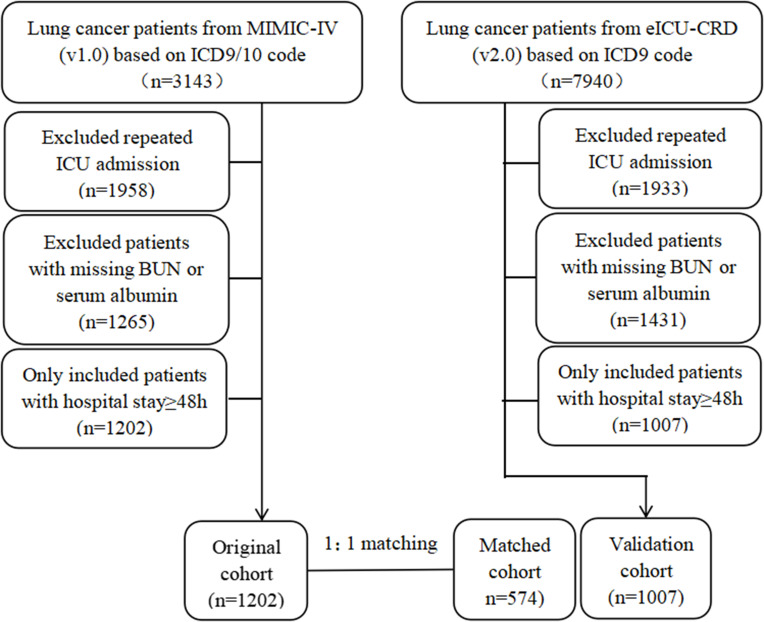
Medical Information Mart for Intensive Care IV (MIMIC-IV v1.0) database was used to identify patients who were diagnosed with lung cancer. The primary outcome was in-hospital mortality. Multivariate COX regression was used to investigate the association between BAR and in-hospital mortality and propensity score matching (PSM) and inverse probability of treatment weighting (IPTW) were also used to ensure the robustness of our findings. eICU-CRD database (validation cohort) was also applied to validate our findings.
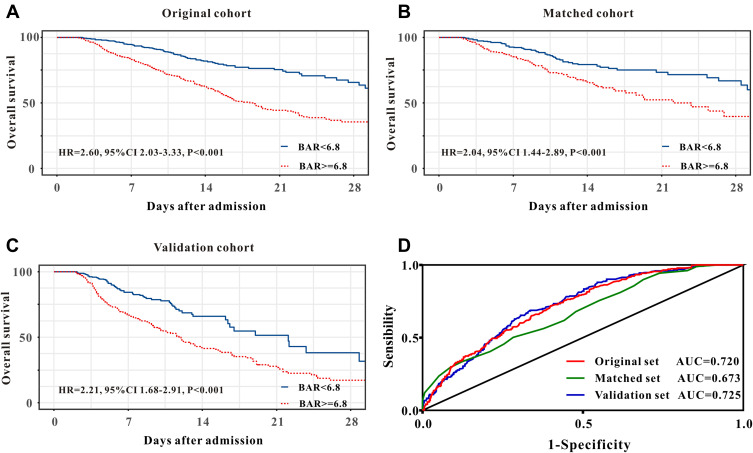
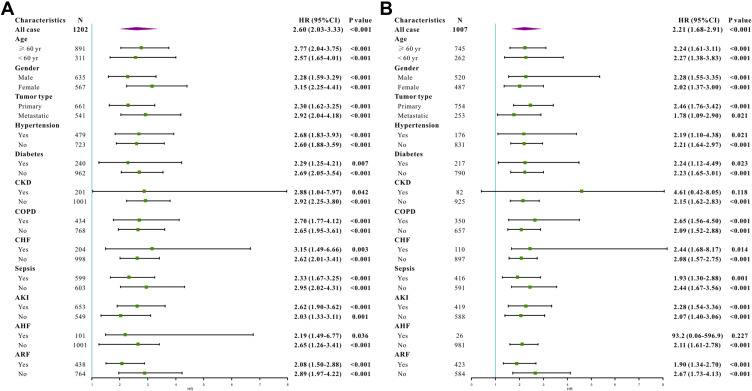
The optimal cut-off value for BAR was 6.8mg/g. Among 1202 patients who were diagnosed with lung cancer, 287 high-BAR group (≥6.8mg/g) patients and 287 low-BAR group (<6.8mg/g) patients, who had similar propensity scores were included in this study. After matching, the high-BAR group had significantly higher in-hospital mortality (hazard ratio, HR, 2.24, 95% confidence index, 95% CI, 1.57-3.19, P<0.001) even after adjustment for confounding factors. Moreover, the performance of BAR was superior to that of BUN and serum albumin alone and could add net benefit in predicting in-hospital mortality. Those results were further confirmed in the validation cohort.
As an easily accessible and cost-effective parameter, BAR could serve as a good prognostic predictor for lung cancer patients in ICU.
我们旨在评估血尿素氮(BUN)与血清白蛋白比值(BAR)预测重症监护病房(ICU)肺癌患者院内死亡率的预后能力。
使用重症监护医学信息集市IV(MIMIC-IV v1.0)数据库来识别被诊断为肺癌的患者。主要结局是院内死亡率。采用多变量COX回归研究BAR与院内死亡率之间的关联,还使用倾向评分匹配(PSM)和逆概率加权法(IPTW)来确保研究结果的稳健性。eICU-CRD数据库(验证队列)也用于验证我们的研究结果。
BAR的最佳截断值为6.8mg/g。在1202例被诊断为肺癌的患者中,本研究纳入了287例高BAR组(≥6.8mg/g)患者和287例低BAR组(<6.8mg/g)患者,他们具有相似的倾向评分。匹配后,即使在调整混杂因素后,高BAR组的院内死亡率仍显著更高(风险比,HR,2.24,95%置信区间,95%CI,1.57 - 3.19,P<0.001)。此外,BAR的预测性能优于单独的BUN和血清白蛋白,并且在预测院内死亡率方面可以增加净效益。这些结果在验证队列中得到了进一步证实。
作为一个易于获取且具有成本效益的参数,BAR可以作为ICU中肺癌患者良好的预后预测指标。