Meena Dinesh K, Jayanthi Mathaiyan
Pharmacology, Jawaharlal Institute of Postgraduate Medical Education and Research, Puducherry, IND.
Cureus. 2021 Oct 1;13(10):e18431. doi: 10.7759/cureus.18431. eCollection 2021 Oct.
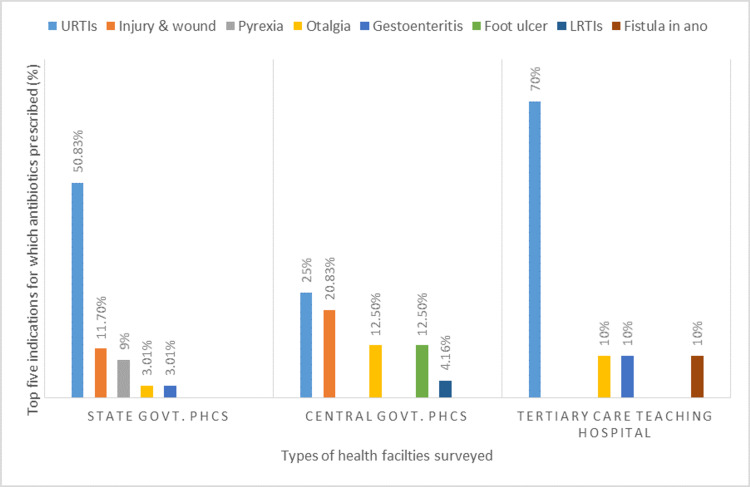
Introduction Antimicrobial resistance is a serious problem to solve for the public health authorities at the global level, particularly in developing countries like India. One of the possible reasons for antimicrobial resistance could be the inappropriate or overuse of antibiotics. The Indian government started the National Action Plan on Antimicrobial Resistance to promote rational use of antibiotics in our country. This study was conducted with the objective to monitor antibiotic use in public health facilities of Puducherry which is a union territory of south India. Methods Total 900 prescriptions were prospectively collected from the 10 public health facilities (nine primary health centres and one outpatient department of tertiary care hospital) over the period of one year to analyse antibiotic use. Results We found that 36.66 % of prescriptions contained at least one antibiotic. Our result shows that antibiotics were more commonly prescribed from the access category. Upper respiratory tract infections was the most common indication for which antibiotic was prescribed in primary health centres. In the tertiary care teaching hospital, half of the antibiotics were prescribed for cough, followed by pharyngitis (20 %). Conclusions A high proportion of antibiotics were prescribed for viral infections. Using antibiotics unnecessary can increase the cost of treatment as well as risk of antibiotic resistance. The Department of Medical Services, Puducherry should take initiative to ensure the successful implantation of the National Action Plan on Antimicrobial Resistance. Data of this study can be used to provide educational intervention for all drug stake holders such as physicians, pharmacists and policy makers to promote rational use of antibiotics.
引言
耐药性是全球公共卫生当局需要解决的一个严重问题,在印度等发展中国家尤为如此。抗生素耐药性的一个可能原因是抗生素使用不当或过度使用。印度政府启动了《抗菌药物耐药性国家行动计划》,以促进我国抗生素的合理使用。本研究旨在监测印度南部联邦属地本地治里公共卫生机构的抗生素使用情况。
方法
在一年的时间里,从10个公共卫生机构(9个初级卫生中心和一家三级护理医院的门诊部)前瞻性收集了900份处方,以分析抗生素的使用情况。
结果
我们发现36.66%的处方至少含有一种抗生素。我们的结果表明,从获取类别来看,抗生素的处方更为常见。上呼吸道感染是初级卫生中心开具抗生素最常见的指征。在三级护理教学医院,一半的抗生素用于治疗咳嗽,其次是咽炎(20%)。
结论
很大一部分抗生素被用于病毒感染。不必要地使用抗生素会增加治疗成本以及抗生素耐药性风险。本地治里医疗服务部应主动确保《抗菌药物耐药性国家行动计划》的成功实施。本研究的数据可用于为医生、药剂师和政策制定者等所有药物利益相关者提供教育干预,以促进抗生素的合理使用。