Division of Otolaryngology-Head and Neck Surgery, University of Utah, Salt Lake City, Utah, U.S.A.
Department of Neurology, University of Utah, Salt Lake City, Utah, U.S.A.
Laryngoscope. 2022 Apr;132 Suppl 7(Suppl 7):S1-S15. doi: 10.1002/lary.29933. Epub 2021 Nov 5.
OBJECTIVES/HYPOTHESIS: We hypothesize that treating hearing loss through cochlear implantation in older adults will improve cognitive function.
Prospective, interventional study.
Thirty-seven participants aged 65 years and older who met criteria for cochlear implantation were enrolled. Subjects underwent preoperative cognitive testing with a novel arrangement of standard neuropsychological tests, including tests of general cognition and mood (Mini-Mental Status Exam [MMSE]), tests of verbally based stimuli and responses (Digit Span, Stroop, Hopkins Verbal Learning Test-Revised [HVLT-R], Hayling Sentence Completion), and comparable visually based tests (Spatial Span, d2 Test of Attention, Brief Visuospatial Memory Test [BVMT], Trails A and B). Testing was repeated 12 months postoperatively.
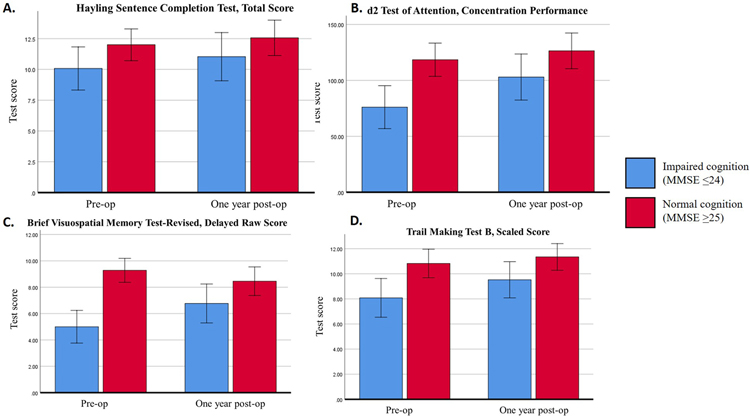
One year postoperatively, subjects showed a statistically significant improvement in hearing and on the following tests of cognitive function: concentration performance of the d2 Test of Attention, Hayling Sentence Completion Test, HVLT-R (total and delayed recall), Spatial Span (backward), and Stroop Color Word Test. A subgroup analysis was performed comparing 13 participants with preoperative cognitive impairment (MMSE ≤ 24) to 24 participants with normal cognition (MMSE ≥ 25). In this subgroup analysis, a greater magnitude of improvement was seen in those with impaired cognition, with statistically significant improvement in Digit Span (scaled score), Stroop Word (T-score), Stroop Color-Word (residual and T-score), HVLT-R, and Hayling (overall). All verbally based test scores improved, and 75% of the visually based test scores improved.
This study demonstrates the cognitive benefits of cochlear implantation in older adults 1 year after surgery. For older adults with cognitive impairment prior to cochlear implantation, the cognitive benefits were even greater than in subjects with normal cognition.
3, nonrandomized controlled cohort Laryngoscope, 132:S1-S15, 2022.
目的/假设:我们假设通过对老年人进行耳蜗植入治疗听力损失将改善认知功能。
前瞻性、干预性研究。
招募了 37 名符合耳蜗植入标准的年龄在 65 岁及以上的参与者。受试者接受了术前认知测试,采用了一种新颖的标准神经心理学测试安排,包括一般认知和情绪测试(Mini-Mental Status Exam [MMSE])、基于言语刺激和反应的测试(数字跨度、Stroop、Hopkins 言语学习测试修订版 [HVLT-R]、Hayling 句子完成),以及类似的基于视觉的测试(空间跨度、d2 注意力测试、简短视觉空间记忆测试 [BVMT]、Trails A 和 B)。测试在术后 12 个月重复进行。
术后 1 年,受试者在听力和以下认知功能测试方面均表现出统计学上显著的改善:d2 注意力测试的注意力集中表现、Hayling 句子完成测试、HVLT-R(总回忆和延迟回忆)、空间跨度(向后)和 Stroop 颜色词测试。对术前认知障碍(MMSE≤24)的 13 名参与者和认知正常(MMSE≥25)的 24 名参与者进行了亚组分析。在该亚组分析中,认知障碍患者的改善程度更大,数字跨度(量表分数)、Stroop 词(T 分数)、Stroop 颜色词(残留和 T 分数)、HVLT-R 和 Hayling(整体)均有统计学显著改善。所有基于言语的测试分数均有所提高,75%的基于视觉的测试分数有所提高。
这项研究表明,在手术后 1 年,耳蜗植入对老年人有认知益处。对于在耳蜗植入前有认知障碍的老年人,认知益处甚至大于认知正常的受试者。
3,非随机对照队列研究《喉镜》,132:S1-S15,2022。