Department of Gastroenterology, Yan'an Hospital of Kunming, Kunming, Yunnan 650051, P.R. China.
Department of Gastroenterology, The Affiliated Yan'an Hospital of Kunming Medical University, Kunming, Yunnan 650051, P.R. China.
Mol Med Rep. 2022 Jan;25(1). doi: 10.3892/mmr.2021.12519. Epub 2021 Nov 5.
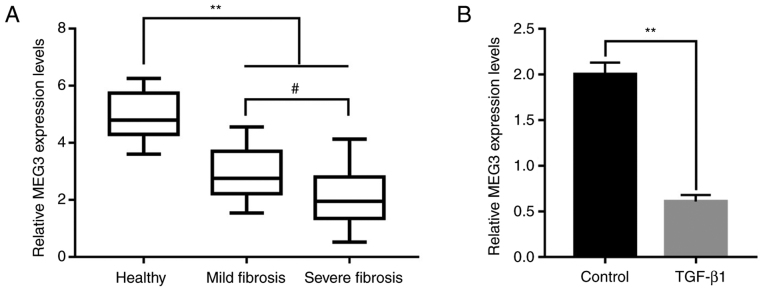
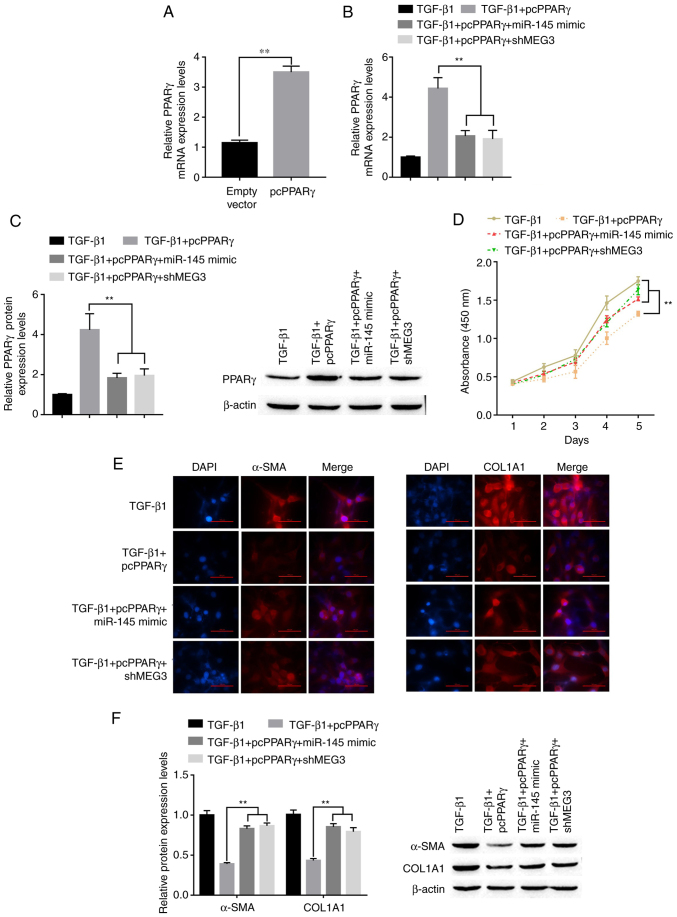
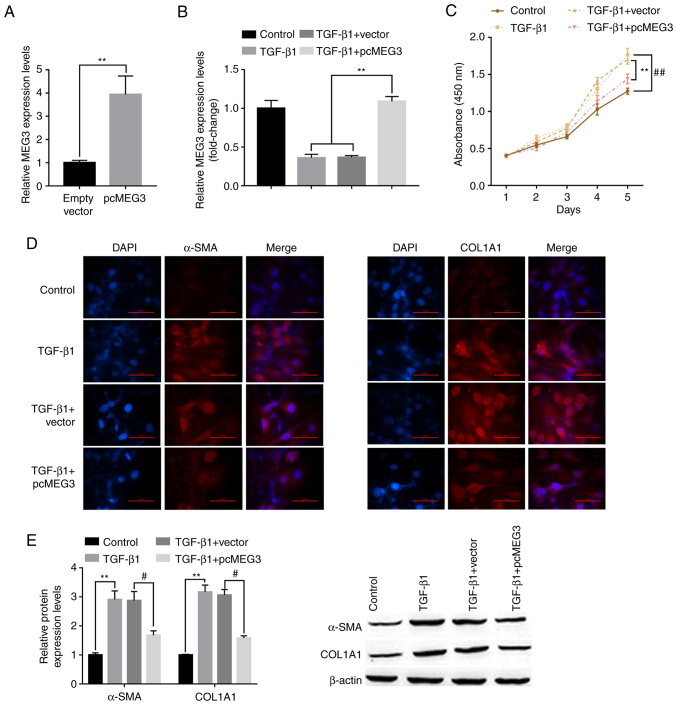
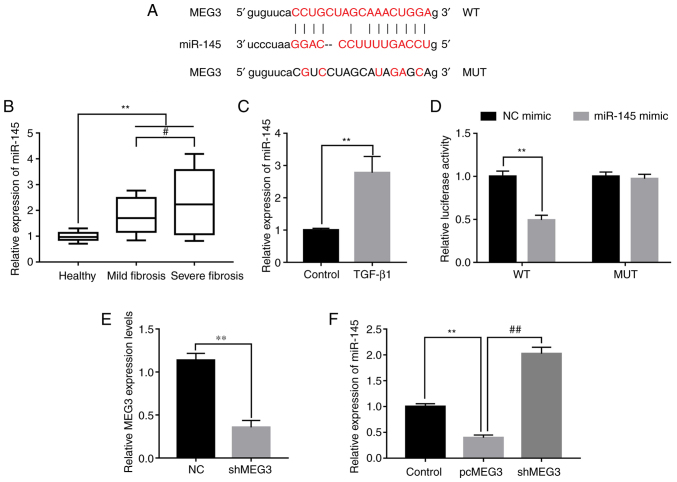
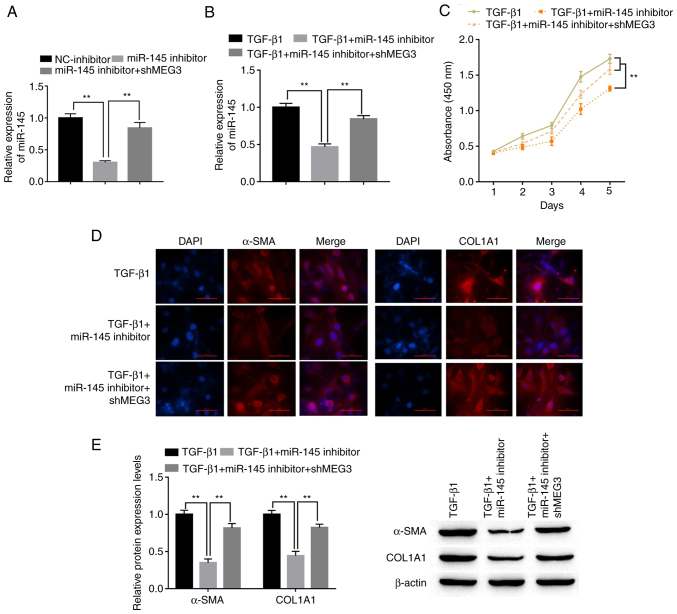
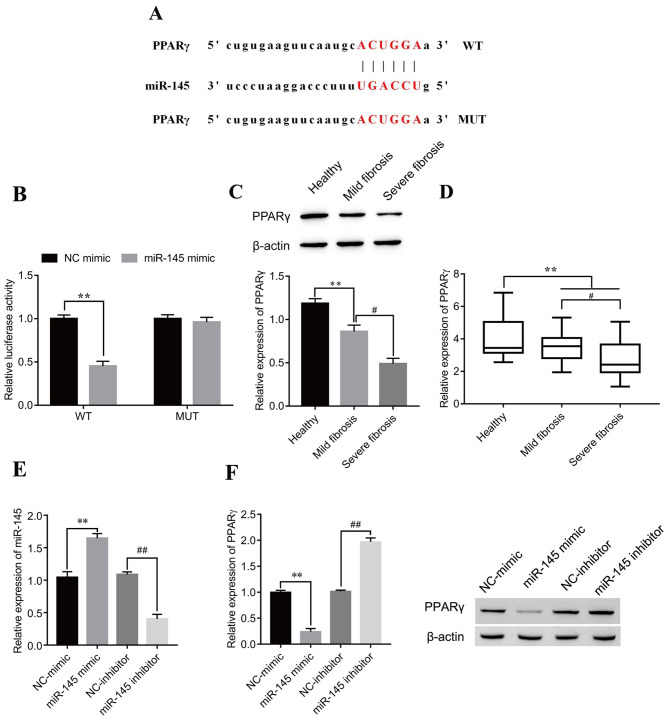
It is important to determine the mechanism of liver fibrosis for targeted therapy and the development of targeted therapies for liver fibrosis may offer promise for patients with liver disease. Long non‑coding RNAs (lncRNAs) serve a role in hepatic fibrosis. The lncRNA maternally expressed gene 3 (MEG3) has been confirmed to inhibit liver fibrosis. The present study investigated the role of the MEG3 in healthy patients and patients with liver fibrosis. The expression levels of MEG3 and microRNA (miR)‑145 in the serum of healthy volunteers and patients with liver fibrosis and in LX‑2 cells were detected using reverse transcription‑quantitative PCR. A dual‑luciferase reporter assay was used to determine the targeting relationship between MEG3 and miR‑145, and the targeting relationship between miR‑145 and peroxisome proliferator‑activated receptor γ (PPARγ). The protein expression levels of PPARγ, α‑smooth muscle actin (α‑SMA) and collagen I (COL1A1) were detected using western blotting. The expression levels of α‑SMA and COL1A1 were also determined using immunofluorescence. Finally, a Cell Counting Kit‑8 assay was performed to assess the proliferative ability of LX‑2 cells. A significantly reduced MEG3 expression level was demonstrated in serum from patients with liver fibrosis compared with serum from healthy controls. TGF‑β1 induced a significantly decreased MEG3 expression level in LX‑2 human hepatic stellate cells . The TGF‑β1‑induced increases in cell proliferation and α‑SMA and COL1A1 protein expression levels were reversed following MEG3 overexpression. The results also demonstrated that MEG3 sponged miR‑145 and competed endogenously with miR‑145 to regulate PPARγ. In summary, the present study identified MEG3 as an anti‑fibrotic lncRNA and provided new information regarding the role of MEG3 in liver fibrosis. MEG3 may therefore be a potential target in the treatment of liver fibrosis.
确定肝纤维化的机制对于靶向治疗很重要,肝纤维化的靶向治疗的发展可能为肝病患者带来希望。长链非编码 RNA(lncRNA)在肝纤维化中发挥作用。已证实母系表达基因 3(MEG3)可抑制肝纤维化。本研究探讨了 MEG3 在健康患者和肝纤维化患者中的作用。采用逆转录定量 PCR 检测健康志愿者和肝纤维化患者血清及 LX-2 细胞中 MEG3 和微小 RNA(miR)-145 的表达水平。采用双荧光素酶报告基因实验确定 MEG3 与 miR-145 之间的靶向关系,以及 miR-145 与过氧化物酶体增殖物激活受体 γ(PPARγ)之间的靶向关系。采用 Western blot 检测 PPARγ、α-平滑肌肌动蛋白(α-SMA)和Ⅰ型胶原(COL1A1)的蛋白表达水平。采用免疫荧光法检测 α-SMA 和 COL1A1 的表达水平。最后,采用细胞计数试剂盒-8 法检测 LX-2 细胞的增殖能力。与健康对照组相比,肝纤维化患者血清中 MEG3 的表达水平显著降低。TGF-β1 可诱导 LX-2 人肝星状细胞中 MEG3 的表达水平显著降低。过表达 MEG3 后,TGF-β1 诱导的细胞增殖增加以及 α-SMA 和 COL1A1 蛋白表达水平增加的情况均得到逆转。结果还表明,MEG3 可吸附 miR-145 并与 miR-145 内源性竞争以调节 PPARγ。综上所述,本研究鉴定出 MEG3 为一种抗纤维化 lncRNA,为 MEG3 在肝纤维化中的作用提供了新的信息。因此,MEG3 可能成为治疗肝纤维化的潜在靶点。