The Hebrew University of Jerusalem, Koret School of Veterinary Medicine, Jerusalem, Israel.
The Hebrew University of Jerusalem, Koret School of Veterinary Medicine-Internal Medicine, Small Animals, Rehovot, Israel.
J Vet Intern Med. 2021 Nov;35(6):2812-2820. doi: 10.1111/jvim.16308. Epub 2021 Nov 5.
Early recognition of acute kidney injury (AKI) is hindered by current definitions and use of traditional, insensitive markers.
HYPOTHESIS/OBJECTIVES: Urinary (u) activity of γ-glutamyl transpeptidase (GGT) and alkaline phosphatase (ALP), and concentrations of heat-shock protein 70 (HSP70) and interleukins (ILs) -6 and -18, are predictive biomarkers for AKI and survival.
Nonazotemic, hospitalized dogs (n = 118) and healthy controls (n = 20).
A prospective observational study. Nonazotemic dogs at risk of AKI were recruited and their urinary biomarker concentrations were measured at presentation. Serum creatinine (sCr) and symmetric dimethylarginine (sSDMA) were measured daily until discharge/death.
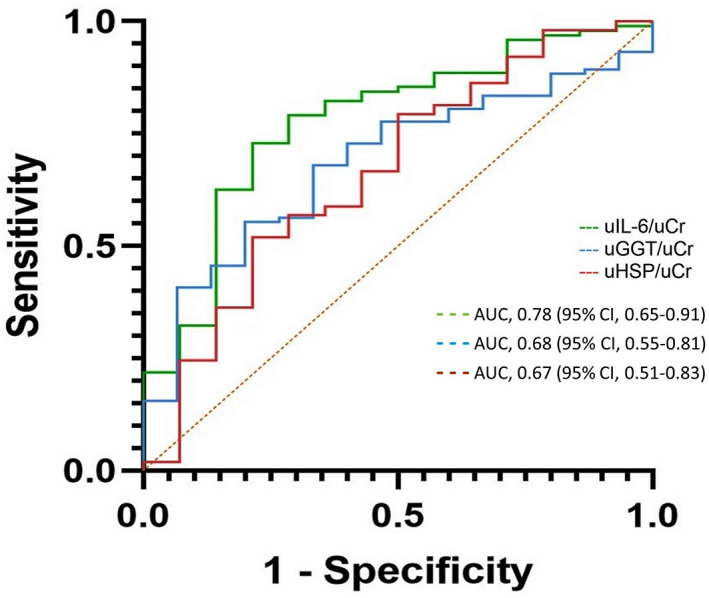
The overall case fatality rate was 18.6%. Fifteen dogs (12.7%) developed AKI, which was associated with death (relative risk, 3.2; 95% confidence interval [CI], 1.57-6.55). All 5 urinary biomarkers were significantly higher in hospitalized dogs compared to controls, with minimal overlap. uHSP70/uCr, uGGT/uCr, and uIL-6/uCr at presentation were higher in dogs which later developed AKI. Areas under the receiver operator characteristic curve (AUROC) (95% CI) for the 3 biomarkers as predictors of AKI were 0.67 (0.51-0.83), 0.68 (0.55-0.81), and 0.78 (0.65-0.91), respectively. When they were categorically classified as elevated/normal, each additional elevated biomarker increased the odds for AKI (OR, 2.83; 95% CI, 1.23-6.52, P = .01). Agreement between sCr and sSDMA was poor (Cohen's kappa = .071). The AUROC of SDMA at presentation for AKI prediction was 0.73 (0.51-0.95).
Kidney injury was common, irrespective of subsequent worsening of azotemia or death. The predictive value of individual urinary biomarkers was reduced by moderate sensitivities and specificities. SDMA showed moderate discriminatory utility for AKI prediction, and often displayed discordant results with sCr.
急性肾损伤(AKI)的早期识别受到当前定义和传统、不敏感标志物的使用的阻碍。
假设/目的:尿(u)γ-谷氨酰转肽酶(GGT)和碱性磷酸酶(ALP)活性以及热休克蛋白 70(HSP70)和白细胞介素(ILs)-6 和-18 的浓度,是 AKI 和存活的预测生物标志物。
非氮血症、住院犬(n=118)和健康对照组(n=20)。
前瞻性观察性研究。招募有 AKI 风险的非氮血症犬,并在就诊时测量其尿生物标志物浓度。每天测量血清肌酐(sCr)和对称二甲基精氨酸(sSDMA),直至出院/死亡。
总病死率为 18.6%。15 只犬(12.7%)发生 AKI,与死亡相关(相对风险,3.2;95%置信区间[CI],1.57-6.55)。与对照组相比,所有住院犬的 5 种尿生物标志物均显著升高,且重叠最小。就诊时 uHSP70/uCr、uGGT/uCr 和 uIL-6/uCr 升高的犬后来发展为 AKI。3 种生物标志物作为 AKI 预测指标的受试者工作特征曲线下面积(AUROC)(95%CI)分别为 0.67(0.51-0.83)、0.68(0.55-0.81)和 0.78(0.65-0.91)。当它们被分类为升高/正常时,每个额外的升高标志物都会增加 AKI 的可能性(OR,2.83;95%CI,1.23-6.52,P=0.01)。sCr 和 sSDMA 之间的一致性较差(Cohen's kappa=0.071)。SDMA 对 AKI 预测的 AUROC 为 0.73(0.51-0.95)。
无论氮血症恶化或死亡与否,肾脏损伤都很常见。单个尿生物标志物的预测价值受到中等敏感性和特异性的限制。SDMA 对 AKI 预测具有中等的判别能力,并且经常与 sCr 显示出不一致的结果。