Clinical Division and Laboratory of Intensive Care Medicine, Department of Cellular and Molecular Medicine, KU Leuven, Leuven, Belgium.
Toxicological Center, University of Antwerp, Wilrijk, Belgium.
Environ Int. 2022 Jan;158:106962. doi: 10.1016/j.envint.2021.106962. Epub 2021 Nov 2.
Children who have been critically ill face long-term developmental impairments. Iatrogenic exposure to di(2-ethylhexyl)phthalate (DEHP), a plasticizer leaching from plastic indwelling medical devices used in the pediatric intensive care unit (PICU), has been associated with the pronounced attention deficit observed in children 4 years after critical illness. As concerns about DEHP toxicity increased, governmental authorities urged the phase out of DEHP in indwelling medical devices and replacement with alternative plasticizers. We hypothesized that exposure to DEHP decreased over the years, attenuating the pronounced long-term attention deficit of these vulnerable children.
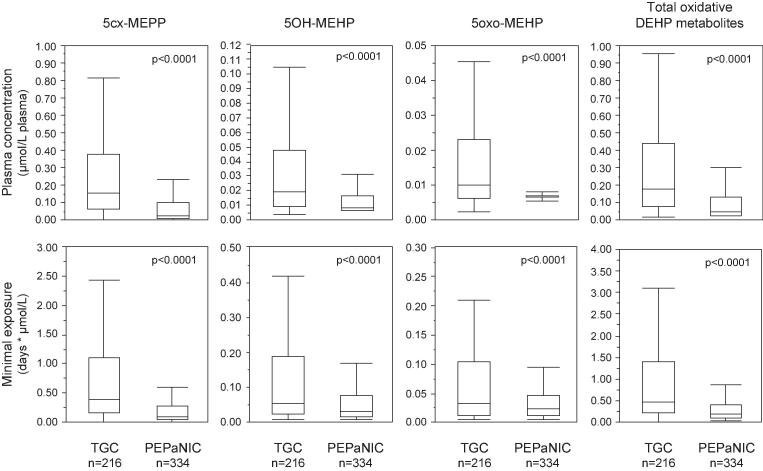
We compared plasma concentrations of 3 oxidative DEHP metabolites (5cx-MEPP, 5OH-MEHP, 5oxo-MEHP) on the last PICU day in 216 patients who participated in the Tight Glucose Control study (2004-2007) and 334 patients who participated in the PEPaNIC study (2012-2015) and survived PICU stay. Corresponding minimal exposures to these metabolites (plasma concentration multiplied with number of days in PICU) were also evaluated. In patients with 4-year follow-up data, we compared measures of attention (standardized reaction times and consistency). Comparisons were performed with univariable analyses and multivariable linear regression analyses adjusted for baseline risk factors.
In the PEPaNIC patients, last PICU day plasma concentrations of 5cx-MEPP, 5OH-MEHP, 5oxo-MEHP and their sum, and corresponding minimal exposures, were reduced to 17-69% of those in the Tight Glucose Control study (p < 0.0001). Differences remained significant after multivariable adjustment (p ≤ 0.001). PEPaNIC patients did not show better attention than patients in the Tight Glucose Control study, also not after multivariable adjustment for risk factors.
Exposure of critically ill children to DEHP in the PICU decreased over the years, but the lower exposure did not translate into improved attention 4 years later. Whether the residual exposure may still be toxic or whether the plasticizers replacing DEHP may not be safe for neurodevelopment needs further investigation.
患有重病的儿童面临长期的发育障碍。从儿科重症监护病房(PICU)中使用的留置医用设备中浸出的增塑剂邻苯二甲酸二(2-乙基己基)酯(DEHP)会导致儿童在重病后 4 年出现明显的注意力缺陷,这种情况已被发现。随着对 DEHP 毒性的担忧增加,政府当局敦促淘汰留置医用设备中的 DEHP,并使用替代增塑剂进行替代。我们假设,随着时间的流逝,DEHP 的暴露量会减少,从而减轻这些脆弱儿童明显的长期注意力缺陷。
我们比较了参加 Tight Glucose Control 研究(2004-2007 年)的 216 名患者和参加 PEPaNIC 研究(2012-2015 年)并在 PICU 中存活的 334 名患者在 PICU 最后一天的血浆中 3 种氧化 DEHP 代谢物(5cx-MEPP、5OH-MEHP、5oxo-MEHP)的浓度。还评估了相应的最小暴露量(血浆浓度乘以在 PICU 中的天数)。对于有 4 年随访数据的患者,我们比较了注意力的测量值(标准化反应时间和一致性)。采用单变量分析和多变量线性回归分析,根据基线危险因素进行调整,对数据进行了比较。
在 PEPaNIC 患者中,PICU 最后一天的 5cx-MEPP、5OH-MEHP、5oxo-MEHP 及其总和的血浆浓度以及相应的最小暴露量降低至 Tight Glucose Control 研究中的 17-69%(p<0.0001)。多变量调整后差异仍有统计学意义(p≤0.001)。PEPaNIC 患者的注意力并未优于 Tight Glucose Control 研究中的患者,即使在多变量调整了危险因素后也没有改善。随着时间的流逝,儿童在 PICU 中接触 DEHP 的情况有所减少,但较低的暴露水平并未在 4 年后转化为更好的注意力。残留的暴露量是否仍具有毒性,或者替代 DEHP 的增塑剂是否对神经发育安全,仍需要进一步研究。