Department of Women's and Children's Health, Uppsala University, Uppsala, Sweden.
Institute of Nutrition of Central America and Panama (INCAP), Calzada Roosevelt 6-25, Zona 11, Guatemala, Guatemala.
BMC Pregnancy Childbirth. 2021 Nov 5;21(1):749. doi: 10.1186/s12884-021-04215-4.
We aimed to identify the 2001-2013 incidence trend, and characteristics associated with adolescent pregnancies reported by 20-24-year-old women.
A retrospective analysis of the Cuatro Santos Northern Nicaragua Health and Demographic Surveillance 2004-2014 data on women aged 15-19 and 20-24. To calculate adolescent birth and pregnancy rates, we used the first live birth at ages 10-14 and 15-19 years reported by women aged 15-19 and 20-24 years, respectively, along with estimates of annual incidence rates reported by women aged 20-24 years. We conducted conditional inference tree analyses using 52 variables to identify characteristics associated with adolescent pregnancies.
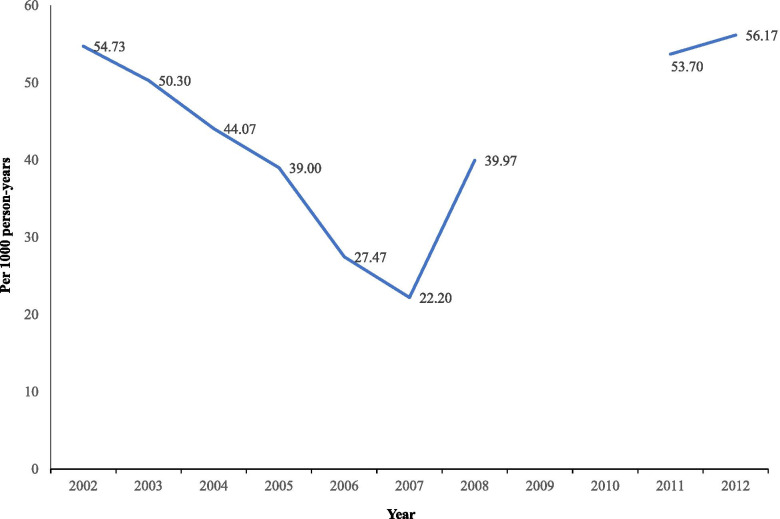
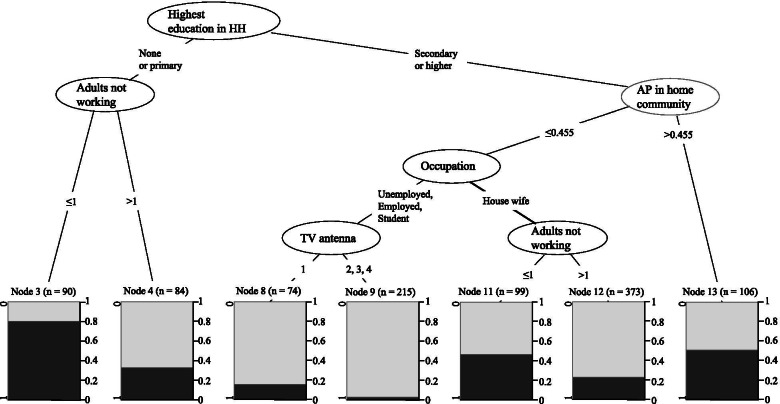
The number of first live births reported by women aged 20-24 years was 361 during the study period. Adolescent pregnancies and live births decreased from 2004 to 2009 and thereafter increased up to 2014. The adolescent pregnancy incidence (persons-years) trend dropped from 2001 (75.1 per 1000) to 2007 (27.2 per 1000), followed by a steep upward trend from 2007 to 2008 (19.1 per 1000) that increased in 2013 (26.5 per 1000). Associated factors with adolescent pregnancy were living in low-education households, where most adults in the household were working, and high proportion of adolescent pregnancies in the local community. Wealth was not linked to teenage pregnancies.
Interventions to prevent adolescent pregnancy are imperative and must bear into account the context that influences the culture of early motherhood and lead to socioeconomic and health gains in resource-poor settings.
本研究旨在分析 2001-2013 年期间,20-24 岁女性报告的青少年妊娠发生率趋势及其特征。
对 2004-2014 年 Cuatro Santos 北部尼加拉瓜健康和人口监测数据进行回顾性分析,研究对象为 15-19 岁和 20-24 岁女性。为计算青少年的出生率和妊娠率,我们分别使用 15-19 岁和 20-24 岁女性报告的最早活产年龄为 10-14 岁和 15-19 岁的首次活产,以及 20-24 岁女性报告的年度发病率估计值。我们对 52 个变量进行条件推理树分析,以确定与青少年妊娠相关的特征。
在研究期间,20-24 岁女性报告的首次活产数为 361 例。青少年妊娠和活产率从 2004 年至 2009 年下降,此后一直上升至 2014 年。青少年妊娠发生率(人年)趋势从 2001 年(75.1/1000)下降到 2007 年(27.2/1000),随后在 2007 年至 2008 年急剧上升(19.1/1000),并在 2013 年进一步上升(26.5/1000)。与青少年妊娠相关的因素包括居住在低教育水平家庭,家庭中大多数成年人都在工作,以及当地社区青少年妊娠比例较高。财富与青少年妊娠无关。
在资源匮乏的环境中,预防青少年妊娠的干预措施是必要的,必须考虑到影响早育文化的因素,并带来社会经济和健康方面的收益。