Ophthalmology department, Bellvitge University Hospital, Carrer de la Feixa Llarga, s/n, 08907. Hospitalet de Llobregat, Barcelona, Spain.
BMC Ophthalmol. 2021 Nov 5;21(1):387. doi: 10.1186/s12886-021-02132-w.
The purpose of this study is to assess the effectiveness of topical nonsteroidal anti-inflammatory drugs (NSAIDs) and corticosteroids (intravitreal dexamethasone and peribulbar triamcinolone) in treating pseudophakic macular edema (PME).
Retrospective study of 33 eyes. Variables included best corrected visual acuity (BCVA; logMAR scale) and central retinal thickness (CRT) and central choroidal thickness (CCT) assessed with swept-source OCT. All patients were initially prescribed topical NSAIDs and reevaluated after 2 months. If improvement in BCVA or CRT was noted, topical NSAIDs were continued until resolution. If no improvement was observed at 2 months or subsequent visits, intravitreal dexamethasone implant was performed. Patients who refused intravitreal treatment were offered peribulbar triamcinolone.
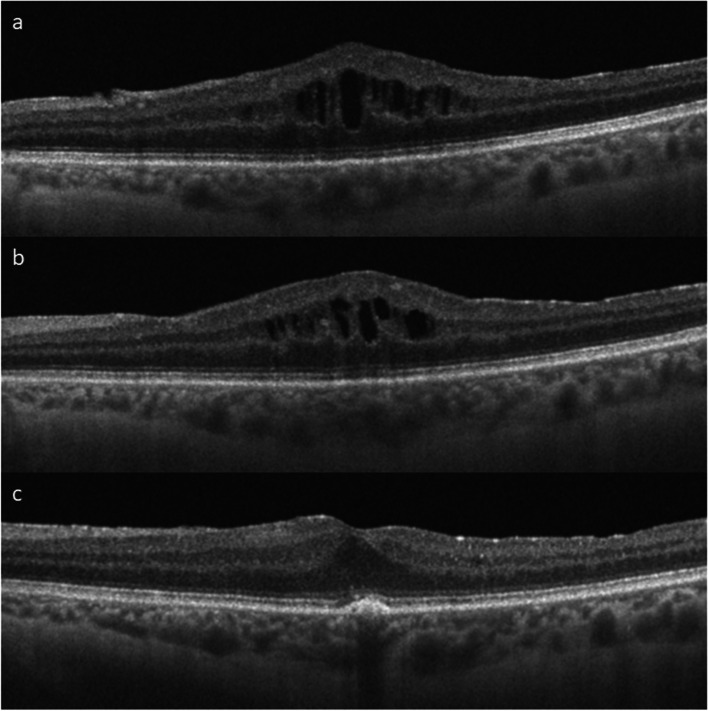
After treatment with topical NSAIDs for a median of 2 months, BCVA increased significantly from 0.5 to 0.3 while CRT decreased significantly from 435 to 316 μm. PME resolved in 19 of the 33 eyes (57.6%). Of the 14 recalcitrant cases, 13 were treated with corticosteroids. Of these 13 cases, 9 (69.2%) resolved. BCVA increased non-significantly from 0.7 to 0.4. CRT and CCT decreased significantly from 492 to 317 μm and from 204 to 182 μm respectively.
The overall success rate of the treatment algorithm was greater than 80%, a remarkable finding considering that no randomized study has yet been conducted to determine the optimal therapeutic protocol for PME. This is the first study to evaluate choroidal thickness in PME using SS-OCT, which could play a key role in its pathophysiology and provide useful information to improve the management of PME.
本研究旨在评估局部非甾体抗炎药(NSAIDs)和皮质类固醇(玻璃体内地塞米松和球旁曲安奈德)治疗后发性白内障黄斑水肿(PME)的疗效。
对 33 只眼进行回顾性研究。变量包括最佳矫正视力(BCVA;logMAR 量表)和中央视网膜厚度(CRT)以及中心脉络膜厚度(CCT),使用扫频源光学相干断层扫描(SS-OCT)进行评估。所有患者最初均接受局部 NSAIDs 治疗,并在 2 个月后进行重新评估。如果 BCVA 或 CRT 改善,则继续使用局部 NSAIDs,直至缓解。如果在 2 个月或后续随访时未见改善,则进行玻璃体内地塞米松植入。拒绝眼内治疗的患者接受球旁曲安奈德治疗。
在接受局部 NSAIDs 治疗中位数为 2 个月后,BCVA 从 0.5 显著提高至 0.3,而 CRT 从 435 显著降低至 316μm。33 只眼中的 19 只(57.6%)PME 缓解。在 14 例难治性病例中,13 例接受皮质类固醇治疗。这 13 例中,9 例(69.2%)缓解。BCVA 从 0.7 非显著提高至 0.4。CRT 和 CCT 分别从 492 显著降低至 317μm和从 204 显著降低至 182μm。
治疗方案的总体成功率大于 80%,这是一个显著的发现,因为尚未进行随机研究来确定 PME 的最佳治疗方案。这是第一项使用 SS-OCT 评估 PME 脉络膜厚度的研究,它可能在其发病机制中发挥关键作用,并为改善 PME 的管理提供有用信息。