State Key Laboratory for Protein and Plant Gene Research, Peking-Tsinghua Center for Life Sciences at College of Life Sciences, Peking University, Beijing 100871, People's Republic of China.
State Key Laboratory for Protein and Plant Gene Research, Peking-Tsinghua Center for Life Sciences at College of Life Sciences, Peking University, Beijing 100871, People's Republic of China; The National Plant Gene Research Center (Beijing), Beijing 100101, People's Republic of China.
Mol Plant. 2022 Feb 7;15(2):354-362. doi: 10.1016/j.molp.2021.11.001. Epub 2021 Nov 3.
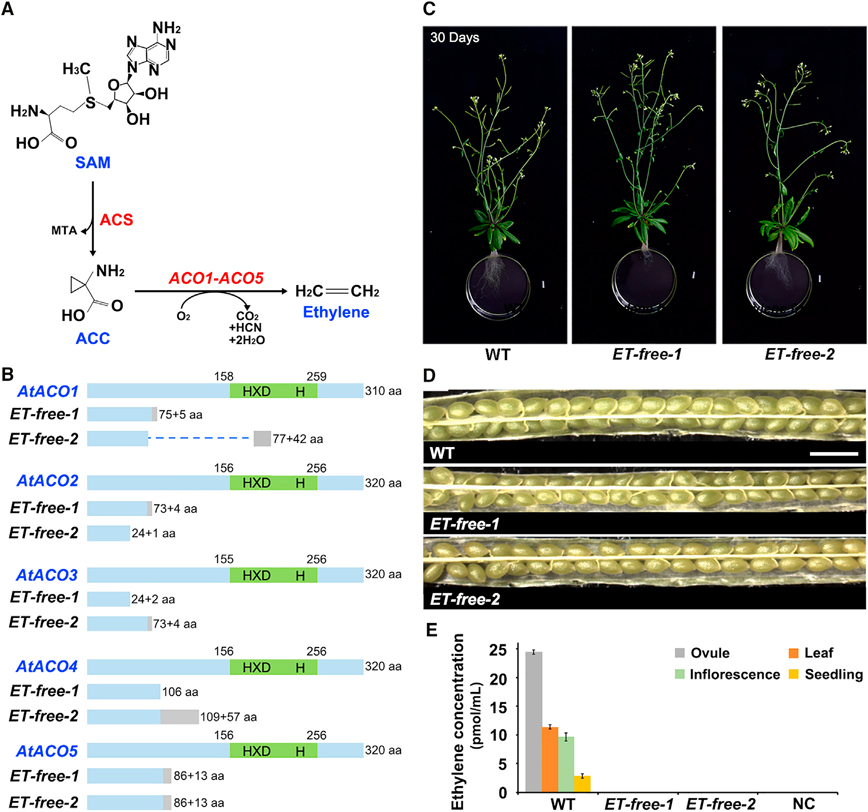
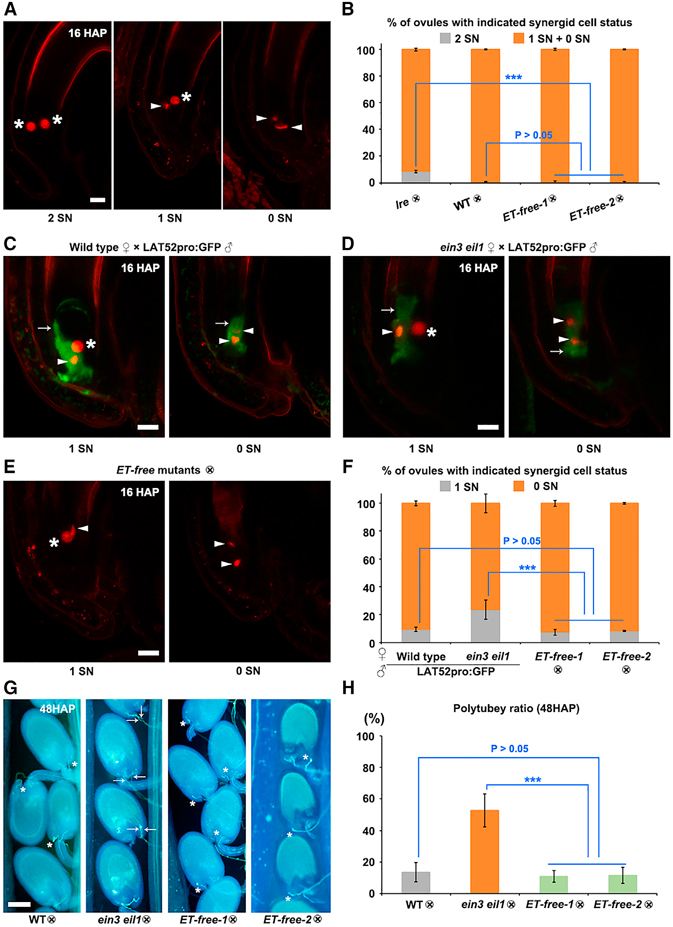
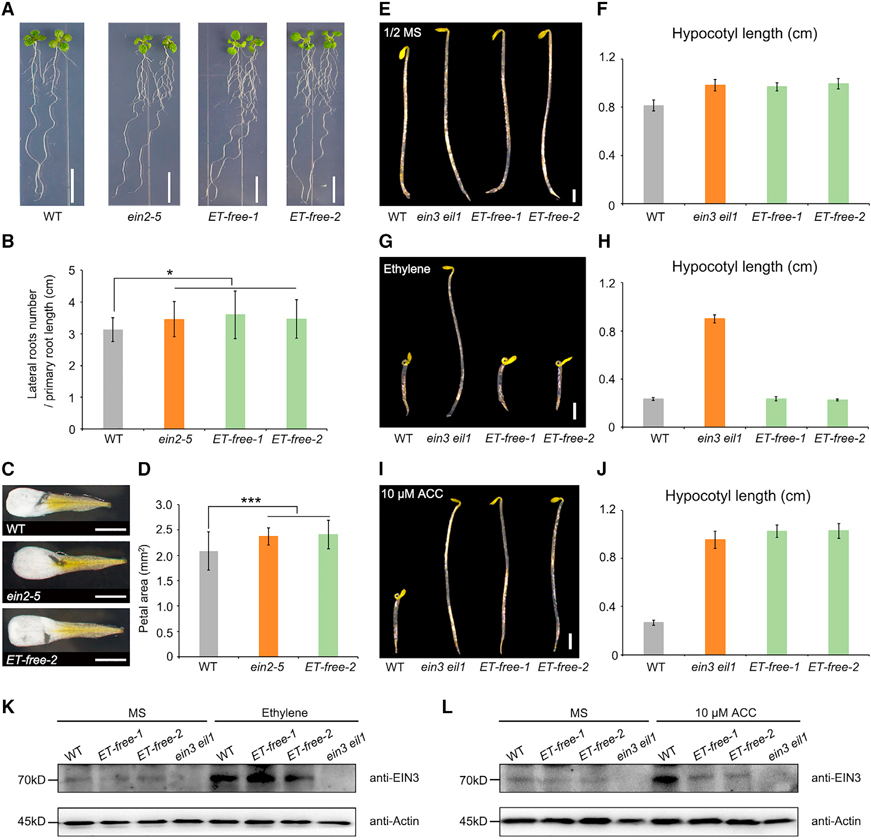
The signaling pathway of the gaseous hormone ethylene is involved in plant reproduction, growth, development, and stress responses. During reproduction, the two synergid cells of the angiosperm female gametophyte both undergo programmed cell death (PCD)/degeneration but in a different manner: PCD/degeneration of one synergid facilitates pollen tube rupture and thereby the release of sperm cells, while PCD/degeneration of the other synergid blocks supernumerary pollen tubes. Ethylene signaling was postulated to participate in some of the synergid cell functions, such as pollen tube attraction and the induction of PCD/degeneration. However, ethylene-mediated induction of synergid PCD/degeneration and the role of ethylene itself have not been firmly established. Here, we employed the CRISPR/Cas9 technology to knock out the five ethylene-biosynthesis 1-aminocyclopropane-1-carboxylic acid oxidase (ACO) genes and created Arabidopsis mutants free of ethylene production. The ethylene-free mutant plants showed normal triple responses when treated with ethylene rather than 1-aminocyclopropane-1-carboxylic acid, but had increased lateral root density and enlarged petal sizes, which are typical phenotypes of mutants defective in ethylene signaling. Using these ethylene-free plants, we further demonstrated that production of ethylene is not necessarily required to trigger PCD/degeneration of the two synergid cells, but certain components of ethylene signaling including transcription factors ETHYLENE-INSENSITIVE 3 (EIN3) and EIN3-LIKE 1 (EIL1) are necessary for the death of the persistent synergid cell.
气态激素乙烯的信号通路参与植物的繁殖、生长、发育和应激反应。在繁殖过程中,被子植物雌配子体的两个助细胞都经历程序性细胞死亡(PCD)/退化,但方式不同:一个助细胞的 PCD/退化有助于花粉管破裂,从而释放精子细胞,而另一个助细胞的 PCD/退化阻止多余的花粉管。乙烯信号被假设参与一些助细胞功能,如花粉管吸引和 PCD/退化的诱导。然而,乙烯介导的助细胞 PCD/退化的诱导和乙烯本身的作用尚未得到确凿的证实。在这里,我们使用 CRISPR/Cas9 技术敲除了五个乙烯生物合成 1-氨基环丙烷-1-羧酸氧化酶(ACO)基因,创建了没有乙烯产生的拟南芥突变体。与 1-氨基环丙烷-1-羧酸相比,乙烯处理时,乙烯缺失突变体植物表现出正常的三重反应,但侧根密度增加,花瓣尺寸增大,这是乙烯信号缺陷突变体的典型表型。利用这些乙烯缺失植物,我们进一步证明,触发两个助细胞 PCD/退化不一定需要产生乙烯,但是乙烯信号的某些成分,包括转录因子 ETHYLENE-INSENSITIVE 3(EIN3)和 EIN3-LIKE 1(EIL1),对于持久助细胞的死亡是必需的。