Locomotion Laboratory, Department of Integrative Physiology, University of Colorado, Boulder, CO 80309, USA.
Integrative Locomotion Lab, Department of Kinesiology, University of Massachusetts, Amherst, MA 01003, USA.
J Sport Health Sci. 2022 May;11(3):303-308. doi: 10.1016/j.jshs.2021.10.004. Epub 2021 Nov 3.
Compared to conventional racing shoes, Nike Vaporfly 4% running shoes reduce the metabolic cost of level treadmill running by 4%. The reduction is attributed to their lightweight, highly compliant, and resilient midsole foam and a midsole-embedded curved carbon-fiber plate. We investigated whether these shoes also could reduce the metabolic cost of moderate uphill (+3°) and downhill (-3°) grades. We tested the null hypothesis that, compared to conventional racing shoes, highly cushioned shoes with carbon-fiber plates would impart the same ∼4% metabolic power (W/kg) savings during uphill and downhill running as they do during level running.
After familiarization, 16 competitive male runners performed six 5-min trials (2 shoes × 3 grades) in 2 Nike marathon racing-shoe models (Streak 6 and Vaporfly 4%) on a level, uphill (+3°), and downhill (-3°) treadmill at 13 km/h (3.61 m/s). We measured submaximal oxygen uptake and carbon dioxide production during Minutes 4-5 and calculated metabolic power (W/kg) for each shoe model and grade combination.
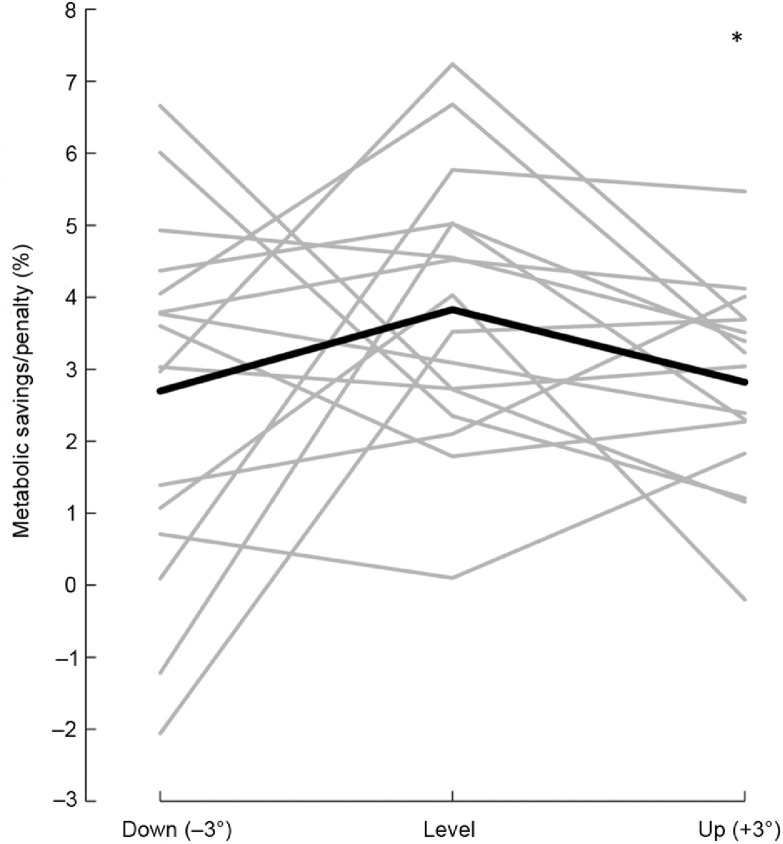
Compared to the conventional shoes (Streak 6), the metabolic power in the Vaporfly 4% shoes was 3.83% (level), 2.82% (uphill), and 2.70% (downhill) less (all p < 0.001). The percent of change in metabolic power for uphill running was less compared to level running (p = 0.04; effect size (ES) = 0.561) but was not statistically different between downhill and level running (p = 0.17; ES = 0.356).
On a running course with uphill and downhill sections, the metabolic savings and hence performance enhancement provided by Vaporfly 4% shoes would likely be slightly less overall, compared to the savings on a perfectly level race course.
与传统跑鞋相比,Nike Vaporfly 4%跑鞋可将水平跑步机跑步的代谢成本降低 4%。这种降低归因于其轻巧、高弹性和高回弹性的中底泡沫以及中底嵌入的弯曲碳纤维板。我们研究了这些鞋子是否也可以降低适度上坡(+3°)和下坡(-3°)坡度的代谢成本。我们测试了一个零假设,即在水平、上坡和下坡跑步时,与传统跑鞋相比,具有碳纤维板的高缓冲鞋将提供相同的约 4%代谢功率(W/kg)节省。
在熟悉之后,16 名男性竞技跑步者在水平、上坡(+3°)和下坡(-3°)跑步机上以 13 公里/小时(3.61 米/秒)的速度进行了 6 次 5 分钟的试验(2 双鞋×3 个坡度),使用 2 种 Nike 马拉松跑鞋(Streak 6 和 Vaporfly 4%)。我们在第 4-5 分钟测量了亚最大耗氧量和二氧化碳产生量,并计算了每种鞋型和坡度组合的代谢功率(W/kg)。
与传统鞋(Streak 6)相比,Vaporfly 4%鞋的代谢功率在水平、上坡和下坡时分别降低了 3.83%、2.82%和 2.70%(均 p < 0.001)。与水平跑步相比,上坡跑步的代谢功率变化百分比较低(p=0.04;效应量(ES)=0.561),但下坡与水平跑步之间无统计学差异(p=0.17;ES=0.356)。
在具有上坡和下坡路段的跑步路线上,与在完全水平的比赛路线上相比,Vaporfly 4%鞋提供的代谢节省和因此的性能提升可能总体上略低。