Centre for Cancer and Inflammation Research, School of Chinese Medicine, Hong Kong Baptist University, Hong Kong, China.
Biotechnological Institute of Chinese Materia Medical, Jinan University, Guangzhou, China.
Cell Death Dis. 2021 Nov 5;12(11):1053. doi: 10.1038/s41419-021-04247-w.
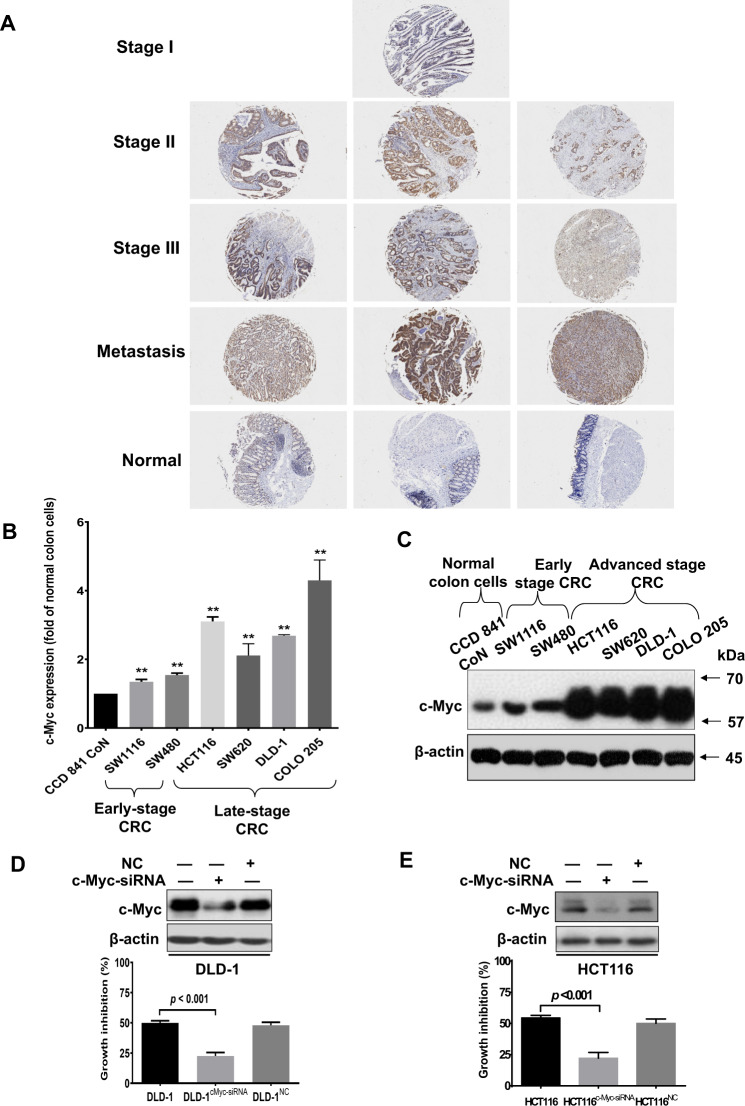
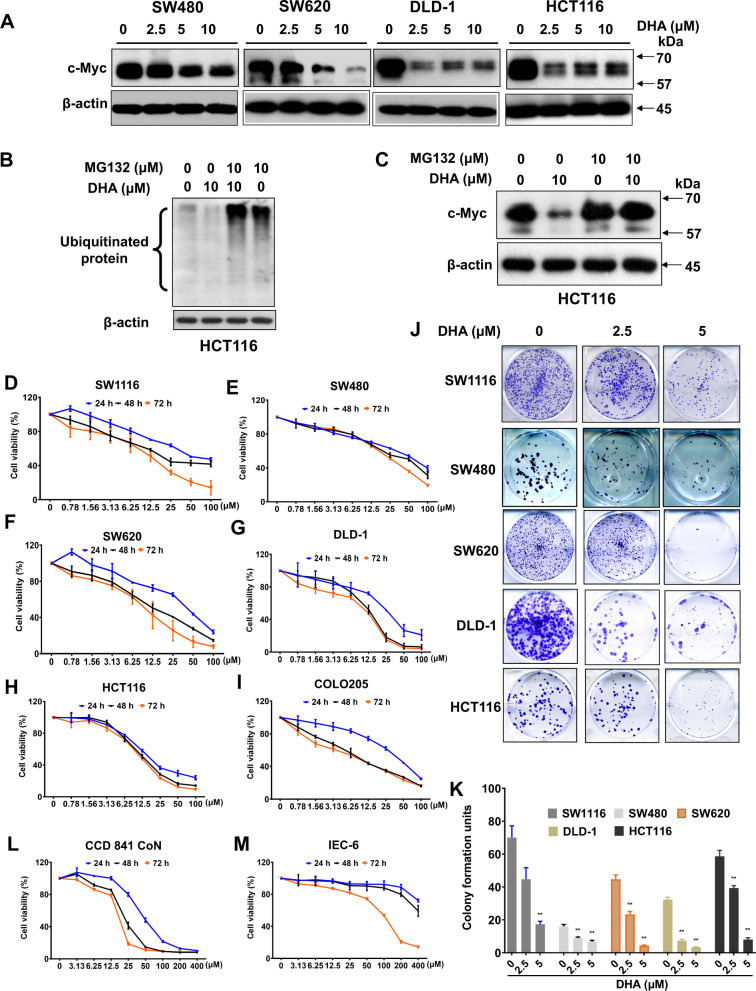
Currently, no frontline treatment is effective for the late-stage colorectal cancer (CRC). Understanding the molecular differences in different stages of CRC can help us to identify the critical therapeutic targets for designing therapeutic strategy. Our data show that c-Myc protein is highly expressed in late-stage CRC when compared with early-stage CRC in both clinical samples and in cell lines representing different cancer stages. Given that c-Myc is a well-known oncogenic driver in CRC, its high expression in the late-stage CRC may represent a critical therapeutic target for treating the cancer. Dihydroartemisinin treatment significantly increases c-Myc protein degradation and hence reduces its expression in CRC. The treatment also reduces CRC cell viability. Interestingly, dihydroartemisinin exhibits a more potent growth-inhibitory effect in late-stage CRC than the early-stage CRC. The treatment also possesses potent growth-inhibitory effects in mouse models bearing c-Myc-overexpressed CRC. The reduced c-Myc level and its reduced transcriptional activity reduce the expressions of acetyl-CoA carboxylase, fatty acid synthase, carnitine-palmitoyltransferase-1, and medium-chain acyl-CoA dehydrogenase in the cancer cells. Lipidomics study also shows that dihydroartemisinin treatment changes the metabolic phenotypes in CRC, reduces oxygen consumption, respiration, and ATP production, hence reduces the cell proliferation and induces apoptosis. Our study provides strong pharmacological evidence to support the translation of dihydroartemisinin for the treatment of late-stage CRC by targeting c-Myc.
目前,晚期结直肠癌(CRC)没有有效的一线治疗方法。了解 CRC 不同阶段的分子差异有助于我们确定关键的治疗靶点,以设计治疗策略。我们的数据显示,与早期 CRC 相比,临床样本和不同癌症阶段的细胞系中晚期 CRC 中 c-Myc 蛋白表达水平较高。鉴于 c-Myc 是 CRC 中众所周知的致癌驱动基因,其在晚期 CRC 中的高表达可能代表治疗该癌症的关键治疗靶点。二氢青蒿素治疗可显著增加 c-Myc 蛋白降解,从而降低 CRC 中的表达。该治疗还降低了 CRC 细胞的活力。有趣的是,与早期 CRC 相比,二氢青蒿素在晚期 CRC 中表现出更强的生长抑制作用。该治疗还在携带 c-Myc 过表达 CRC 的小鼠模型中具有很强的生长抑制作用。c-Myc 水平降低及其转录活性降低,降低了癌细胞中乙酰辅酶 A 羧化酶、脂肪酸合酶、肉碱棕榈酰转移酶-1 和中链酰基辅酶 A 脱氢酶的表达。脂质组学研究还表明,二氢青蒿素治疗改变了 CRC 的代谢表型,降低了耗氧量、呼吸和 ATP 产生,从而减少了细胞增殖并诱导了细胞凋亡。我们的研究为二氢青蒿素通过靶向 c-Myc 治疗晚期 CRC 提供了强有力的药理学证据支持。