Islam Md Rashedul, Islam Mohammad Tariqul, Soliman Mohamed S, Baharuddin Mohd Hafiz, Mat Kamarulzaman, Moubark Asraf Mohamed, Almalki Sami H A
Department of Electrical, Electronic and Systems Engineering, Faculty of Engineering and Built Environment, Universiti Kebangsaan Malaysia, Bangi, 43600, Selangor, Malaysia.
Department of Electrical Engineering, College of Engineering, Taif University, P.O. Box 11099, Taif, 21944, Kingdom of Saudi Arabia.
Sci Rep. 2021 Nov 5;11(1):21782. doi: 10.1038/s41598-021-01275-6.
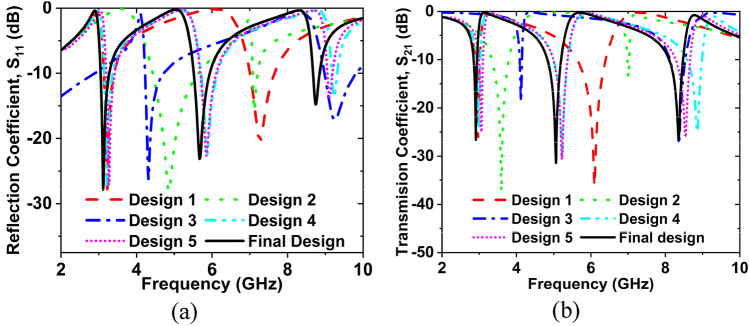
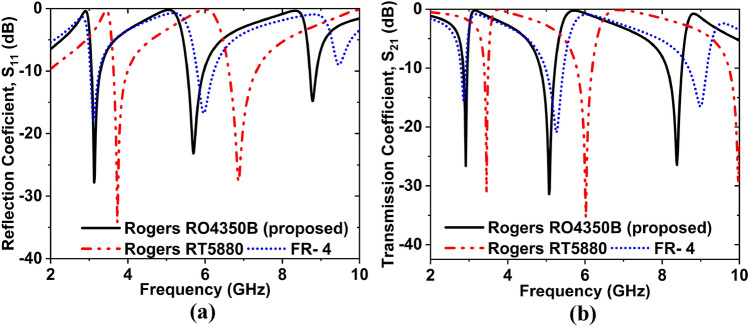
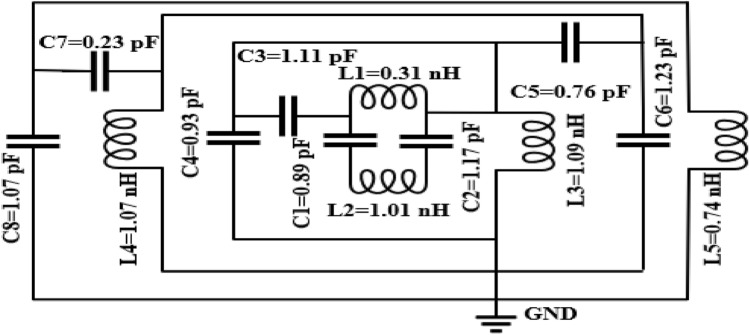
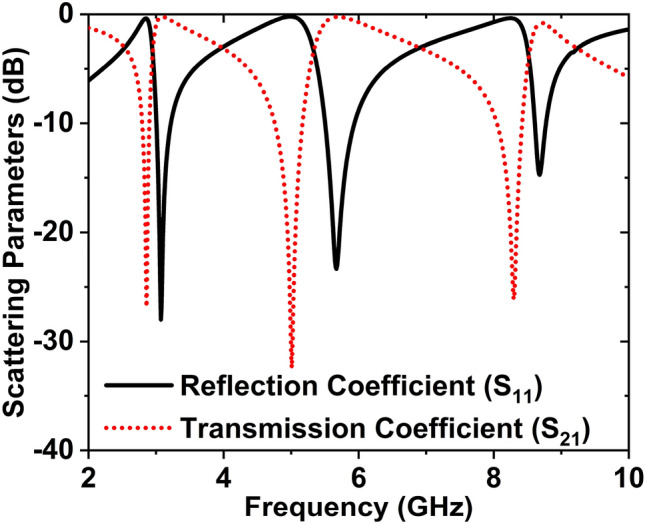
In this research paper, an inverse double V loaded complementary square split ring resonator based double negative (DNG) metamaterial has been developed and examined numerically and experimentally. The electromagnetic (EM) properties of the proposed inverse double V-structure were calculated using computer simulation technology (CST-2019) and the finite integration technique (FIT). The designed metamaterial provides three resonance frequencies are 2.86, 5, and 8.30 GHz, covering S-, C-, and X-bands. The total size of the recommended unit cell is 8 [Formula: see text] 8 [Formula: see text] 1.524 mm, and a high effective medium ratio (EMR) value of 13.11 was found from it. The - 10 dB bandwidths of this structure are 2.80 to 2.91, 4.76 to 5.17, and 8.05 to 8.42 GHz. The proposed structure's novelty is its small size, simple resonator structure, which provides double negative characteristics, high EMR, maximum coverage band, and required resonance frequencies. Wi-Fi network speeds are generally faster when frequencies in the 5 GHz band are used. Since the proposed structure provides a 5 GHz frequency band, hence the suggested metamaterial can be used in Wi-Fi for high bandwidth and high-speed applications. The marine radars operate in X-band, and weather radar works in S-band. Since the designed cell provides two more resonance frequencies, i.e., 2.86 GHz (S-band) and 8.30 GHz (X-band), the proposed metamaterial could be used in weather radar and marine radar. The design process and various parametric studies have been analyzed in this article. The equivalent circuit is authenticated using the advanced design system (ADS) software compared with CST simulated result. The surface current, E-field, and H-field distributions have also been analyzed. Different types of array structure, i.e., 1 [Formula: see text] 2, 2 [Formula: see text] 2, 3 [Formula: see text] 3, 4 [Formula: see text] 4, and 20 [Formula: see text] 25 is examined and validated by the measured result. The simulated and measured outcome is an excellent agreement for the inverse double V loaded CSSRR unit cell and array. We showed the overall performance of the suggested structure is better than the other structures mentioned in the paper. Since the recommended metamaterial unit cell size is small, provides desired resonance frequency, gives a large frequency band and high EMR value; hence the suggested metamaterial can be highly applicable for Radar and Wi-Fi.
在本研究论文中,已开发出一种基于反向双V加载互补方形分裂环谐振器的双负(DNG)超材料,并进行了数值和实验研究。使用计算机模拟技术(CST - 2019)和有限积分技术(FIT)计算了所提出的反向双V结构的电磁(EM)特性。所设计的超材料提供三个谐振频率,分别为2.86、5和8.30 GHz,覆盖S波段、C波段和X波段。推荐的单元胞总尺寸为8×8×1.524 mm,并由此发现了13.11的高效介质比(EMR)值。该结构的 - 10 dB带宽分别为2.80至2.91 GHz、4.76至5.17 GHz以及8.05至8.42 GHz。所提出结构的新颖之处在于其尺寸小、谐振器结构简单,具有双负特性、高EMR、最大覆盖频段以及所需的谐振频率。当使用5 GHz频段的频率时,Wi - Fi网络速度通常更快。由于所提出的结构提供了5 GHz频段,因此所建议的超材料可用于Wi - Fi以实现高带宽和高速应用。船用雷达工作在X波段,气象雷达工作在S波段。由于所设计的单元提供了另外两个谐振频率,即2.86 GHz(S波段)和8.30 GHz(X波段),所提出的超材料可用于气象雷达和船用雷达。本文分析了设计过程和各种参数研究。与CST模拟结果相比,使用先进设计系统(ADS)软件对等效电路进行了验证。还分析了表面电流、电场和磁场分布。对不同类型的阵列结构,即1×2、2×2、3×3、4×4和20×25进行了研究,并通过测量结果进行了验证。对于反向双V加载的CSSRR单元胞和阵列,模拟结果与测量结果非常吻合。我们表明所建议结构的整体性能优于论文中提到的其他结构。由于所建议的超材料单元胞尺寸小,提供了所需的谐振频率,给出了较宽的频段和高EMR值;因此所建议的超材料在雷达和Wi - Fi方面具有很高的适用性。