Claudepierre S G, Blake J B, Boyd A J, Clemmons J H, Fennell J F, Gabrielse C, Looper M D, Mazur J E, O'Brien T P, Reeves G D, Roeder J L, Spence H E, Turner D L
Space Science Applications Laboratory, The Aerospace Corporation, El Segundo, CA USA.
Department of Atmospheric and Oceanic Sciences, UCLA, Los Angeles, CA USA.
Space Sci Rev. 2021;217(8):80. doi: 10.1007/s11214-021-00855-2. Epub 2021 Oct 28.
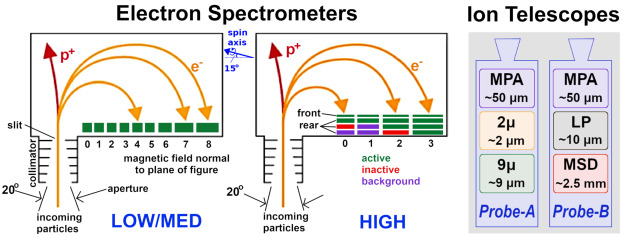
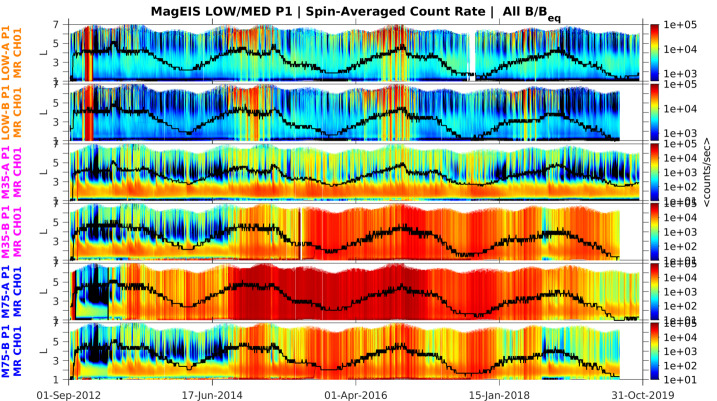
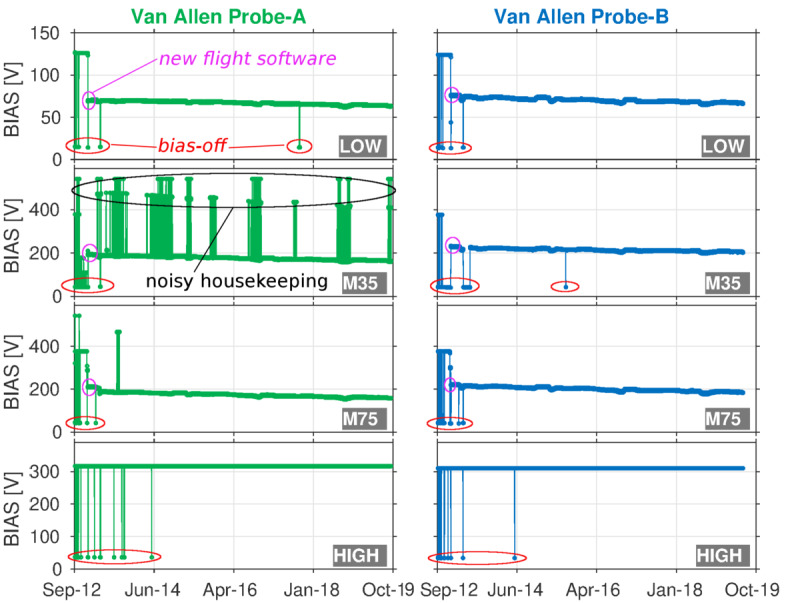
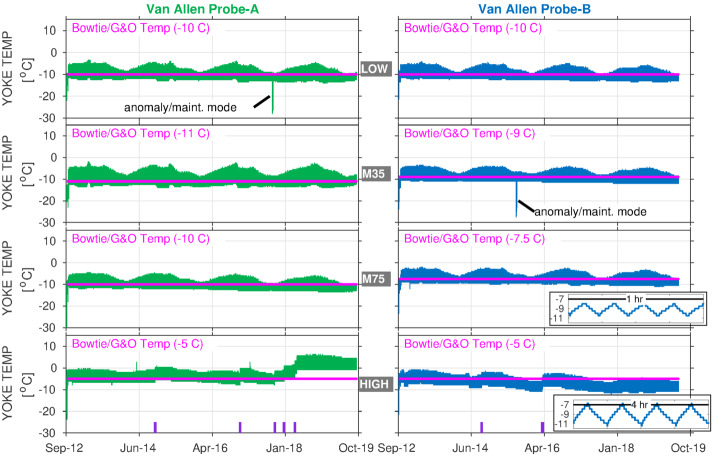
Measurements from NASA's Van Allen Probes have transformed our understanding of the dynamics of Earth's geomagnetically-trapped, charged particle radiation. The Van Allen Probes were equipped with the Magnetic Electron Ion Spectrometers (MagEIS) that measured energetic and relativistic electrons, along with energetic ions, in the radiation belts. Accurate and routine measurement of these particles was of fundamental importance towards achieving the scientific goals of the mission. We provide a comprehensive review of the MagEIS suite's on-orbit performance, operation, and data products, along with a summary of scientific results. The purpose of this review is to serve as a complement to the MagEIS instrument paper, which was largely completed before flight and thus focused on pre-flight design and performance characteristics. As is the case with all space-borne instrumentation, the anticipated sensor performance was found to be different once on orbit. Our intention is to provide sufficient detail on the MagEIS instruments so that future generations of researchers can understand the subtleties of the sensors, profit from these unique measurements, and continue to unlock the mysteries of the near-Earth space radiation environment.
The online version contains supplementary material available at 10.1007/s11214-021-00855-2.
美国国家航空航天局(NASA)的范艾伦探测器所进行的测量改变了我们对地球地磁捕获的带电粒子辐射动力学的理解。范艾伦探测器配备了磁电子离子谱仪(MagEIS),该仪器可测量辐射带中的高能和相对论电子以及高能离子。对这些粒子进行准确且常规的测量对于实现该任务的科学目标至关重要。我们全面回顾了MagEIS套件的在轨性能、操作和数据产品,并总结了科学成果。本次回顾的目的是对MagEIS仪器论文进行补充,该论文在很大程度上是在飞行前完成的,因此重点关注飞行前的设计和性能特征。与所有航天仪器一样,一旦进入轨道,预期的传感器性能会有所不同。我们的目的是提供关于MagEIS仪器的足够详细信息,以便后代研究人员能够理解传感器的细微之处,从这些独特的测量中受益,并继续解开近地空间辐射环境的谜团。
在线版本包含可在10.1007/s11214-021-00855-2获取的补充材料。