Li Meng-Ting, Ke Jia, Guo Shu-Fen, Wu Yang, Bian Yue-Feng, Shan Li-Li, Liu Qian-Yun, Huo Ya-Jing, Guo Cen, Liu Ming-Yuan, Liu Ya-Jie, Han Yan
Department of Neurology, Yueyang Hospital of Integrated Traditional Chinese and Western Medicine, Shanghai University of Traditional Chinese Medicine, Shanghai, China.
Department of Neurology, Shenzhen Hospital, Southern Medical University, Shenzhen, China.
Front Pharmacol. 2021 Oct 20;12:732874. doi: 10.3389/fphar.2021.732874. eCollection 2021.
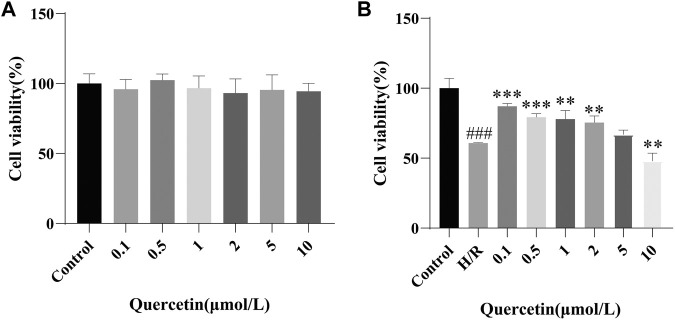
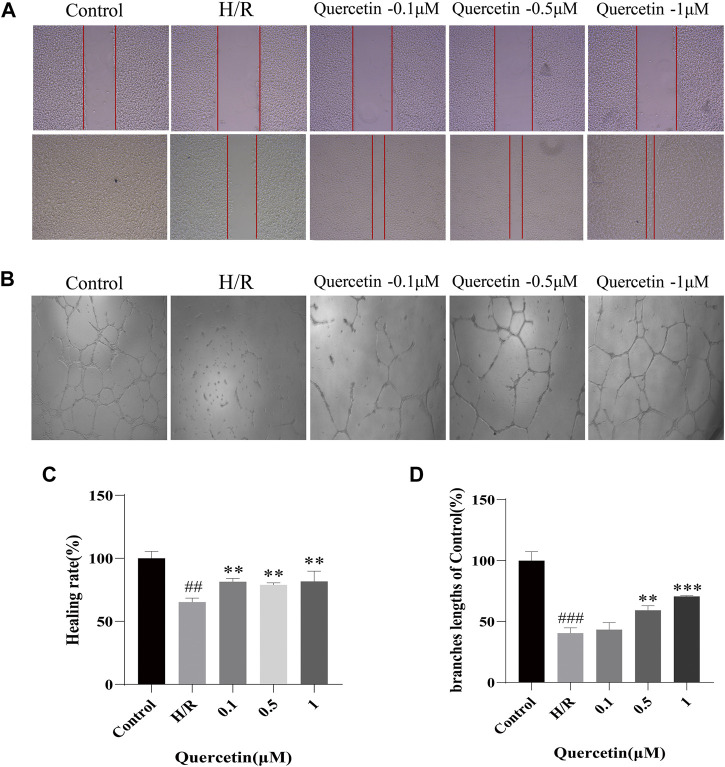
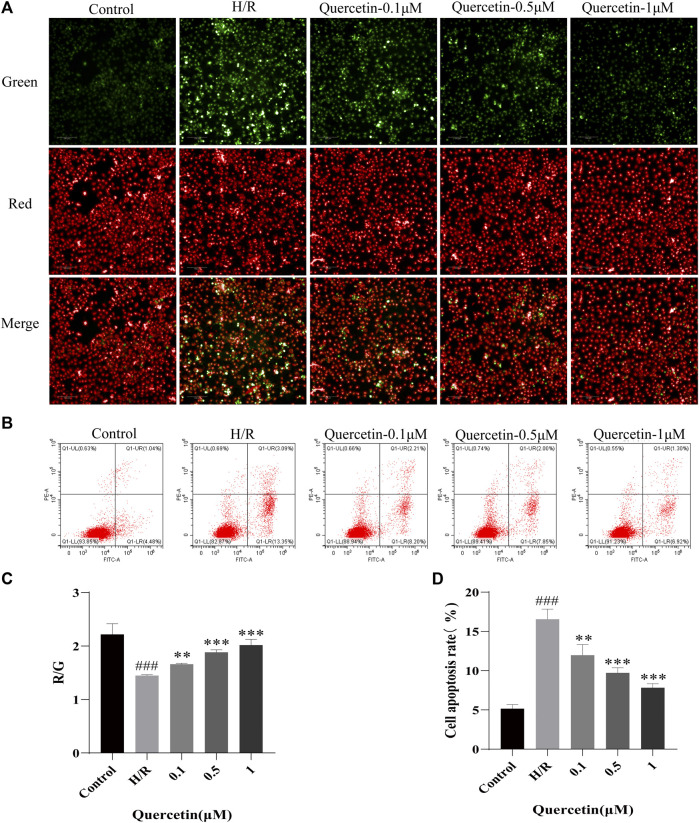
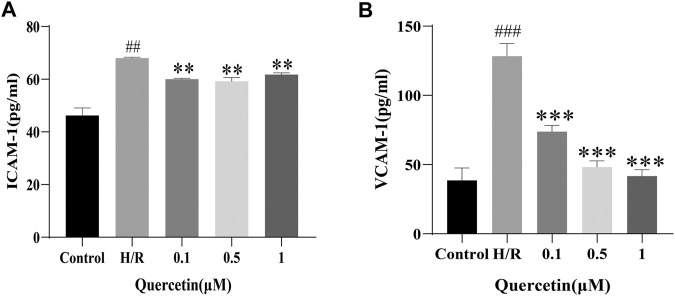
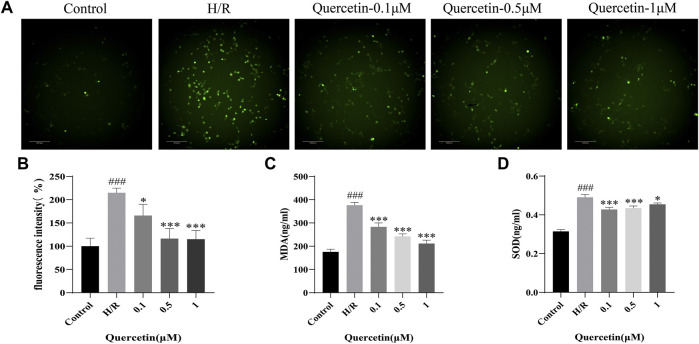
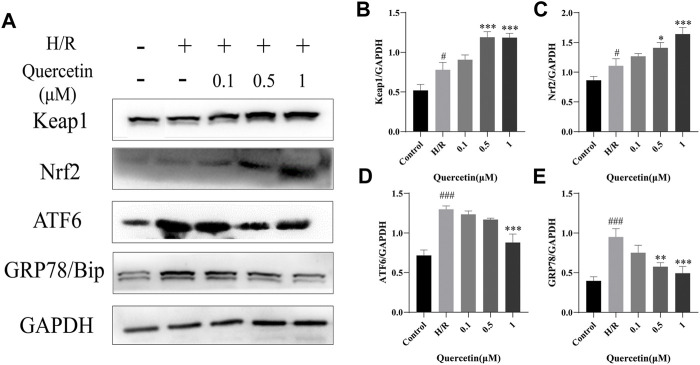
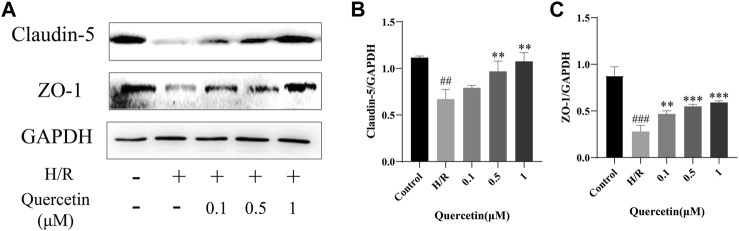
Cerebral small vessel disease (CSVD) is a group of clinical syndromes covering all pathological processes of small vessels in the brain, which can cause stroke and serious dementia. However, as the pathogenesis of CSVD is not clear, so the treatment is limited. Endothelial cell dysfunction is earlier than clinical symptoms, such as hypertension and leukosis. Therefore, the treatment of endothelial cells is expected to be a new breakthrough. Quercetin, a flavonoid present in a variety of plants, has the function of anti-inflammation and anti-oxidation. This study aimed to investigate the protective effect of quercetin on endothelial cell injury and provide a basic theory for subsequent application in the clinic. Human brain microvascular endothelial cells (HBMECs) were cultured , and the injury model of endothelial cells was established by hypoxia and reoxygenation (H/R). The protective effects of quercetin on HBMECs were studied from the perspectives of cell viability, cell migration, angiogenesis and apoptosis. In order to further study the mechanism of quercetin, oxidative stress and endoplasmic reticulum stress were analyzed. What's more, blood-brain barrier (BBB) integrity was also studied. Quercetin can promote the viability, migration and angiogenesis of HBMECs, and inhibit the apoptosis. In addition, quercetin can also activate Keap1/Nrf2 signaling pathway, reduce ATF6/GRP78 protein expression. Further study showed that quercetin could increase the expression of Claudin-5 and Zonula occludens-1. Our experiments show that quercetin can protect HBMECs from H/R, which contains promoting cell proliferation, cell migration and angiogenesis, reducing mitochondrial membrane potential damage and inhibiting cell apoptosis. This may be related to its antioxidation and inhibition of endoplasmic reticulum stress. At the same time, quercetin can increase the level of BBB connexin, suggesting that quercetin can maintain BBB integrity.
脑小血管病(CSVD)是一组涵盖脑内小血管所有病理过程的临床综合征,可导致中风和严重痴呆。然而,由于CSVD的发病机制尚不清楚,因此治疗手段有限。内皮细胞功能障碍早于高血压和白细胞增多等临床症状出现。因此,对内皮细胞的治疗有望成为新的突破点。槲皮素是一种存在于多种植物中的黄酮类化合物,具有抗炎和抗氧化功能。本研究旨在探讨槲皮素对内皮细胞损伤的保护作用,并为其后续临床应用提供基础理论依据。培养人脑血管内皮细胞(HBMECs),通过缺氧复氧(H/R)建立内皮细胞损伤模型。从细胞活力、细胞迁移、血管生成和凋亡等方面研究槲皮素对HBMECs的保护作用。为进一步研究槲皮素的作用机制,分析了氧化应激和内质网应激情况。此外,还研究了血脑屏障(BBB)的完整性。槲皮素可促进HBMECs的活力、迁移和血管生成,并抑制细胞凋亡。此外,槲皮素还可激活Keap1/Nrf2信号通路,降低ATF6/GRP78蛋白表达。进一步研究表明,槲皮素可增加Claudin-5和紧密连接蛋白1的表达。我们的实验表明,槲皮素可保护HBMECs免受H/R损伤,包括促进细胞增殖、细胞迁移和血管生成、减少线粒体膜电位损伤以及抑制细胞凋亡。这可能与其抗氧化和抑制内质网应激有关。同时,槲皮素可提高BBB连接蛋白水平,提示槲皮素可维持BBB的完整性。