Ottenburghs Jente
Wildlife Ecology and Conservation Wageningen University & Research Wageningen The Netherlands.
Forest Ecology and Forest Management Wageningen University & Research Wageningen The Netherlands.
Evol Appl. 2021 Mar 26;14(10):2342-2360. doi: 10.1111/eva.13223. eCollection 2021 Oct.
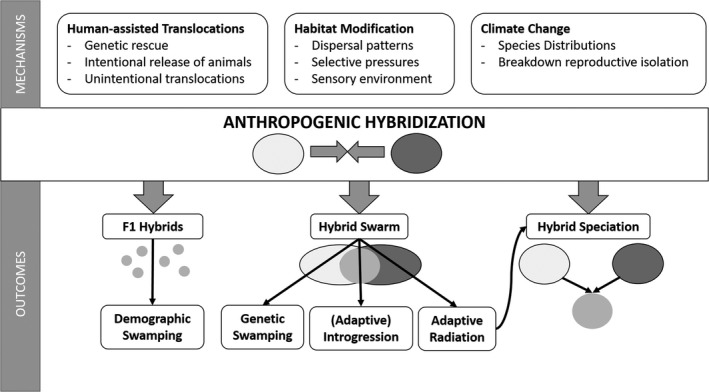
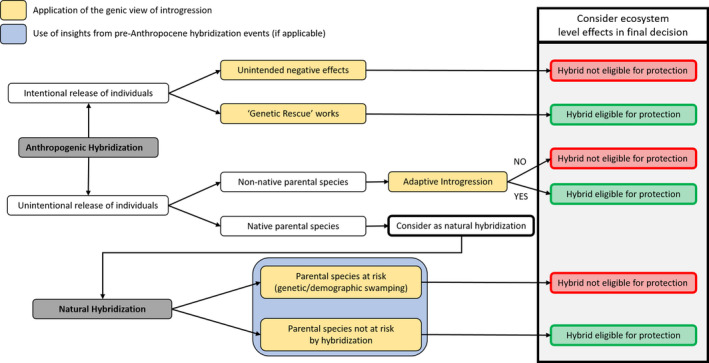
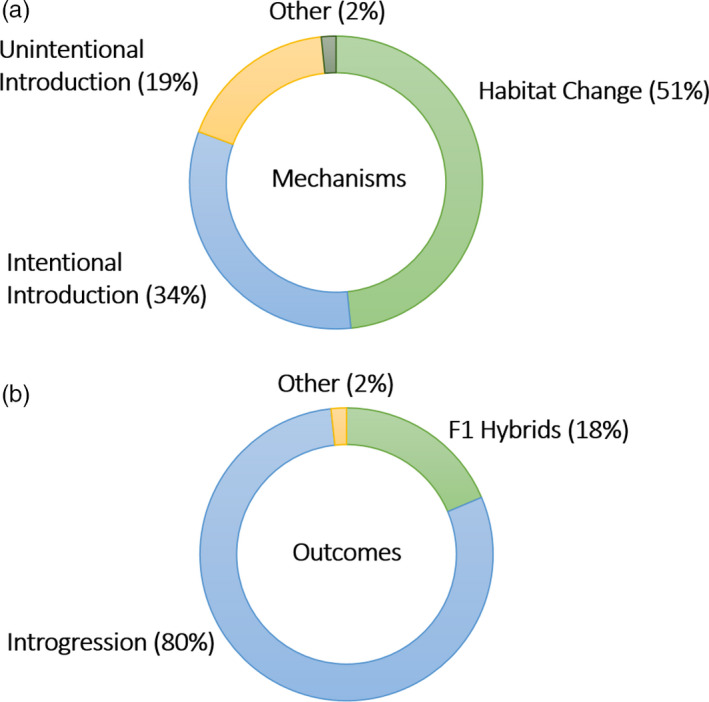
Human impact is noticeable around the globe, indicating that a new era might have begun: the Anthropocene. Continuing human activities, including land-use changes, introduction of non-native species and rapid climate change, are altering the distributions of countless species, often giving rise to human-mediated hybridization events. While the interbreeding of different populations or species can have detrimental effects, such as genetic extinction, it can be beneficial in terms of adaptive introgression or an increase in genetic diversity. In this paper, I first review the different mechanisms and outcomes of anthropogenic hybridization based on literature from the last five years (2016-2020). The most common mechanisms leading to the interbreeding of previously isolated taxa include habitat change (51% of the studies) and introduction of non-native species (34% intentional and 19% unintentional). These human-induced hybridization events most often result in introgression (80%). The high incidence of genetic exchange between the hybridizing taxa indicates that the application of a genic view of speciation (and introgression) can provide crucial insights on how to address hybridization events in the Anthropocene. This perspective considers the genome as a dynamic collection of genetic loci with distinct evolutionary histories, giving rise to a heterogenous genomic landscape in terms of genetic differentiation and introgression. First, understanding this genomic landscape can lead to a better selection of diagnostic genetic markers to characterize hybrid populations. Second, describing how introgression patterns vary across the genome can help to predict the likelihood of negative processes, such as demographic and genetic swamping, as well as positive outcomes, such as adaptive introgression. It is especially important to not only quantify how much genetic material introgressed, but also what has been exchanged. Third, comparing introgression patterns in pre-Anthropocene hybridization events with current human-induced cases might provide novel insights into the likelihood of genetic swamping or species collapse during an anthropogenic hybridization event. However, this comparative approach remains to be tested before it can be applied in practice. Finally, the genic view of introgression can be combined with conservation genomic studies to determine the legal status of hybrids and take appropriate measures to manage anthropogenic hybridization events. The interplay between evolutionary and conservation genomics will result in the constant exchange of ideas between these fields which will not only improve our knowledge on the origin of species, but also how to conserve and protect them.
人类影响在全球范围内都很明显,这表明一个新时代可能已经开始:人类世。持续的人类活动,包括土地利用变化、引入非本地物种和快速的气候变化,正在改变无数物种的分布,常常引发人类介导的杂交事件。虽然不同种群或物种的杂交可能产生有害影响,如基因灭绝,但在适应性渐渗或遗传多样性增加方面可能是有益的。在本文中,我首先根据过去五年(2016 - 2020年)的文献回顾了人为杂交的不同机制和结果。导致先前隔离的分类群杂交的最常见机制包括栖息地变化(占研究的51%)和引入非本地物种(34%为有意引入,19%为无意引入)。这些人类引发的杂交事件最常导致渐渗(80%)。杂交分类群之间基因交换的高发生率表明,物种形成(和渐渗)的基因观点应用可以为如何应对人类世的杂交事件提供关键见解。这种观点将基因组视为具有不同进化历史的基因座的动态集合,在遗传分化和渐渗方面产生了异质的基因组景观。首先,了解这种基因组景观可以更好地选择诊断性遗传标记来表征杂交种群。其次,描述渐渗模式如何在整个基因组中变化有助于预测负面过程的可能性,如种群统计学和基因淹没,以及正面结果,如适应性渐渗。不仅要量化有多少遗传物质发生了渐渗,还要确定交换了什么,这一点尤其重要。第三,将人类世前杂交事件中的渐渗模式与当前人类引发的案例进行比较,可能会为人类介导的杂交事件中基因淹没或物种崩溃的可能性提供新的见解。然而,这种比较方法在实际应用之前仍有待检验。最后,渐渗的基因观点可以与保护基因组学研究相结合,以确定杂交种的法律地位,并采取适当措施管理人为杂交事件。进化基因组学和保护基因组学之间的相互作用将导致这些领域之间不断地思想交流,这不仅会提高我们对物种起源的认识,还会提升我们对如何保护物种的理解。