Jain Prantesh, Khorrami Mohammadhadi, Gupta Amit, Rajiah Prabhakar, Bera Kaustav, Viswanathan Vidya Sankar, Fu Pingfu, Dowlati Afshin, Madabhushi Anant
Department of Hematology and Oncology, University Hospitals Cleveland Medical Center, Cleveland, OH, United States.
Department of Biomedical Engineering, Case Western Reserve University, Cleveland, OH, United States.
Front Oncol. 2021 Oct 20;11:744724. doi: 10.3389/fonc.2021.744724. eCollection 2021.
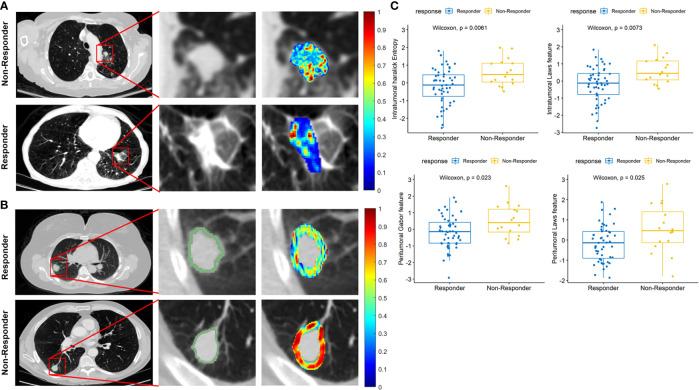
Small cell lung cancer (SCLC) is an aggressive malignancy characterized by initial chemosensitivity followed by resistance and rapid progression. Presently, there are no predictive biomarkers that can accurately guide the use of systemic therapy in SCLC patients. This study explores the role of radiomic features from both within and around the tumor lesion on pretreatment CT scans to a) prognosticate overall survival (OS) and b) predict response to chemotherapy.
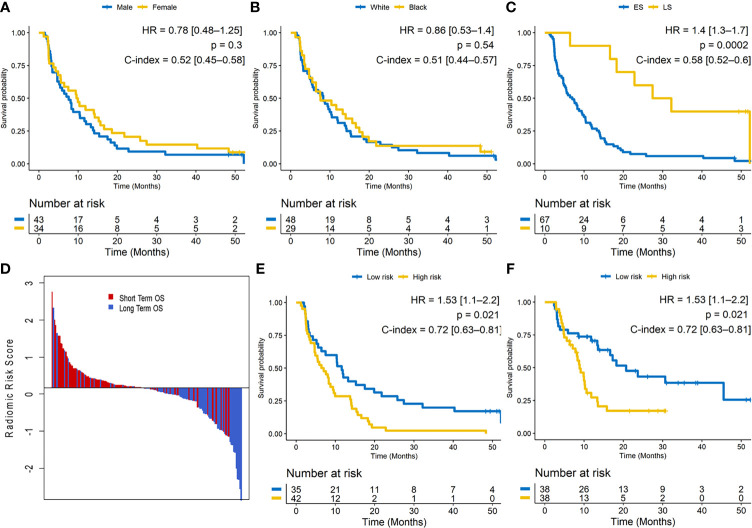
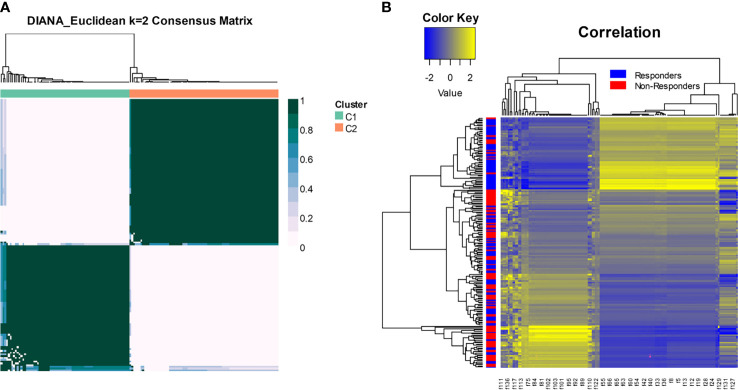
One hundred fifty-three SCLC patients who had received chemotherapy were included. Lung tumors were contoured by an expert reader. The patients were divided randomly into approximately equally sized training (S = 77) and test sets (S = 76). Textural descriptors were extracted from the nodule (intratumoral) and parenchymal regions surrounding the nodule (peritumoral). The clinical endpoints of this study were OS, progression-free survival (PFS), and best objective response to chemotherapy. Patients with complete or partial response were defined as "responders," and those with stable or progression of disease were defined as "non-responders." The radiomic risk score (RRS) was generated by using the least absolute shrinkage and selection operator (LASSO) with the Cox regression model. Patients were classified into the high-risk or low-risk groups based on the median of RRS. Association of the radiomic signature with OS was evaluated on S and then tested on S. The features identified by LASSO were then used to train a linear discriminant analysis (LDA) classifier (M) to predict response to chemotherapy. A prognostic nomogram (N) was also developed on S by combining clinical and prognostic radiomic features and validated on S. The Kaplan-Meier survival analysis and log-rank statistical tests were performed to assess the discriminative ability of the features. The discrimination performance of the N was assessed by Harrell's C-index. To estimate the clinical utility of the nomogram, decision curve analysis (DCA) was performed by calculating the net benefits for a range of threshold probabilities in predicting which high-risk patients should receive more aggressive treatment as compared with the low-risk patients.
A univariable Cox regression analysis indicated that RRS was significantly associated with OS in S (HR: 1.53; 95% CI, [1.1-2.2; p = 0.021]; C-index = 0.72) and S (HR: 1.4, [1.1-1.82], p = 0.0127; C-index = 0.69). The RRS was also significantly associated with PFS in S (HR: 1.89, [1.4-4.61], p = 0.047; C-index = 0.7) and S (HR: 1.641, [1.1-2.77], p = 0.04; C-index = 0.67). M was able to predict response to chemotherapy with an area under the receiver operating characteristic curve (AUC) of 0.76 ± 0.03 within S and 0.72 within S. Predictors, including the RRS, gender, age, stage, and smoking status, were used in the prognostic nomogram. The discrimination ability of the N model on S and S was C-index [95% CI]: 0.68 [0.66-0.71] and 0.67 [0.63-0.69], respectively. DCA indicated that the N model was clinically useful.
Radiomic features extracted within and around the lung tumor on CT images were both prognostic of OS and predictive of response to chemotherapy in SCLC patients.
小细胞肺癌(SCLC)是一种侵袭性恶性肿瘤,其特点是初始化疗敏感,随后出现耐药和快速进展。目前,尚无能够准确指导SCLC患者全身治疗使用的预测生物标志物。本研究探讨肿瘤病灶内部及周围的放射组学特征在治疗前CT扫描中的作用,以a)预测总生存期(OS)和b)预测化疗反应。
纳入153例接受过化疗的SCLC患者。由专业阅片者勾勒肺部肿瘤轮廓。患者被随机分为大小近似相等的训练集(S = 77)和测试集(S = 76)。从结节(瘤内)和结节周围的实质区域(瘤周)提取纹理描述符。本研究的临床终点为OS、无进展生存期(PFS)和化疗的最佳客观反应。完全缓解或部分缓解的患者被定义为“反应者”,疾病稳定或进展的患者被定义为“无反应者”。通过使用最小绝对收缩和选择算子(LASSO)与Cox回归模型生成放射组学风险评分(RRS)。根据RRS的中位数将患者分为高风险或低风险组。在S上评估放射组学特征与OS的相关性,然后在S上进行测试。然后使用LASSO确定的特征训练线性判别分析(LDA)分类器(M)以预测化疗反应。还通过结合临床和预后放射组学特征在S上开发了预后列线图(N)并在S上进行验证。进行Kaplan-Meier生存分析和对数秩统计检验以评估特征的判别能力。通过Harrell's C指数评估N的判别性能。为了评估列线图的临床实用性,通过计算一系列阈值概率下的净效益进行决策曲线分析(DCA),以预测哪些高风险患者与低风险患者相比应接受更积极的治疗。
单变量Cox回归分析表明,RRS与S中的OS显著相关(HR:1.53;95% CI,[1.1 - 2.2;p = 0.021];C指数 = 0.72)和S(HR:1.4,[1.1 - 1.82],p = 0.0127;C指数 = 0.69)。RRS在S中也与PFS显著相关(HR:1.89,[1.4 - 4.61],p = 0.047;C指数 = 0.7)和S(HR:1.641,[1.1 - 2.77],p = 0.04;C指数 = 0.67)。M能够在S内以0.76 ± 0.03的受试者工作特征曲线下面积(AUC)预测化疗反应,在S内为0.72。预后列线图中使用了包括RRS、性别、年龄、分期和吸烟状态在内的预测因素。N模型在S和S上的判别能力分别为C指数[95% CI]:0.68 [0.66 - 0.71]和0.67 [0.63 - 0.69]。DCA表明N模型具有临床实用性。
CT图像上肺肿瘤内部及周围提取的放射组学特征对SCLC患者的OS具有预后价值,对化疗反应具有预测价值。