Fan Zhiwen, Kong Ming, Miao Xiulian, Guo Yan, Ren Haozhen, Wang Jinglin, Wang Shuai, Tang Ning, Shang Longcheng, Zhu Zhengyi, Liu Hanyi, Zhu Wei, Shi Xiaolei
Department of Hepatobiliary Surgery, Affiliated Nanjing Drum Tower Hospital of Nanjing University Medical School, Nanjing, China.
Hepatobiliary Institute, Nanjing University, Nanjing, China.
Front Cell Dev Biol. 2021 Oct 22;9:742319. doi: 10.3389/fcell.2021.742319. eCollection 2021.
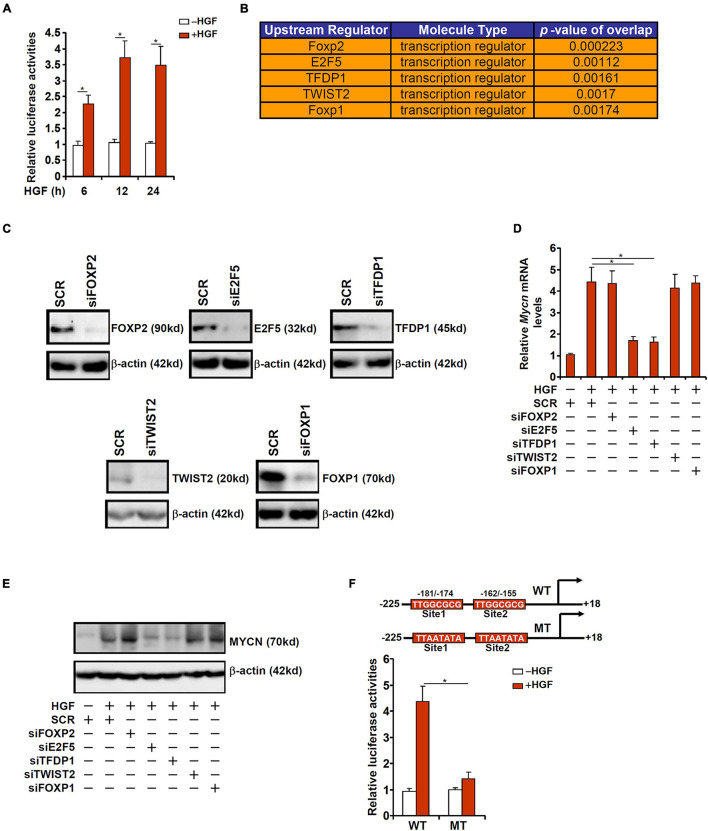
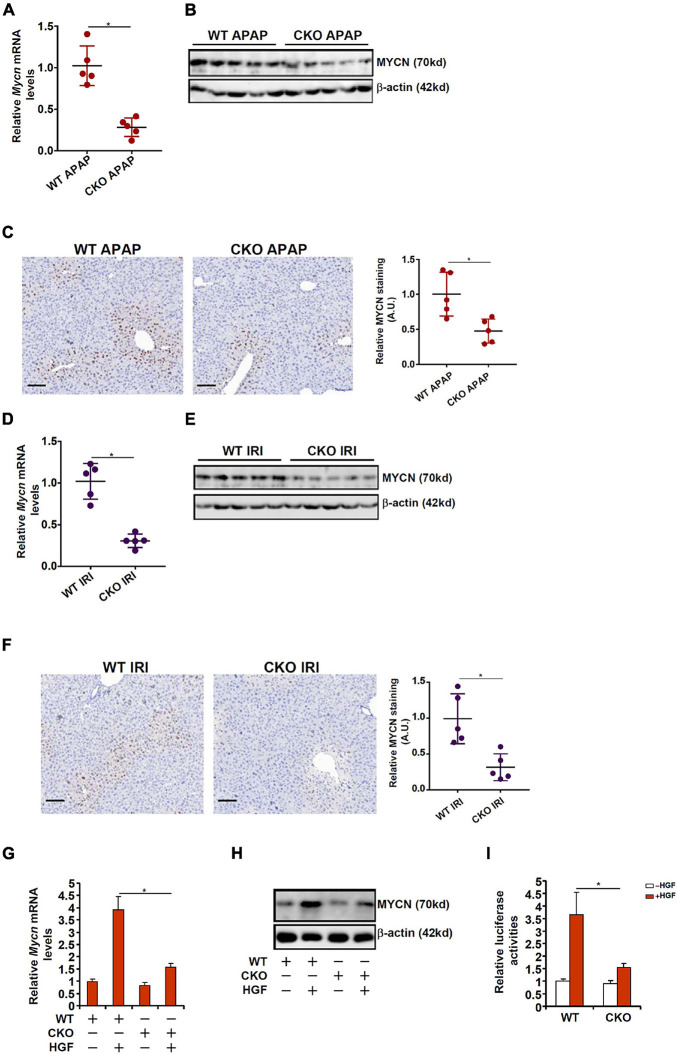
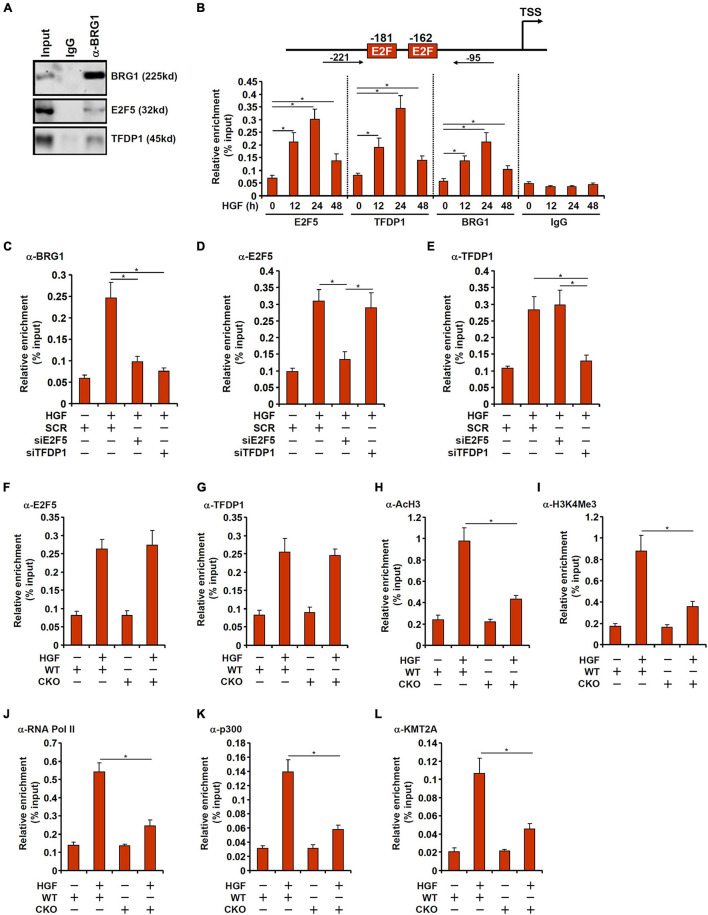
Liver regeneration is characterized by cell cycle reentrance of hepatocytes. N-Myc, encoded by MYCN, is a member of the Myc family of transcription factors. Elevation of MYCN expression has been noted in the course of liver regeneration whereas the underlying mechanism remains unclear. Here we describe that up-regulation of MYCN expression, as measured by quantitative PCR, Western blotting, and immunohistochemical staining, paralleled liver regeneration in animal and cell models. MYCN expression was up-regulated as a result of transcriptional activation. Ingenuity pathway analysis (IPA) revealed several up-stream transcriptional regulators for MYCN and RNA interference validated E2F5 and TFDP1 as essential for hepatocyte growth factor (HGF)-induced MYCN -activation. Further examination showed that deficiency of BRG1, a chromatin remodeling protein, attenuated MYCN induction during liver regeneration. BRG1 interacted with and was recruited by E2F5/TFDP1 to the MYCN promoter. Mechanistically, BRG1 might play a role regulating histone H3 acetylation and H3K4 trimethylation and facilitating/stabilizing the binding of RNA polymerase II surrounding the MYCN promoter. Over-expression of ectopic MYCN in BRG1-null hepatocytes overcame deficiency of proliferation. Importantly, a positive correlation between MYCN expression and BRG1/E2F5/TFDP1 expression was observed in human liver specimens. In conclusion, our data identify a novel epigenetic pathway where an E2F5-TFDP1-BRG1 complex regulates MYCN transcription to promote liver regeneration.
肝脏再生的特征是肝细胞重新进入细胞周期。由MYCN编码的N-Myc是Myc转录因子家族的成员。在肝脏再生过程中已注意到MYCN表达升高,但其潜在机制仍不清楚。在此我们描述,通过定量PCR、蛋白质免疫印迹和免疫组织化学染色测量,MYCN表达的上调与动物和细胞模型中的肝脏再生平行。MYCN表达因转录激活而上调。 Ingenuity通路分析(IPA)揭示了MYCN的几个上游转录调节因子,RNA干扰证实E2F5和TFDP1对肝细胞生长因子(HGF)诱导的MYCN激活至关重要。进一步研究表明,染色质重塑蛋白BRG1的缺失减弱了肝脏再生过程中MYCN的诱导。BRG1与E2F5/TFDP1相互作用并被招募到MYCN启动子。从机制上讲,BRG1可能在调节组蛋白H3乙酰化和H3K4三甲基化以及促进/稳定MYCN启动子周围RNA聚合酶II的结合中发挥作用。在BRG1缺失的肝细胞中过表达异位MYCN克服了增殖缺陷。重要的是,在人类肝脏标本中观察到MYCN表达与BRG1/E2F5/TFDP1表达之间呈正相关。总之,我们的数据确定了一条新的表观遗传途径,其中E2F5-TFDP1-BRG1复合物调节MYCN转录以促进肝脏再生。