Department of Psychiatry, Yale University School of Medicine, New Haven, CT, USA; Department of Biomedical Engineering, School of Life Sciences, Beijing Institute of Technology, Beijing, China.
Department of Psychiatry, Yale University School of Medicine, New Haven, CT, USA.
Neuroimage Clin. 2021;32:102866. doi: 10.1016/j.nicl.2021.102866. Epub 2021 Oct 27.
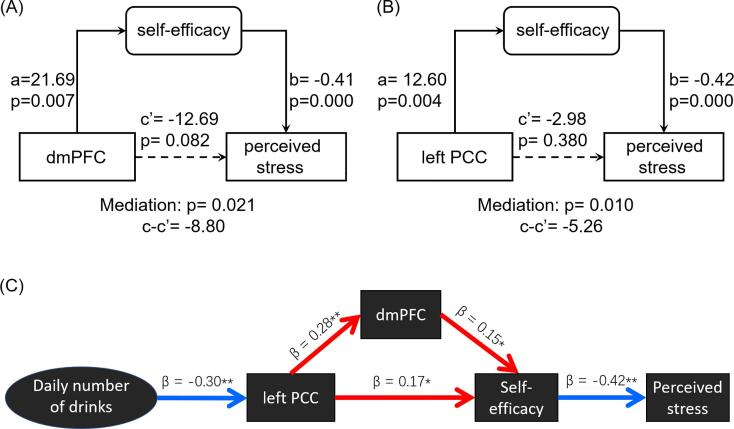
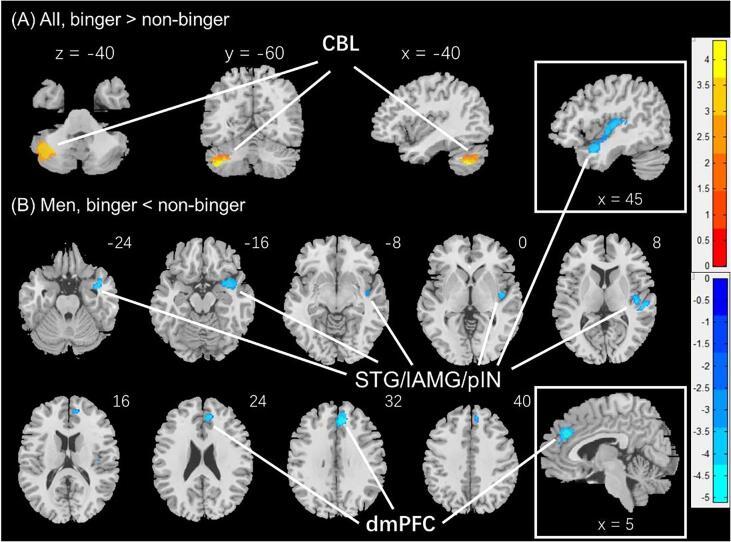
Studies have identified cerebral morphometric markers of binge drinking and implicated cortical regions in support of self-efficacy and stress regulation. However, it remains unclear how cortical structures of self-control play a role in ameliorating stress and alcohol consumption or how chronic alcohol exposure alters self-control and leads to emotional distress. We examined the data of 180 binge (131 men) and 256 non-binge (83 men) drinkers from the Human Connectome Project. We obtained data on regional cortical thickness from the HCP and derived gray matter volumes (GMVs) with voxel-based morphometry. At a corrected threshold, binge relative to non-binge drinking men showed diminished posterior cingulate cortex (PCC) thickness and dorsomedial prefrontal cortex (dmPFC) GMV. PCC thickness and dmPFC GMVs were positively and negatively correlated with self-efficacy and perceived stress, respectively, as assessed with the NIH Emotion Toolbox. Mediation and path analyses to query the inter-relationships between the neural markers and clinical variables showed a best fit of the model with daily drinks → lower PCC thickness and dmPFC GMV → lower self-efficacy → higher perceived stress in men. In contrast, binge and non-binge drinking women did not show significant differences in regional cortical thickness or GMVs. These findings suggest a pathway whereby chronic alcohol consumption alters cortical structures and self-efficacy mediates the effects of cortical structural deficits on perceived stress in men. The findings also suggest the need to investigate multimodal neural markers underlying the interplay between stress, self-control and alcohol use behavior in women.
研究已经确定了狂欢性饮酒的大脑形态计量学标志物,并暗示了皮质区域在支持自我效能感和应激调节方面的作用。然而,皮质结构的自我控制在改善应激和饮酒方面的作用以及慢性酒精暴露如何改变自我控制并导致情绪困扰仍不清楚。我们检查了来自人类连接组计划的 180 名狂欢(131 名男性)和 256 名非狂欢(83 名男性)饮酒者的数据。我们从 HCP 获得了区域皮质厚度的数据,并通过基于体素的形态计量学获得了灰质体积(GMV)。在纠正后的阈值下,狂欢性饮酒者与非狂欢性饮酒者相比,后扣带回皮质(PCC)厚度和背内侧前额叶皮质(dmPFC)GMV 减少。PCC 厚度和 dmPFC GMV 分别与 NIH 情绪工具包评估的自我效能感和感知压力呈正相关和负相关。中介和路径分析用于查询神经标志物与临床变量之间的相互关系,表明在男性中,每日饮酒量→PCC 厚度降低和 dmPFC GMV 降低→自我效能感降低→感知压力升高的模型拟合度最佳。相比之下,狂欢性和非狂欢性饮酒的女性在区域皮质厚度或 GMV 方面没有显示出显著差异。这些发现表明,慢性酒精消费改变皮质结构,自我效能感介导皮质结构缺陷对男性感知压力的影响的途径。这些发现还表明,需要研究应激、自我控制和饮酒行为之间相互作用的多模态神经标志物。