Department of Sciences, University of Roma Tre, Rome, Italy.
Department of Biology, University of Naples Federico II, Naples, Italy.
BMC Genomics. 2021 Nov 8;22(1):808. doi: 10.1186/s12864-021-08118-8.
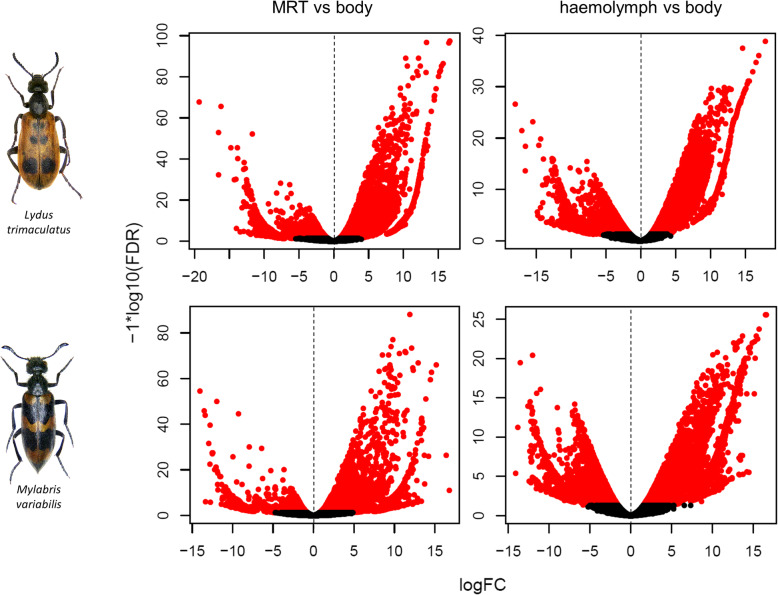
Meloidae (blister beetles) are known to synthetize cantharidin (CA), a toxic and defensive terpene mainly stored in male accessory glands (MAG) and emitted outward through reflex-bleeding. Recent progresses in understanding CA biosynthesis and production organ(s) in Meloidae have been made, but the way in which self-protection is achieved from the hazardous accumulation and release of CA in blister beetles has been experimentally neglected. To provide hints on this pending question, a comparative de novo assembly transcriptomic approach was performed by targeting two tissues where CA is largely accumulated and regularly circulates in Meloidae: the male reproductive tract (MRT) and the haemolymph. Differential gene expression profiles in these tissues were examined in two blister beetle species, Lydus trimaculatus (Fabricius, 1775) (tribe Lyttini) and Mylabris variabilis (Pallas, 1781) (tribe Mylabrini). Upregulated transcripts were compared between the two species to identify conserved genes possibly involved in CA detoxification and transport.
Based on our results, we hypothesize that, to avoid auto-intoxication, ABC, MFS or other solute transporters might sequester purported glycosylated CA precursors into MAG, and lipocalins could bind CA and mitigate its reactivity when released into the haemolymph during the autohaemorrhaging response. We also found an over-representation in haemolymph of protein-domains related to coagulation and integument repairing mechanisms that likely reflects the need to limit fluid loss during reflex-bleeding.
The de novo assembled transcriptomes of L. trimaculatus and M. variabilis here provided represent valuable genetic resources to further explore the mechanisms employed to cope with toxicity of CA in blister beetle tissues. These, if revealed, might help conceiving safe and effective drug-delivery approaches to enhance the use of CA in medicine.
芫菁科(斑蝥)已知能合成斑蝥素(CA),一种主要储存在雄性附腺(MAG)中的有毒防御性萜烯,通过反射性出血向外释放。近年来,人们对芫菁科 CA 生物合成和产生器官有了更多的了解,但在斑蝥中,CA 的危险积累和释放如何实现自我保护这一问题尚未得到实验验证。为了提供关于这一悬而未决问题的线索,我们采用从头组装转录组学方法,针对 CA 在芫菁科中大量积累并循环的两个组织:雄性生殖道(MRT)和血淋巴,对其进行了研究。在两种斑蝥中(Lyttini 族的 Lydus trimaculatus(Fabricius,1775)和 Mylabrini 族的 Mylabris variabilis(Pallas,1781)),检查了这两个组织的差异基因表达谱。比较了两个物种之间上调的转录本,以鉴定可能参与 CA 解毒和转运的保守基因。
基于我们的结果,我们假设,为了避免自身中毒,ABC、MFS 或其他溶质转运体可能将所谓的糖基化 CA 前体隔离到 MAG 中,而脂联蛋白可以结合 CA,并在反射性出血反应中释放到血淋巴时减轻其反应性。我们还发现血淋巴中与凝血和表皮修复机制相关的蛋白结构域过度表达,这可能反映了在反射性出血期间限制液体流失的需要。
本文中从头组装的 L. trimaculatus 和 M. variabilis 转录组提供了有价值的遗传资源,可进一步探索应对斑蝥组织中 CA 毒性的机制。如果揭示了这些机制,可能有助于设计安全有效的药物输送方法,以提高 CA 在医学中的应用。