School of Medicine, College of Medicine, I-Shou University, Kaohsiung, Taiwan.
Division of Gastroenterology and Hepatology, Department of Medicine, E-Da Hospital, I-Shou University, No. 1, Yida Road, Jiaosu Village, Yanchao District, Kaohsiung City, 82445, Taiwan.
BMC Gastroenterol. 2021 Nov 8;21(1):418. doi: 10.1186/s12876-021-01995-z.
The detection rate of Barcelona Clinic Liver Cancer (BCLC) very-early-stage hepatocellular carcinoma (HCC) is increasing because of advances in surveillance and improved imaging technologies for high-risk populations. Surgical resection (SR) and radiofrequency ablation (RFA) are both first-line treatments for very-early-stage HCC, but the differences in clinical outcomes between patients treated with SR and RFA remain unclear. This study investigated the prognosis of SR and RFA for very-early-stage HCC patients with long-term follow-up.
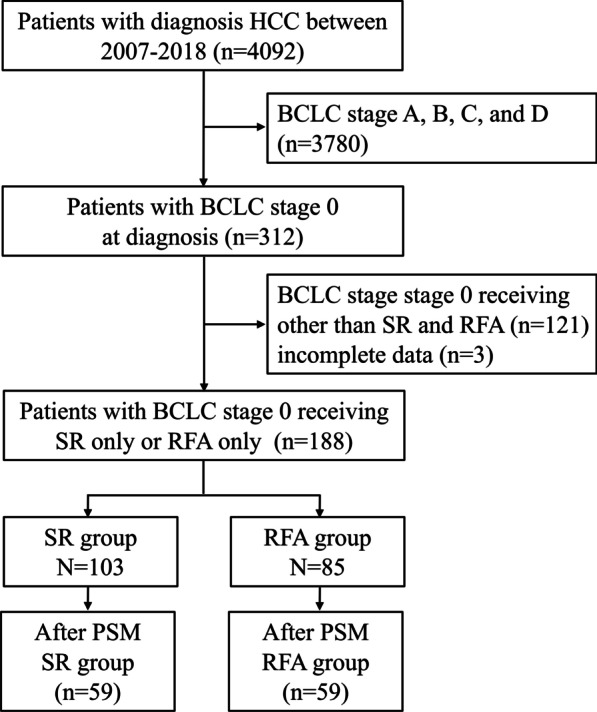
This study was retrospectively collected data on the clinicopathological characteristics, overall survival (OS), and disease-free survival (DFS) of 188 very-early-stage HCC patients (≤ 2 cm single HCC). OS and DFS were analyzed using the Kaplan-Meier method and Cox regression analysis. Propensity score matching (PSM) analysis was performed.
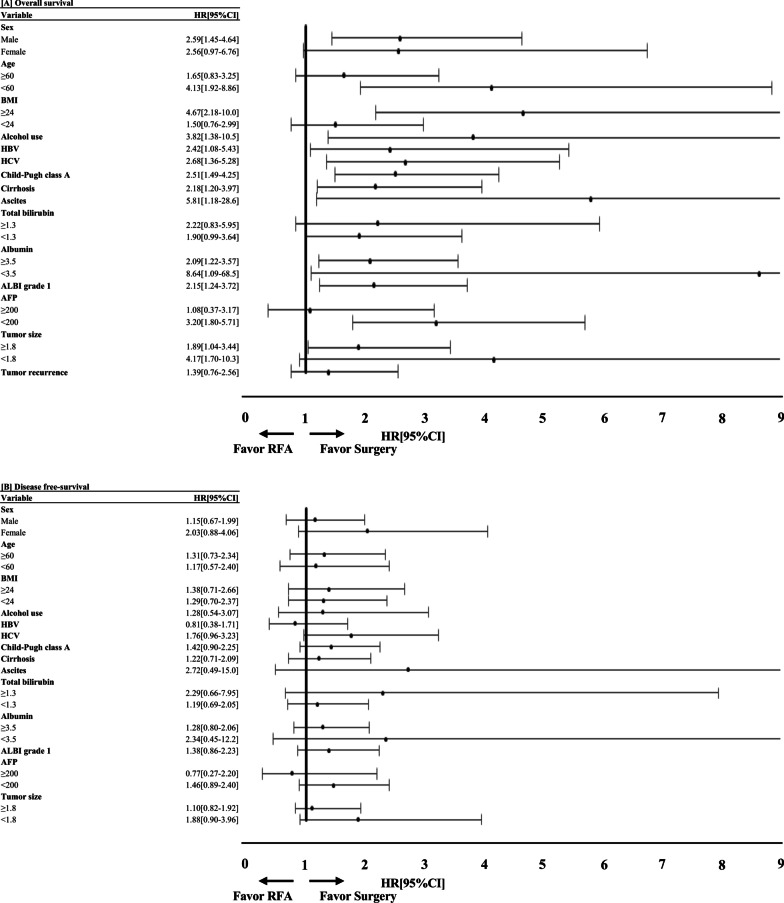
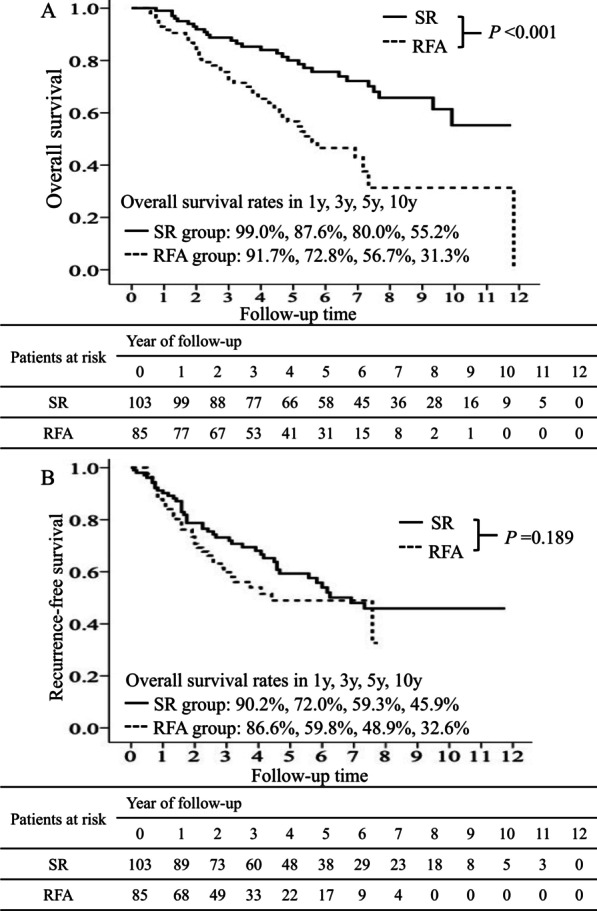
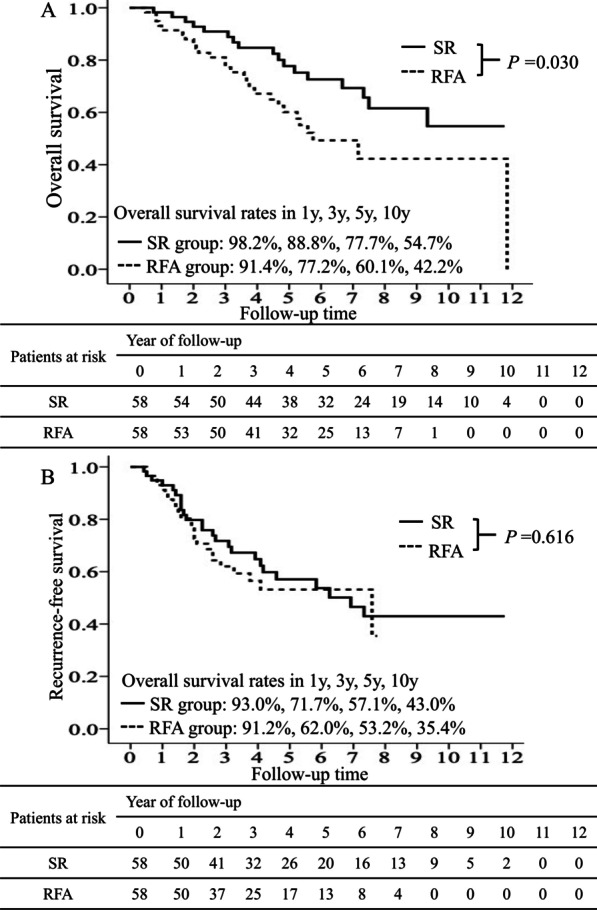
Of the 188 HCC patients, 103 received SR and 85 received RFA. The median follow-up time was 56 months. The SR group had significantly higher OS than the RFA group (10-year cumulative OS: 55.2% and 31.3% in the SR and RFA groups, respectively). No statistically significant difference was observed in DFS between the SR and RFA groups (10-year cumulative DFS: 45.9% and 32.6% in the SR and RFA groups, respectively). After PSM, the OS in the SR group remained significantly higher than that in the RFA group (10-year cumulative OS: 54.7% and 42.2% in the SR and RFA groups, respectively). No significant difference was observed in DFS between the SR and RFA groups (10-year cumulative DFS: 43.0% and 35.4% in the SR and RFA groups, respectively). Furthermore, in the multivariate Cox regression analysis, treatment type (hazard ratio (HR): 0.54, 95% confidence interval (CI): 0.31-0.95; P = 0.032) and total bilirubin (HR: 1.92; 95% CI: 1.09-3.41; P = 0.025) were highly associated with OS. In addition, age (HR: 2.14, 95% CI: 1.36-3.36; P = 0.001) and cirrhosis (HR: 1.79; 95% CI: 1.11-2.89; P = 0.018) were strongly associated with DFS.
For patients with very-early-stage HCC, SR was associated with significantly higher OS rates than RFA. However, no significant difference was observed in DFS between the SR and RFA groups.
由于对高危人群的监测和影像学技术的改进,巴塞罗那临床肝癌(BCLC)极早期肝癌(HCC)的检出率不断提高。手术切除(SR)和射频消融(RFA)都是极早期 HCC 的一线治疗方法,但接受 SR 和 RFA 治疗的患者的临床结果差异仍不清楚。本研究通过长期随访,探讨了 SR 和 RFA 治疗极早期 HCC 患者的预后。
本研究回顾性收集了 188 例极早期 HCC 患者(≤2cm 单发 HCC)的临床病理特征、总生存期(OS)和无病生存期(DFS)的临床资料。采用 Kaplan-Meier 法和 Cox 回归分析进行 OS 和 DFS 分析。进行倾向评分匹配(PSM)分析。
188 例 HCC 患者中,103 例行 SR 治疗,85 例行 RFA 治疗。中位随访时间为 56 个月。SR 组的 OS 明显高于 RFA 组(10 年累积 OS:SR 组和 RFA 组分别为 55.2%和 31.3%)。SR 组和 RFA 组的 DFS 无统计学差异(10 年累积 DFS:SR 组和 RFA 组分别为 45.9%和 32.6%)。PSM 后,SR 组的 OS 仍明显高于 RFA 组(10 年累积 OS:SR 组和 RFA 组分别为 54.7%和 42.2%)。两组的 DFS 无统计学差异(10 年累积 DFS:SR 组和 RFA 组分别为 43.0%和 35.4%)。此外,多因素 Cox 回归分析显示,治疗方式(风险比(HR):0.54,95%置信区间(CI):0.31-0.95;P=0.032)和总胆红素(HR:1.92;95%CI:1.09-3.41;P=0.025)与 OS 高度相关。此外,年龄(HR:2.14,95%CI:1.36-3.36;P=0.001)和肝硬化(HR:1.79;95%CI:1.11-2.89;P=0.018)与 DFS 密切相关。
对于极早期 HCC 患者,SR 的 OS 率明显高于 RFA,但两组的 DFS 无显著差异。