Department of Preventive and Social Dentistry, College of Dentistry, Seoul National University, 28 Younkeon-Dong, Chongro-Ku, Seoul, 03080, Korea.
Dental Research Institute, College of Dentistry, Seoul National University, Seoul, Korea.
BMC Oral Health. 2021 Nov 8;21(1):571. doi: 10.1186/s12903-021-01928-y.
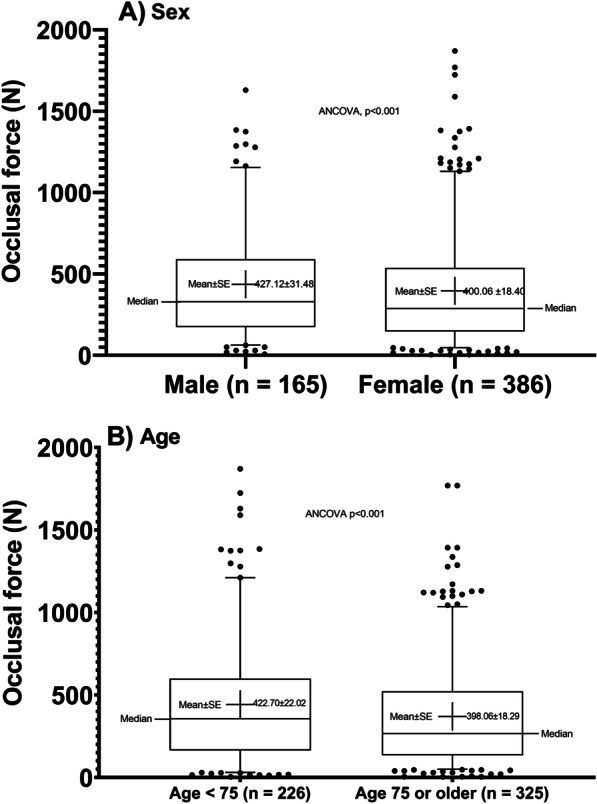
This study aimed to investigate the distribution of objective total occlusal force (TOF) and its association with dental health indicators: dental status, number of natural teeth (NT), natural and rehabilitated teeth, natural posterior teeth (NT-Post), and natural and rehabilitated posterior teeth among Korean elders after controlling for various confounders encompassing socio-demographic factors, behavioral factors and health/oral health factors.
This cross-sectional study recruited 551 elders from the Sungbook-Gu health education cohort. TOF was measured using Prescale II as an outcome variable. Dental health indicators assessed by dentists were the main explanatory variables. Analysis of covariance and multivariable linear regression models were applied to evaluate the adjusted association of dental health indicators with TOF. Gender and age group stratified analyses were also applied.
TOF was higher in dentate elders than denture wearers in males and younger elders. The adjusted mean of TOF and standard error was 464.24 ± 17.15 N for dentate elders, 297.15 ± 28.85 N for partial denture wearers, 280.42 ± 47.71 N for complete denture wearers. Among all dental health indicators, NT-Post showed the highest association with TOF (partial r = 0.330, p < 0.001, R = 0.15), followed by NT (partial r = 0.329, p < 0.001, R = 0.16). Older elders highlighted the association of NT (partial r = 0.37, p < 0.001, R = 0.18). Males decreased the association of NT (partial r = 0.30, p < 0.001, R = 0.20) and NT-Post (partial r = 0.29, p < 0.001, R = 0.20).
TOF was significantly associated with dental health indicators, and its association was modified by sex and age group.
本研究旨在调查客观总牙合力(TOF)的分布情况,并探讨其与口腔健康指标之间的关联,包括牙列状况、天然牙数(NT)、天然牙和修复牙、天然后牙(NT-Post)以及天然牙和修复后牙。研究在控制了社会人口因素、行为因素和健康/口腔健康因素等多种混杂因素后,对韩国老年人进行了研究。
本横断面研究招募了来自 Sungbook-Gu 健康教育队列的 551 名老年人。使用 Prescale II 作为测量结果变量来测量 TOF。由牙医评估的口腔健康指标作为主要解释变量。采用协方差分析和多变量线性回归模型来评估口腔健康指标与 TOF 的调整关联。还进行了性别和年龄组分层分析。
在男性和年轻老年人中,有牙列的老年人的 TOF 高于戴假牙的老年人。有牙列的老年人的调整后 TOF 平均值和标准误差为 464.24 ± 17.15 N,部分义齿佩戴者为 297.15 ± 28.85 N,全口义齿佩戴者为 280.42 ± 47.71 N。在所有口腔健康指标中,NT-Post 与 TOF 的相关性最高(偏相关系数 r=0.330,p<0.001,R²=0.15),其次是 NT(偏相关系数 r=0.329,p<0.001,R²=0.16)。年龄较大的老年人则与 NT 之间的关联更为显著(偏相关系数 r=0.37,p<0.001,R²=0.18)。男性则降低了 NT(偏相关系数 r=0.30,p<0.001,R²=0.20)和 NT-Post(偏相关系数 r=0.29,p<0.001,R²=0.20)之间的关联。
TOF 与口腔健康指标显著相关,其相关性受到性别和年龄组的影响。