Park William Y, Yiannakou Ioanna, Petersen Julie M, Hoffmann Udo, Ma Jiantao, Long Michelle T
Department of Medicine, Boston Medical Center, Boston University School of Medicine, Boston.
Preventive Medicine and Epidemiology, Department of Medicine, Boston University School of Medicine, Boston; PhD in Biomedical Science, Nutrition and Metabolism, Boston University School of Medicine, Boston.
Clin Gastroenterol Hepatol. 2022 Nov;20(11):2524-2532.e2. doi: 10.1016/j.cgh.2021.11.001. Epub 2021 Nov 6.
BACKGROUND & AIMS: Nonalcoholic fatty liver disease (NAFLD) is associated with sugar-sweetened beverage (SSB) consumption in cross-sectional studies. In a prospective cohort, we examined the association of beverage consumption (SSB and diet soda) with incident NAFLD and changes in hepatic fat in the Framingham Heart Study (FHS).
We conducted a prospective observational study of participants from the FHS Third Generation and Offspring cohorts who participated in computed tomography sub-studies. Participants were classified according to their average SSB or diet soda consumption, which was derived from baseline and follow-up food frequency questionnaires: non-consumers (0-<1/month), occasional consumers (1/month-<1/week), and frequent consumers (≥1/week-≥1/day). Hepatic fat was quantified by the liver fat attenuation measurements on computed tomography scan. The primary dependent variable was incident NAFLD; secondarily, we investigated change in liver fat.
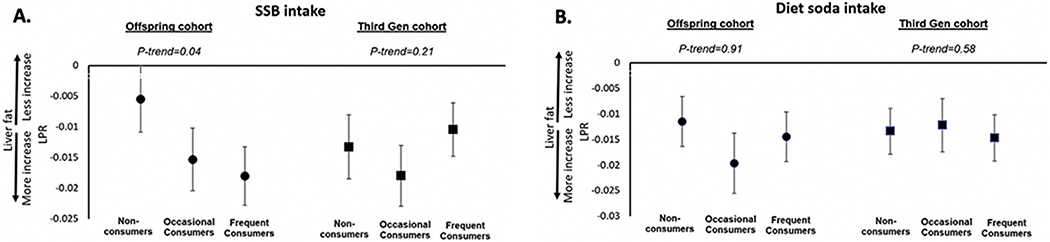
The cohorts included 691 Offspring (mean age, 62.8 ± 8.2 years; 57.7% women) and 945 Third Generation participants (mean age, 48.4 ± 6.3 years; 46.6% women). In the Offspring cohort, there was a dose-response relationship with SSB consumption and incident NAFLD. Frequent SSB consumers had 2.53 times increased odds of incident NAFLD compared with non-consumers (95% confidence interval, 1.36-4.7) after multivariable analysis. For Offspring cohort participants, occasional and frequent consumers of SSB had a more adverse increase in liver fat compared with non-consumers.
Higher average SSB intake is associated with increase in liver fat over 6 years of follow-up and increased odds of incident NAFLD especially among the older cohort, whereas no consistent association was observed for the younger Third Generation cohort.
在横断面研究中,非酒精性脂肪性肝病(NAFLD)与含糖饮料(SSB)的摄入有关。在一项前瞻性队列研究中,我们在弗雷明汉心脏研究(FHS)中检验了饮料摄入(SSB和无糖汽水)与新发NAFLD以及肝脏脂肪变化之间的关联。
我们对参与计算机断层扫描子研究的FHS第三代和后代队列的参与者进行了一项前瞻性观察性研究。参与者根据其平均SSB或无糖汽水摄入量进行分类,摄入量来自基线和随访食物频率问卷:非消费者(0 - <1/月)、偶尔消费者(1/月 - <1/周)和频繁消费者(≥1/周 - ≥1/天)。通过计算机断层扫描上的肝脏脂肪衰减测量来量化肝脏脂肪。主要因变量是新发NAFLD;其次,我们研究了肝脏脂肪的变化。
队列包括691名后代(平均年龄,62.8±8.2岁;57.7%为女性)和945名第三代参与者(平均年龄,48.4±6.3岁;46.6%为女性)。在后代队列中,SSB摄入量与新发NAFLD之间存在剂量反应关系。多变量分析后,频繁饮用SSB的消费者发生NAFLD的几率比非消费者高2.53倍(95%置信区间,1.36 - 4.7)。对于后代队列的参与者,与非消费者相比,偶尔和频繁饮用SSB的消费者肝脏脂肪增加更为不利。
在6年的随访中,较高的平均SSB摄入量与肝脏脂肪增加以及新发NAFLD几率增加有关,尤其是在年龄较大的队列中,而在较年轻的第三代队列中未观察到一致的关联。