Ramier Clémence, Protopopescu Camelia, Di Beo Vincent, Parlati Lucia, Marcellin Fabienne, Carrat Fabrice, Asselah Tarik, Bourlière Marc, Carrieri Patrizia
Aix Marseille Univ, INSERM, IRD, SESSTIM, Sciences Économiques and Sociales de la Santé and Traitement de l'Information Médicale, Marseille, France.
Département d'Hépatologie/Addictologie, Université de Paris Cité; INSERM U1016, AP-HP, Hôpital Cochin, Paris, France.
Liver Int. 2025 Apr;45(4):e70065. doi: 10.1111/liv.70065.
Early assessment of hepatocellular carcinoma (HCC) risk could improve long-term outcomes in people with chronic hepatitis B virus (HBV) infection. Some existing HCC predictive scores are not easily implementable. We developed easy-to-use HCC predictive scores based on behavioural and routine bio-clinical data in people with chronic HBV infection.
Eight-year follow-up data was analysed from people with chronic HBV infection enrolled in the French ANRS CO22 HEPATHER cohort. Patients were randomly split into two samples (training/testing). A multivariable Cox model for time to HCC was estimated on the training sample. The HCC predictive score was computed by summing the points assigned to model predictors, normalising their coefficients over a 10-year age increment, and rounding to the nearest integer. The Youden index identified the score's optimal risk threshold. Comparisons with existing predictive scores were performed on the testing sample.
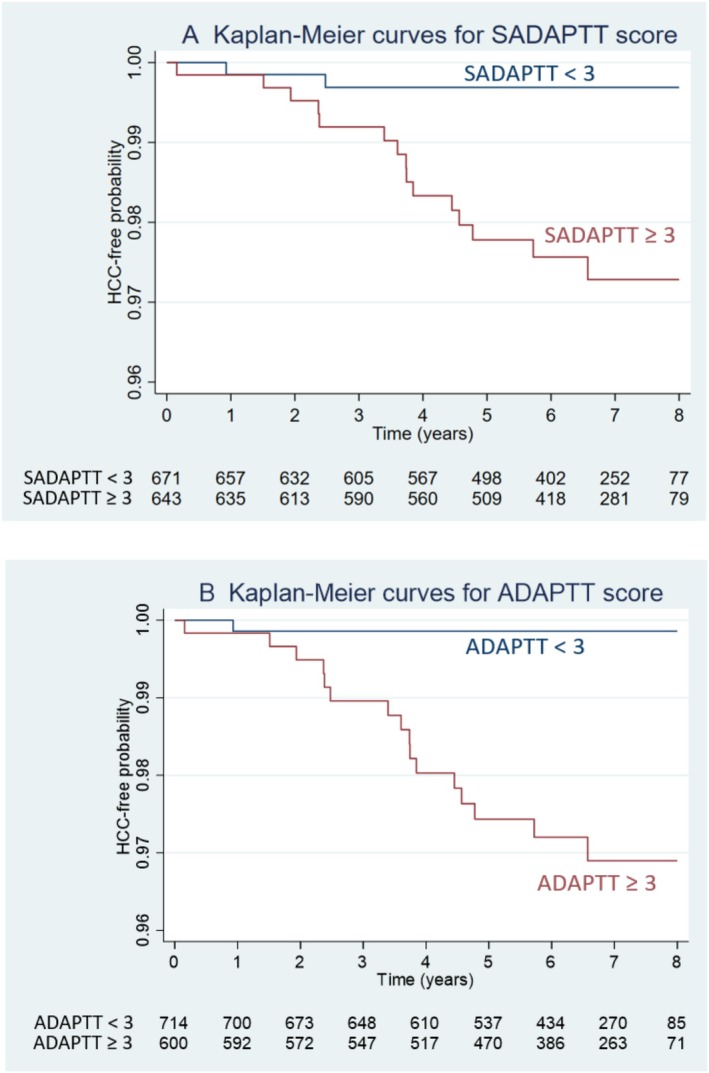
In the study population (N = 4370; 63% of men; 65% of < 50 years old), 56 HCC cases occurred during 25,900 follow-up person-years. Two HCC predictive scores were defined: SADAPTT (daily soft drink consumption, age, hepatitis Delta infection, unhealthy alcohol use, platelet count, heavy tobacco smoking, and HBV treatment) and ADAPTT (the same predictors except for daily soft drink consumption), with ranges 0-13 and 0-14, respectively, and values ≥ 3 indicating a high HCC risk. Their performances were similar to existing scores.
We developed two effective behaviour-based HCC predictive scores, implementable in many settings, including primary care and decentralised areas. Further studies are needed to validate these scores in other datasets.
早期评估肝细胞癌(HCC)风险可改善慢性乙型肝炎病毒(HBV)感染者的长期预后。一些现有的HCC预测评分不易实施。我们基于慢性HBV感染者的行为和常规生物临床数据,开发了易于使用的HCC预测评分。
对纳入法国ANRS CO22 HEPATHER队列的慢性HBV感染者的八年随访数据进行分析。患者被随机分为两个样本(训练/测试)。在训练样本上估计HCC发生时间的多变量Cox模型。HCC预测评分通过对模型预测因子分配的分数求和,将其系数在10岁年龄增量上进行标准化,并四舍五入到最接近的整数来计算。约登指数确定评分的最佳风险阈值。在测试样本上与现有预测评分进行比较。
在研究人群(N = 4370;63%为男性;65%年龄<50岁)中,在25900人年的随访期间发生了56例HCC病例。定义了两个HCC预测评分:SADAPTT(每日软饮料消费量、年龄、丁型肝炎感染、不健康饮酒、血小板计数、大量吸烟和HBV治疗)和ADAPTT(除每日软饮料消费量外的相同预测因子),范围分别为0 - 13和0 - 14,值≥3表明HCC风险高。它们的性能与现有评分相似。
我们开发了两个基于行为的有效HCC预测评分,可在许多环境中实施,包括初级保健和偏远地区。需要进一步研究在其他数据集中验证这些评分。