Vaccine Research Center, NIAID, National Institutes of Health, Bethesda, MD, 20892, USA.
Department of Medicine and Department of Microbiology, Icahn School of Medicine at Mount Sinai, New York, NY, 10029, USA.
Nat Commun. 2021 Nov 9;12(1):6470. doi: 10.1038/s41467-021-26579-z.
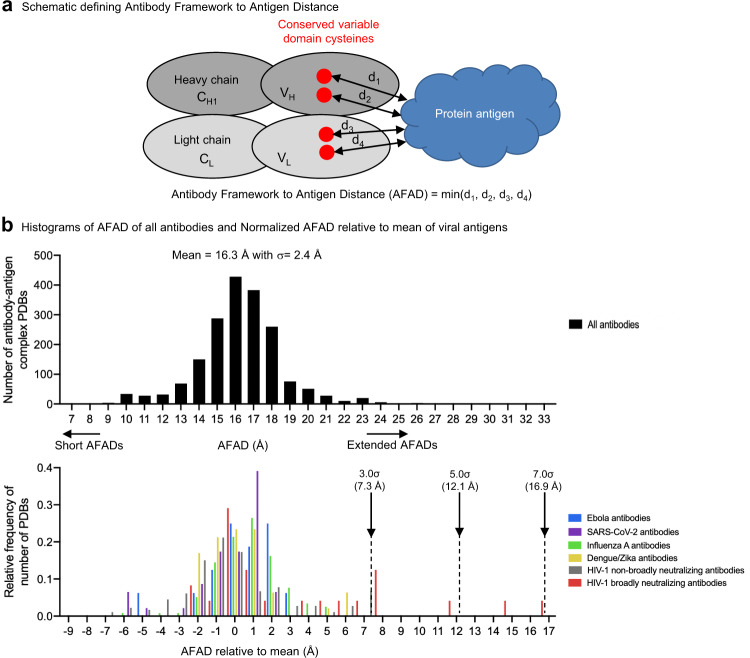
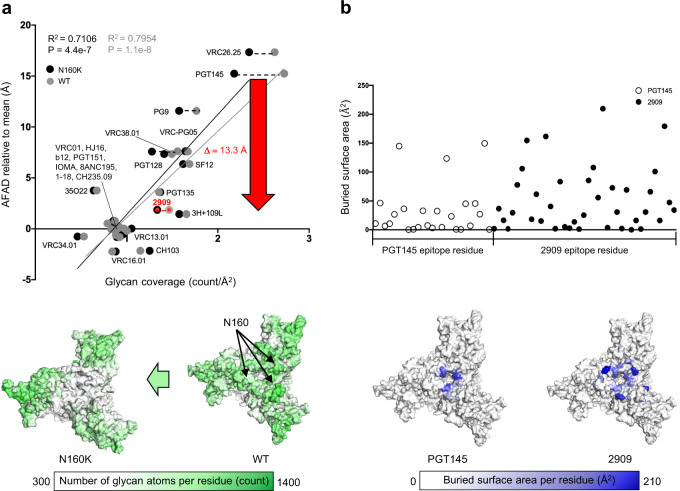
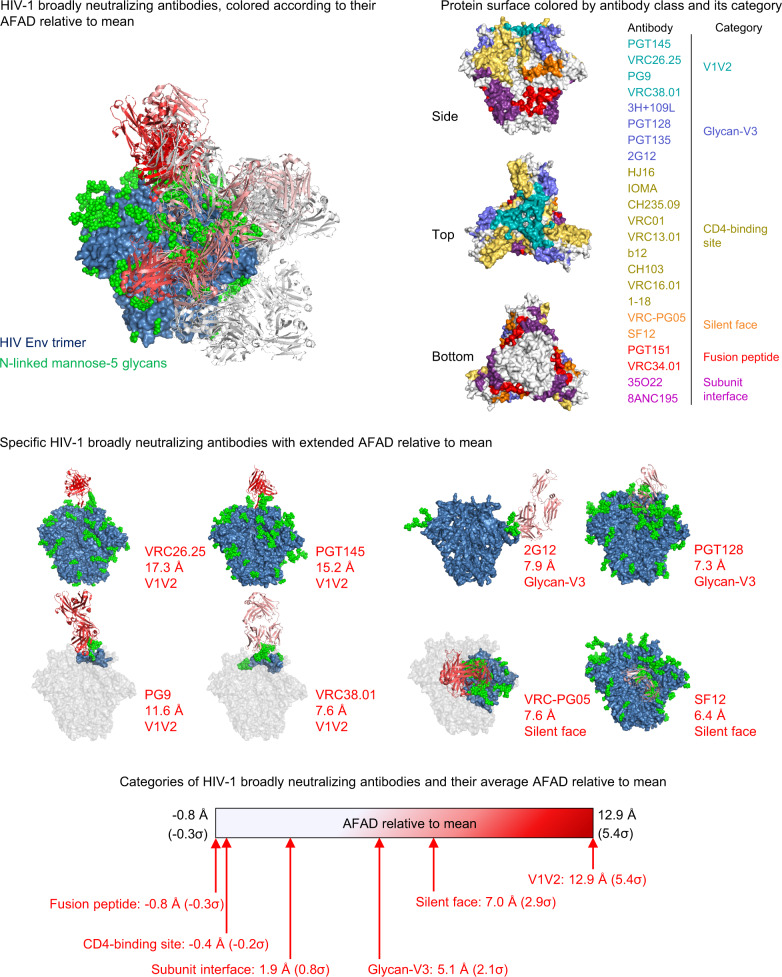
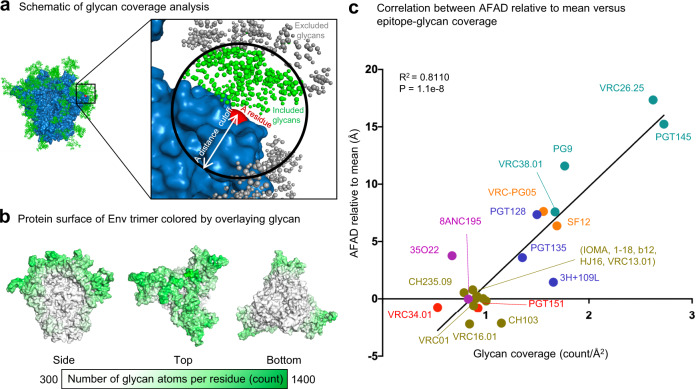
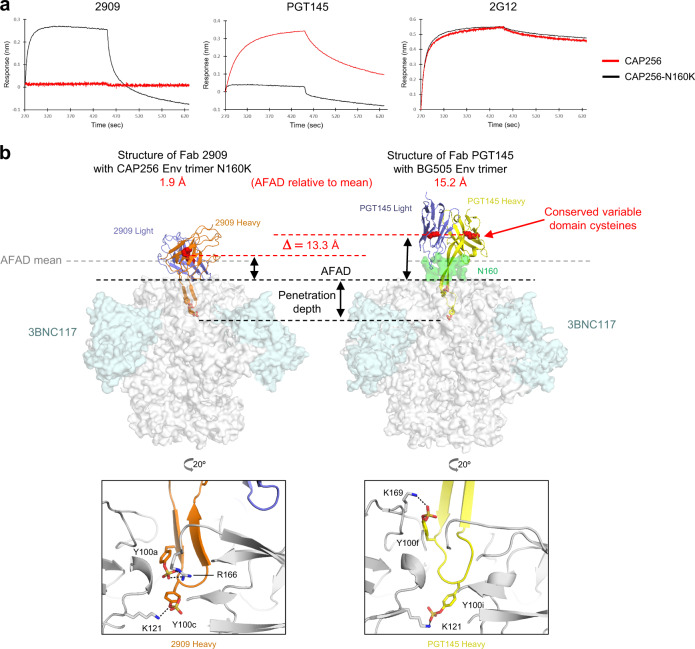
Antibody-Framework-to-Antigen Distance (AFAD) - the distance between the body of an antibody and a protein antigen - is an important parameter governing antibody recognition. Here, we quantify AFAD for ~2,000 non-redundant antibody-protein-antigen complexes in the Protein Data Bank. AFADs showed a gaussian distribution with mean of 16.3 Å and standard deviation (σ) of 2.4 Å. Notably, antibody-antigen complexes with extended AFADs (>3σ) were exclusively human immunodeficiency virus-type 1 (HIV-1)-neutralizing antibodies. High correlation (R = 0.8110) was observed between AFADs and glycan coverage, as assessed by molecular dynamics simulations of the HIV-1-envelope trimer. Especially long AFADs were observed for antibodies targeting the glycosylated trimer apex, and we tested the impact of introducing an apex-glycan hole (N160K); the cryo-EM structure of the glycan hole-targeting HIV-1-neutralizing antibody 2909 in complex with an N160K-envelope trimer revealed a substantially shorter AFAD. Overall, extended AFADs exclusively recognized densely glycosylated surfaces, with the introduction of a glycan hole enabling closer recognition.
抗体-抗原距离(AFAD)-抗体与蛋白质抗原之间的距离-是控制抗体识别的重要参数。在这里,我们对蛋白质数据库中约 2000 个非冗余的抗体-蛋白-抗原复合物进行了 AFAD 的定量分析。AFAD 呈高斯分布,平均值为 16.3Å,标准偏差(σ)为 2.4Å。值得注意的是,具有较大 AFAD(>3σ)的抗体-抗原复合物仅为人类免疫缺陷病毒 1 型(HIV-1)中和抗体。通过对 HIV-1 包膜三聚体的分子动力学模拟,观察到 AFAD 与聚糖覆盖率之间存在高度相关性(R=0.8110)。对于靶向糖基化三聚体顶端的抗体,观察到特别长的 AFAD,我们测试了引入顶端聚糖孔(N160K)的影响;靶向 N160K 包膜三聚体的聚糖孔的 HIV-1 中和抗体 2909 的冷冻电镜结构显示出明显较短的 AFAD。总的来说,较长的 AFAD 仅识别高度糖基化的表面,引入聚糖孔可实现更紧密的识别。