Wei Ming-Ze, Yan Ze-Jun, Jiang Jun-Hui, Jia Xiao-Long
Department of Urology, Ningbo First Hospital, Ningbo Hospital of Zhejiang University, Ningbo 315000, Zhejiang Province, China.
World J Clin Cases. 2021 Oct 6;9(28):8453-8460. doi: 10.12998/wjcc.v9.i28.8453.
Granular cell tumor (GCT) is a neurogenic tumor mainly occurring in the head and neck. GCT in the genitourinary system is extremely rare and only sporadic cases of urinary bladder GCT have been reported. Most urinary bladder GCT cases are benign and only two malignant cases have been reported. Due to its rarity, no consensus criteria for the treatment of urinary bladder GCT are available at present.
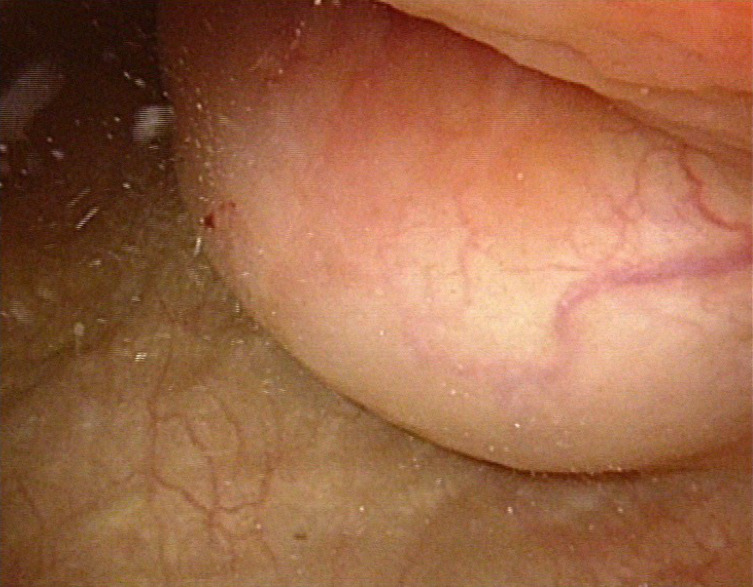
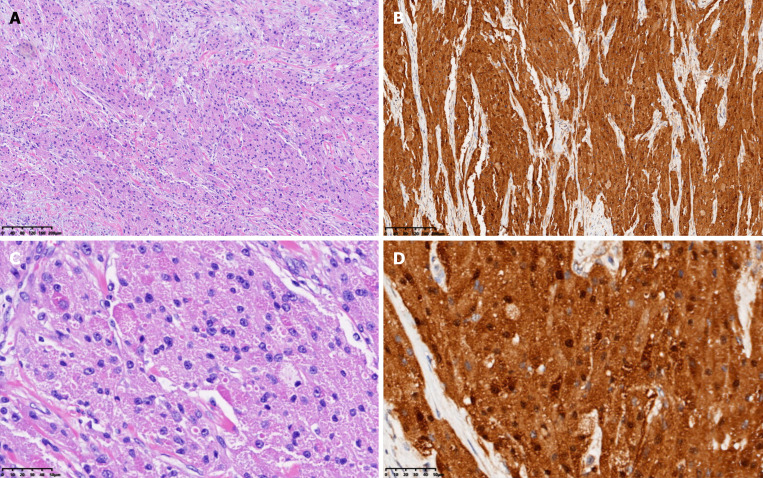
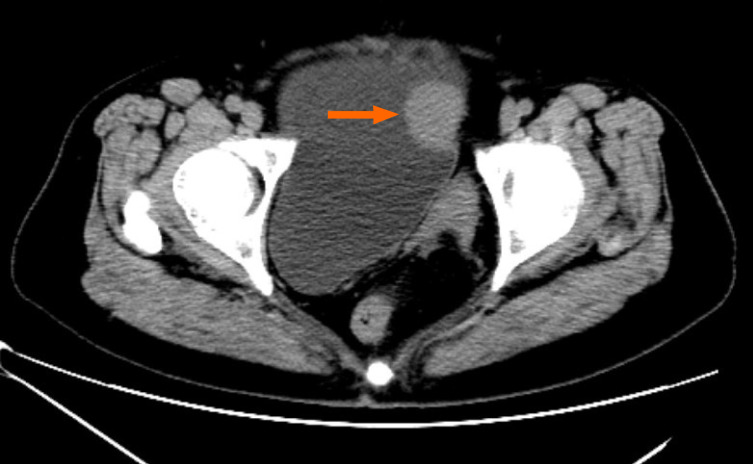
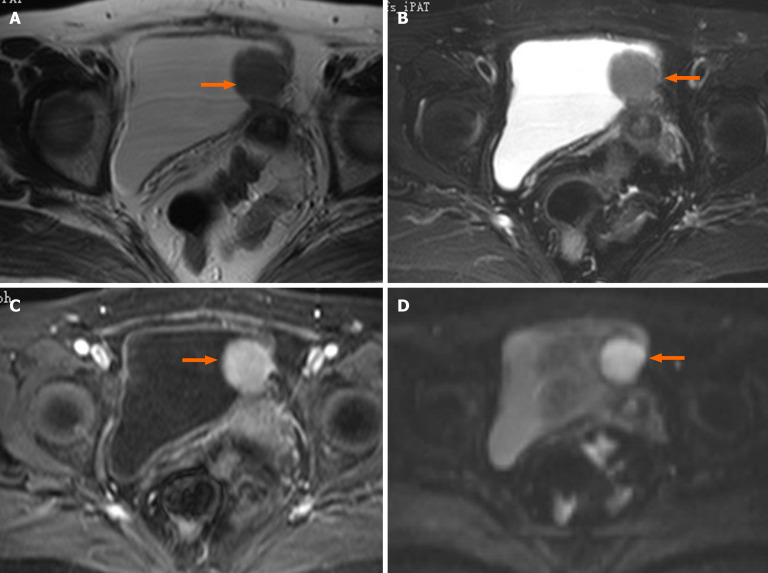
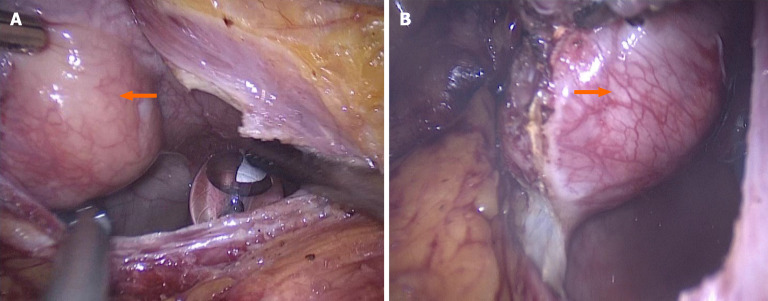
A 62-year-old Chinese woman was found to have a urinary bladder tumor without any clinical manifestations on physical examination. Cystoscopy revealed a semispherical shaped lesion measuring approximately 4.0 cm in diameter at the junction of the left wall and roof of the bladder, which was covered with normal bladder mucosa. Computed tomography scan demonstrated a high-density lesion on the left wall of the bladder, measuring approximately 2.9 cm × 2.4 cm with clear boundaries. Contrast-enhanced pelvic magnetic resonance imaging revealed a space-occupying lesion on the left wall of the bladder (non-mucosal origin/ external pressure), which was preliminarily suspected to be a desmoplastic fibroma or leiomyoma. In the context of the above findings, a pre-operative diagnosis of bladder leiomyoma was made. The patient consequently underwent a laparoscopic partial cystectomy. The resected bladder mass looked yellowish and well-demarcated, measuring 4.0 cm × 3.5 cm and infiltrated the muscular layer. The diagnosis of urinary bladder GCT was finally made by postoperative pathology, with positive immunohistochemical S-100 staining and negative pancytokeratin. The patient has been followed for 6 mo so far, with no tumor recurrence detected.
This case highlights the biological feature and differential diagnosis of urinary bladder GCT at the pathological and molecular levels. Transurethral resection of the bladder tumor and partial cystectomy are recommended in most urinary bladder GCT cases, while radical cystectomy is recommended in malignant cases.
颗粒细胞瘤(GCT)是一种主要发生于头颈部的神经源性肿瘤。泌尿生殖系统的GCT极为罕见,仅报道过散发性膀胱GCT病例。大多数膀胱GCT病例为良性,仅报道过2例恶性病例。由于其罕见性,目前尚无膀胱GCT的治疗共识标准。
一名62岁中国女性在体格检查时发现膀胱肿瘤,无任何临床表现。膀胱镜检查显示,在膀胱左壁与顶部交界处有一个直径约4.0 cm的半球形病变,表面覆盖正常膀胱黏膜。计算机断层扫描显示膀胱左壁有一个高密度病变,大小约为2.9 cm×2.4 cm,边界清晰。盆腔增强磁共振成像显示膀胱左壁有一个占位性病变(非黏膜起源/外部压迫),初步怀疑为促纤维增生性纤维瘤或平滑肌瘤。根据上述检查结果,术前诊断为膀胱平滑肌瘤。患者随后接受了腹腔镜部分膀胱切除术。切除的膀胱肿块呈淡黄色,边界清晰,大小为4.0 cm×3.5 cm,侵犯肌层。术后病理最终诊断为膀胱GCT,免疫组化S-100染色阳性,全细胞角蛋白染色阴性。患者至今已随访6个月,未发现肿瘤复发。
本病例突出了膀胱GCT在病理和分子水平的生物学特征及鉴别诊断。大多数膀胱GCT病例建议行经尿道膀胱肿瘤切除术和部分膀胱切除术,而恶性病例建议行根治性膀胱切除术。