Personal Care Products Council, Washington, DC, USA.
Environ Toxicol Chem. 2021 Dec;40(12):3441-3464. doi: 10.1002/etc.5229. Epub 2021 Nov 10.
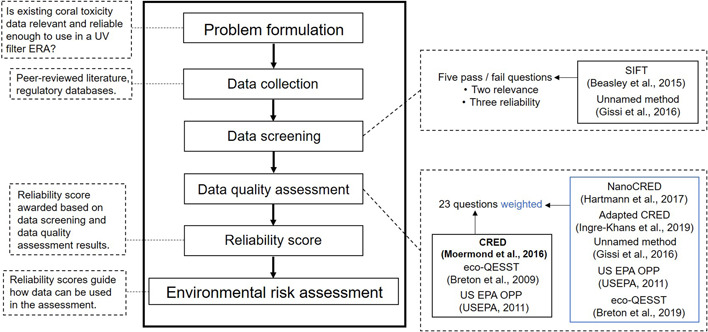
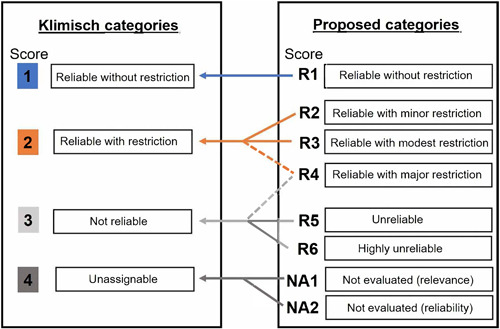
There is growing interest in the environmental safety of ultraviolet (UV) filters found in cosmetic and personal care products (CPCPs). The CPCP industry is assessing appropriate environmental risk assessment (ERA) methods to conduct robust environmental safety assessments for these ingredients. Relevant and reliable data are needed for ERA, particularly when the assessment is supporting regulatory decision-making. In the present study, we apply a data evaluation approach to incorporate nonstandard toxicity data into the ERA process through an expanded range of reliability scores over commonly used approaches (e.g., Klimisch scores). The method employs an upfront screening followed by a data quality assessment based largely on the Criteria for Reporting and Evaluating Ecotoxicity Data (CRED) approach. The method was applied in a coral case study in which UV filter toxicity data was evaluated to identify data points potentially suitable for higher tier and/or regulatory ERA. This is an optimal case study because there are no standard coral toxicity test methods, and UV filter bans are being enacted based on findings reported in the current peer-reviewed data set. Eight studies comprising nine assays were identified; four of the assays did not pass the initial screening assessment. None of the remaining five assays received a high enough reliability score (R ) to be considered of decision-making quality (i.e., R1 or R2). Four assays were suitable for a preliminary ERA (i.e., R3 or R4), and one assay was not reliable (i.e., R6). These results highlight a need for higher quality coral toxicity studies, potentially through the development of standard test protocols, to generate reliable toxicity endpoints. These data can then be used for ERA to inform environmental protection and sustainability decision-making. Environ Toxicol Chem 2021;40:3441-3464. © 2021 Personal Care Products Council. Environmental Toxicology and Chemistry published by Wiley Periodicals LLC on behalf of SETAC.
人们对化妆品和个人护理产品 (CPCP) 中发现的紫外线 (UV) 滤光剂的环境安全性越来越感兴趣。CPCP 行业正在评估适当的环境风险评估 (ERA) 方法,以对这些成分进行稳健的环境安全评估。ERA 需要相关和可靠的数据,特别是当评估支持监管决策时。在本研究中,我们通过扩展常用方法(例如 Klimisch 评分)的可靠性评分范围,应用数据评估方法将非标准毒性数据纳入 ERA 过程。该方法采用了一种前期筛选,然后根据生态毒性数据报告和评估标准 (CRED) 方法进行数据质量评估。该方法应用于珊瑚案例研究中,评估了 UV 滤光剂毒性数据,以确定可能适合更高层次和/或监管 ERA 的数据点。这是一个最佳案例研究,因为没有标准的珊瑚毒性测试方法,并且根据当前同行评议数据集报告的发现,正在对 UV 滤光剂进行禁令。确定了八项研究,共包含九项测定;四项测定未能通过初步筛选评估。其余五项测定中没有一项获得足够高的可靠性评分 (R),不足以被认为具有决策质量(即 R1 或 R2)。四项测定适合初步 ERA(即 R3 或 R4),一项测定不可靠(即 R6)。这些结果突出表明需要进行更高质量的珊瑚毒性研究,可能需要通过制定标准测试协议来生成可靠的毒性终点。然后可以将这些数据用于 ERA,为环境保护和可持续性决策提供信息。环境毒理学与化学 2021;40:3441-3464。版权所有 2021 个人护理产品委员会。环境毒理学与化学由 Wiley Periodicals LLC 代表 SETAC 出版。