Miller Ingo B, Moeller Mareen, Kellermann Matthias Y, Nietzer Samuel, Di Mauro Valentina, Kamyab Elham, Pawlowski Sascha, Petersen-Thiery Mechtild, Schupp Peter J
Environmental Biochemistry, Institute for Chemistry and Biology of the Marine Environment (ICBM), Carl von Ossietzky University Oldenburg, Schleusenstr. 1, 26382 Wilhelmshaven, Germany.
Department of Product Safety, Regulatory Ecotoxicology, BASF SE, Carl-Bosch-Str. 38, 67056 Ludwigshafen am Rhein, Germany.
Toxics. 2022 May 10;10(5):244. doi: 10.3390/toxics10050244.
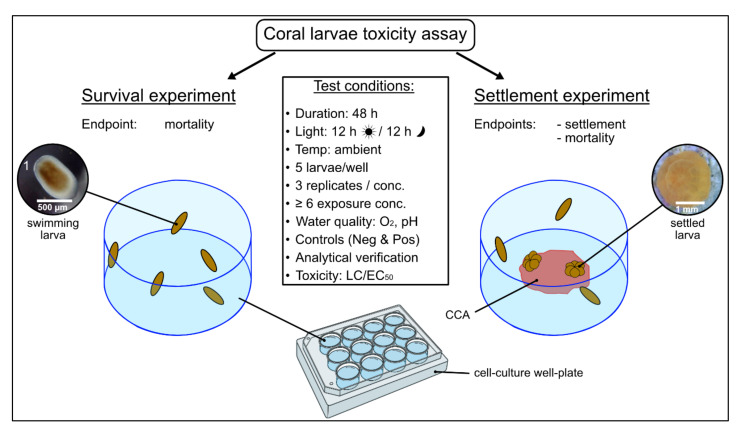
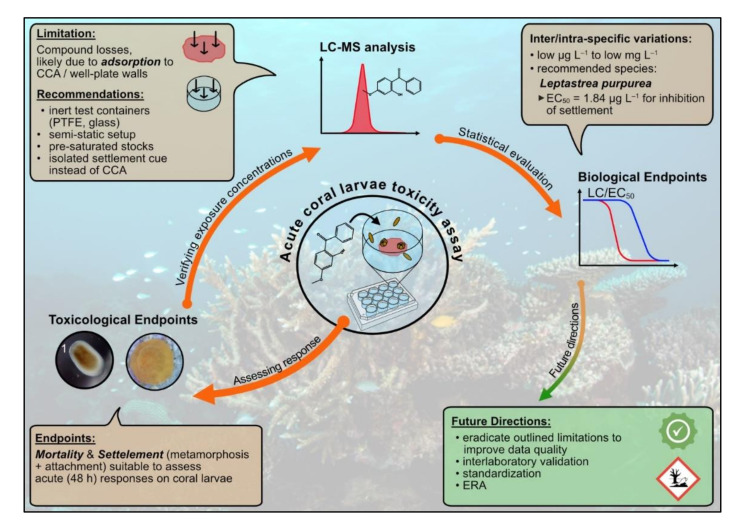
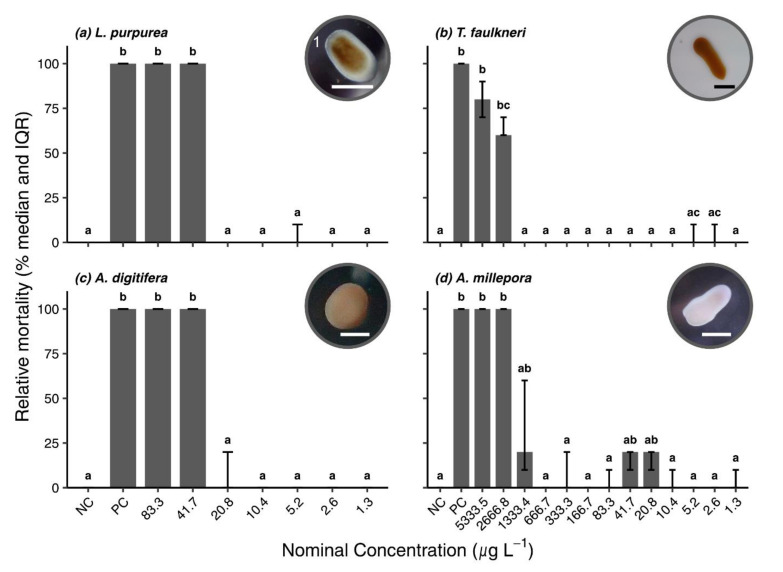
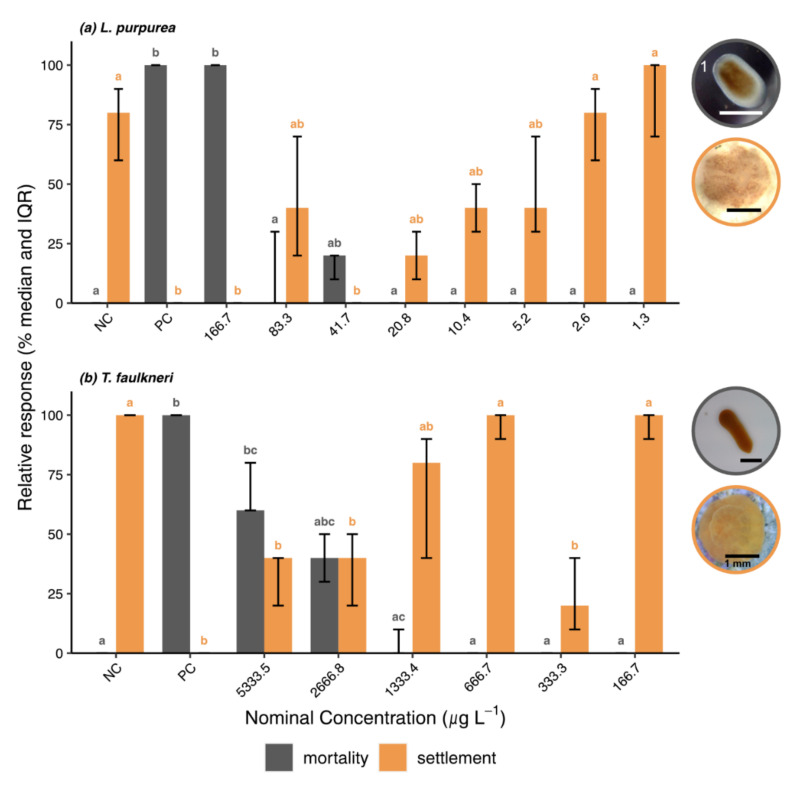
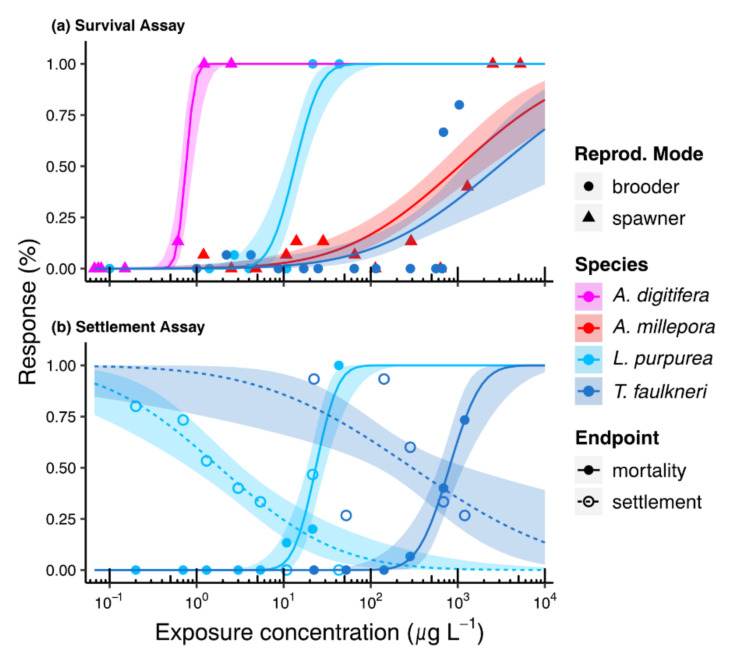
Coral reefs have been declining globally at a historically unprecedented rate. Ultraviolet (UV) filters used in sunscreens may contribute to this decline at local scales, which has already led to bans on various organic UV filters in some regions. However, the underlying studies for these bans demonstrated significant flaws in the experimental design due to a lack of validated and standardized testing methods for corals. This study aimed to investigate options for the development of a standard acute toxicity test for the larval stage of scleractinian corals. Planula larvae of two brooding ( and ) and two spawning ( and ) species were exposed to the organic UV filter benzophenone-3 (BP3) for 48 h under static conditions. We observed interspecific variations in toxicity, with being the most sensitive (LC = 0.75 µg L) and the least sensitive (LC = 2951.24 µg L) species. Inhibition of settlement was found to be a useful endpoint leading to an EC of 1.84 µg L in larvae. Although the analytical challenges of measuring lipophilic substances in small volume test setups remain, the here applied test design and selected endpoints are suitable for further validation and subsequent standardization.
全球范围内,珊瑚礁正以前所未有的速度衰退。防晒霜中使用的紫外线(UV)过滤剂可能在局部范围内导致了这种衰退,这已经促使一些地区禁止使用各种有机紫外线过滤剂。然而,这些禁令背后的研究表明,由于缺乏经过验证的、标准化的珊瑚测试方法,实验设计存在重大缺陷。本研究旨在探讨为石珊瑚幼体阶段开发标准急性毒性试验的方案。在静态条件下,将两种 brooding(和)和两种产卵(和)物种的浮浪幼虫暴露于有机紫外线过滤剂二苯甲酮 - 3(BP3)中48小时。我们观察到了毒性的种间差异,其中是最敏感的物种(LC = 0.75 µg/L),而则是最不敏感的物种(LC = 2951.24 µg/L)。在幼虫中,发现附着抑制是一个有用的终点指标,其EC为1.84 µg/L。尽管在小体积测试装置中测量亲脂性物质存在分析挑战,但此处应用的测试设计和选定的终点指标适用于进一步验证和后续标准化。