Graduate School of Engineering, Yokohama National University, Yokohama, Japan.
Faculty of Engineering, Yokohama National University, Yokohama, Japan.
Sci Rep. 2021 Nov 10;11(1):22012. doi: 10.1038/s41598-021-01050-7.
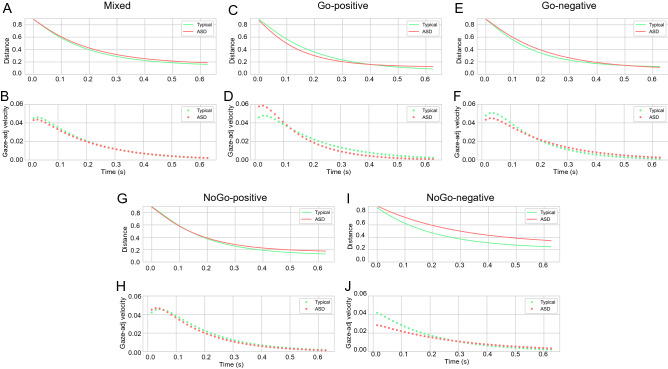
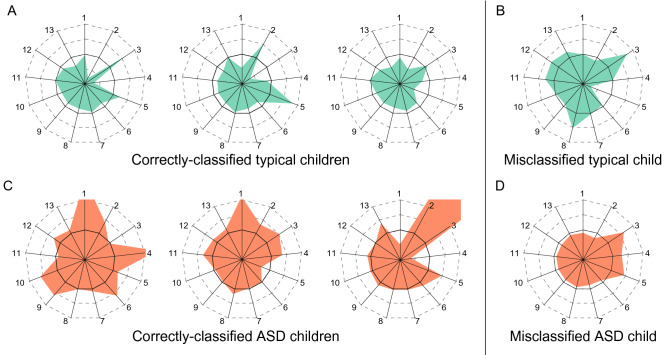
Previous studies have found that Autism Spectrum Disorder (ASD) children scored lower during a Go/No-Go task and faced difficulty focusing their gaze on the speaker's face during a conversation. To date, however, there has not been an adequate study examining children's response and gaze during the Go/No-Go task to distinguish ASD from typical children. We investigated typical and ASD children's gaze modulation when they played a version of the Go/No-Go game. The proposed system represents the Go and the No-Go stimuli as chicken and cat characters, respectively. It tracks children's gaze using an eye tracker mounted on the monitor. Statistically significant between-group differences in spatial and auto-regressive temporal gaze-related features for 21 ASD and 31 typical children suggest that ASD children had more unstable gaze modulation during the test. Using the features that differ significantly as inputs, the AdaBoost meta-learning algorithm attained an accuracy rate of 88.6% in differentiating the ASD subjects from the typical ones.
先前的研究发现,自闭症谱系障碍(ASD)儿童在 Go/No-Go 任务中得分较低,并且在对话中难以将目光集中在说话者的脸上。然而,迄今为止,还没有足够的研究来检查儿童在 Go/No-Go 任务中的反应和注视,以将 ASD 与典型儿童区分开来。我们研究了典型和 ASD 儿童在玩 Go/No-Go 游戏时的眼球调制。拟议的系统分别将 Go 和 No-Go 刺激表示为鸡和猫的角色。它使用安装在监视器上的眼动追踪器来跟踪儿童的目光。21 名 ASD 和 31 名典型儿童的空间和自回归时间眼球相关特征的组间差异具有统计学意义,表明 ASD 儿童在测试过程中眼球调制更不稳定。使用差异显著的特征作为输入,AdaBoost 元学习算法在区分 ASD 受试者和典型受试者方面的准确率达到 88.6%。