CoSys-Lab, University of Antwerp, Antwerp, Belgium.
Flanders Make, Strategic Research Centre, Lommel, Belgium.
Commun Biol. 2021 Nov 10;4(1):1275. doi: 10.1038/s42003-021-02746-2.
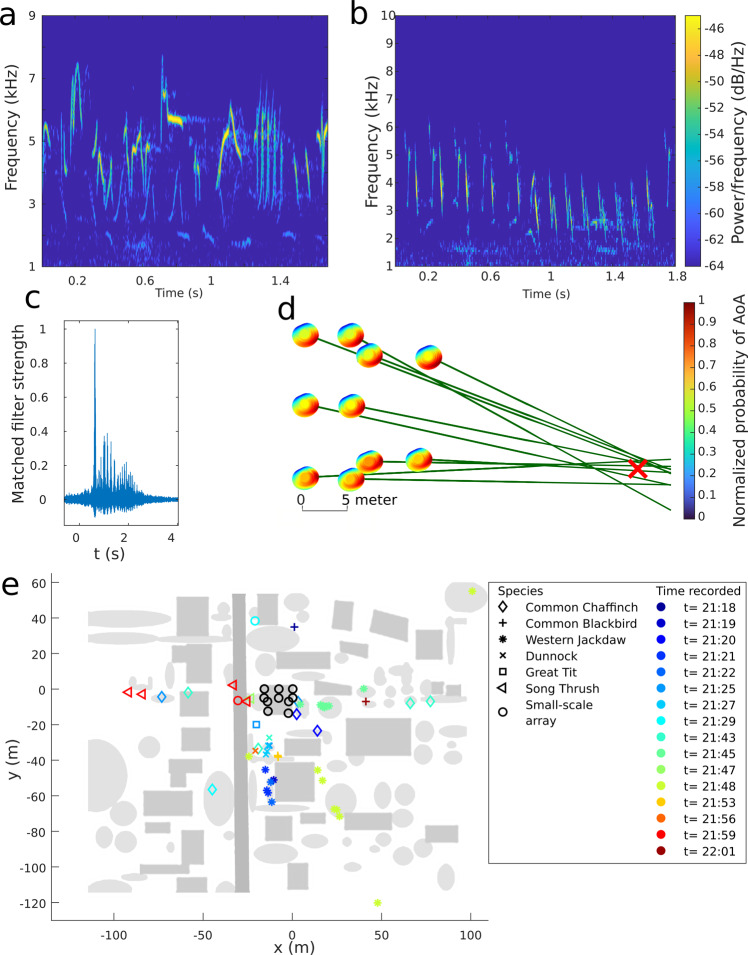
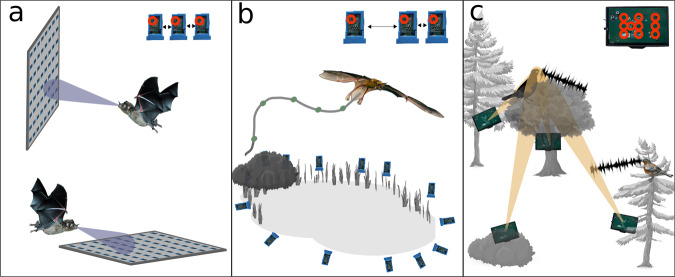
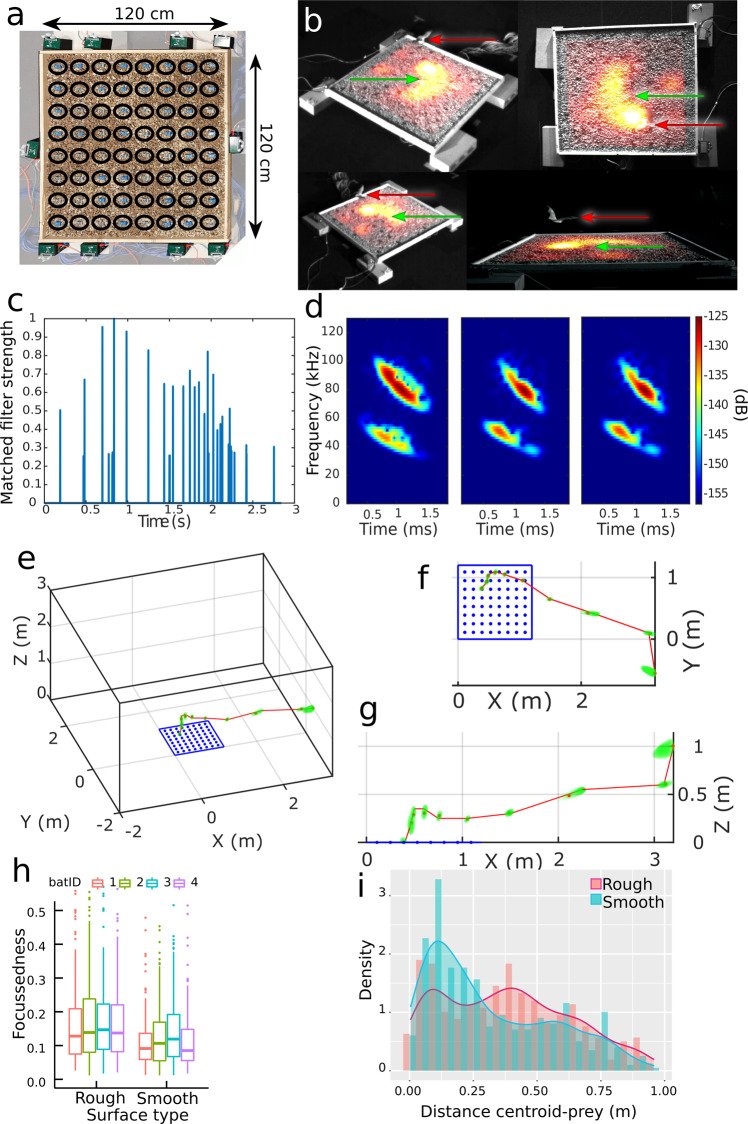
Microphone arrays are an essential tool in the field of bioacoustics as they provide a non-intrusive way to study animal vocalizations and monitor their movement and behavior. Microphone arrays can be used for passive localization and tracking of sound sources while analyzing beamforming or spatial filtering of the emitted sound. Studying free roaming animals usually requires setting up equipment over large areas and attaching a tracking device to the animal which may alter their behavior. However, monitoring vocalizing animals through arrays of microphones, spatially distributed over their habitat has the advantage that unrestricted/unmanipulated animals can be observed. Important insights have been achieved through the use of microphone arrays, such as the convergent acoustic field of view in echolocating bats or context-dependent functions of avian duets. Here we show the development and application of large flexible microphone arrays that can be used to localize and track any vocalizing animal and study their bio-acoustic behavior. In a first experiment with hunting pallid bats the acoustic data acquired from a dense array with 64 microphones revealed details of the bats' echolocation beam in previously unseen resolution. We also demonstrate the flexibility of the proposed microphone array system in a second experiment, where we used a different array architecture allowing to simultaneously localize several species of vocalizing songbirds in a radius of 75 m. Our technology makes it possible to do longer measurement campaigns over larger areas studying changing habitats and providing new insights for habitat conservation. The flexible nature of the technology also makes it possible to create dense microphone arrays that can enhance our understanding in various fields of bioacoustics and can help to tackle the analytics of complex behaviors of vocalizing animals.
麦克风阵列是生物声学领域的重要工具,因为它们提供了一种非侵入性的方式来研究动物的发声,并监测它们的运动和行为。麦克风阵列可用于被动定位和跟踪声源,同时分析发射声音的波束形成或空间滤波。研究自由漫游的动物通常需要在大面积上设置设备,并将跟踪设备附着在动物身上,这可能会改变它们的行为。然而,通过在动物栖息地空间分布的麦克风阵列监测发声动物具有不受限制/未被操纵的动物可以被观察到的优势。通过使用麦克风阵列已经取得了重要的见解,例如回声定位蝙蝠的会聚声场或鸟类二重奏的上下文相关功能。在这里,我们展示了大型灵活麦克风阵列的开发和应用,该阵列可用于定位和跟踪任何发声动物,并研究它们的生物声学行为。在第一个用猎捕苍白蝙蝠进行的实验中,从一个由 64 个麦克风组成的密集阵列中获取的声学数据揭示了蝙蝠回声定位束的细节,这些细节以前从未见过。我们还在第二个实验中展示了所提出的麦克风阵列系统的灵活性,在该实验中,我们使用了不同的阵列架构,允许在 75 米的半径内同时定位几种发声鸣禽。我们的技术使在更大的区域上进行更长时间的测量成为可能,从而研究不断变化的栖息地,并为栖息地保护提供新的见解。该技术的灵活性还使创建密集的麦克风阵列成为可能,这可以增强我们在生物声学各个领域的理解,并有助于解决发声动物复杂行为的分析问题。