
创伤性视神经病变的管理:当前实践模式的调查评估
Traumatic Optic Neuropathy Management: A Survey Assessment of Current Practice Patterns.
作者信息
Bacorn Colin, Morisada Megan V, Dedhia Raj D, Steele Toby O, Strong Edward Bradley, Lin Lily Koo
机构信息
Department of Ophthalmology and Vision Science, University of California Davis Health Eye Center, Sacramento, California.
Department of Otolaryngology - Head and Neck Surgery, University of California Davis Health, Sacramento, California, TN, USA.
出版信息
J Emerg Trauma Shock. 2021 Jul-Sep;14(3):136-142. doi: 10.4103/JETS.JETS_66_20. Epub 2021 Apr 27.
INTRODUCTION
The treatment of traumatic optic neuropathy (TON) is highly controversial with a lack of substantiated evidence to support the use of corticosteroids or surgical decompression of the optic nerve. The aim of the study was to determine if there was a general consensus in the management of TON despite controversy in the literature.
METHODS
An anonymous survey of members of the American Society of Ophthalmic Plastic and Reconstructive Surgery and the North American Neuro-Ophthalmology Society regarding their practice patterns in the management of patients with TON was performed.
RESULTS
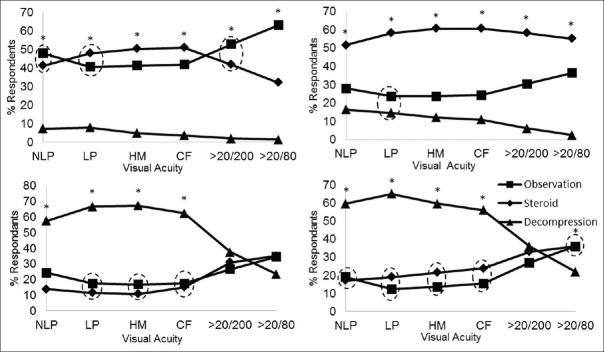
The majority of 165 respondents indicated that they treated TON with corticosteroids (60%) while a significant minority (23%) performed surgical interventions ( < 0.0001). Subgroup analysis comparing rates of treatment with steroids among oculoplastic surgeons and neuro-ophthalmologists (67% vs. 47%) was not significant (Fisher's Exact test [FET], =0.11) while results did suggest that a higher proportion of oculoplastic surgeons (33%) than neuro-ophthalmologists (11%) recommended surgical intervention (FET, =0.004). In cases where visual acuity exhibited a downward trend treatment with steroids was the most commonly employed management. In general, neuro-ophthalmologists trended toward observation over treatment in TON patients with stable visual acuity while oculoplastic surgeons favored treatment with corticosteroids.
CONCLUSIONS
In spite of the lack of class I evidence supporting intervention of TON, the majority of respondents were inclined to offer corticosteroid treatment to patients whose visual acuity showed progressive decline following injury.
引言
创伤性视神经病变(TON)的治疗极具争议,缺乏确凿证据支持使用皮质类固醇或对视神经进行手术减压。本研究的目的是确定尽管文献中存在争议,但在TON的治疗上是否存在普遍共识。
方法
对美国眼科整形与重建外科学会和北美神经眼科学会的成员进行了一项关于他们治疗TON患者的实践模式的匿名调查。
结果
165名受访者中的大多数表示他们用皮质类固醇治疗TON(60%),而少数人(23%)进行了手术干预(<0.0001)。比较眼整形外科医生和神经眼科医生使用类固醇治疗率的亚组分析(67%对47%)无显著差异(Fisher精确检验[FET],P = 0.11),而结果确实表明,推荐手术干预的眼整形外科医生比例(33%)高于神经眼科医生(11%)(FET,P = 0.004)。在视力呈下降趋势的病例中,使用类固醇治疗是最常用的处理方法。总体而言,对于视力稳定的TON患者,神经眼科医生倾向于观察而非治疗,而眼整形外科医生则倾向于用皮质类固醇治疗。
结论
尽管缺乏支持TON干预的I类证据,但大多数受访者倾向于对受伤后视力呈进行性下降的患者提供皮质类固醇治疗。



 Zotero 插件