LaCroix Arianna N, James Eltonnelle, Rogalsky Corianne
College of Health Sciences, Midwestern University, Glendale, AZ, United States.
College of Health Solutions, Arizona State University, Tempe, AZ, United States.
Front Hum Neurosci. 2021 Oct 25;15:680933. doi: 10.3389/fnhum.2021.680933. eCollection 2021.
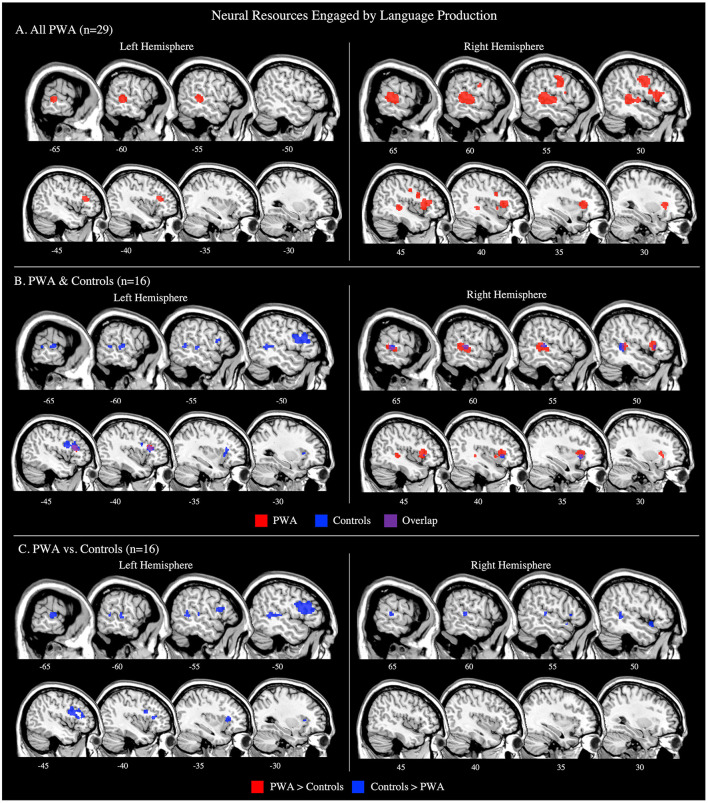
In post-stroke aphasia, language tasks recruit a combination of residual regions within the canonical language network, as well as regions outside of it in the left and right hemispheres. However, there is a lack of consensus as to how the neural resources engaged by language production and comprehension following a left hemisphere stroke differ from one another and from controls. The present meta-analysis used activation likelihood estimates to aggregate across 44 published fMRI and PET studies to characterize the functional reorganization patterns for expressive and receptive language processes in persons with chronic post-stroke aphasia (PWA). Our results in part replicate previous meta-analyses: we find that PWA activate residual regions within the left lateralized language network, regardless of task. Our results extend this work to show differential recruitment of the left and right hemispheres during language production and comprehension in PWA. First, we find that PWA engage left perilesional regions during language comprehension, and that the extent of this activation is likely driven by stimulus type and domain-general cognitive resources needed for task completion. In contrast to comprehension, language production was associated with activation of the right frontal and temporal cortices. Further analyses linked right hemisphere regions involved in motor speech planning for language production with successful naming in PWA, while unsuccessful naming was associated with the engagement of the right inferior frontal gyrus, a region often implicated in domain-general cognitive processes. While the within-group findings indicate that the engagement of the right hemisphere during language tasks in post-stroke aphasia differs for expressive vs. receptive tasks, the overall lack of major between-group differences between PWA and controls implies that PWA rely on similar cognitive-linguistic resources for language as controls. However, more studies are needed that report coordinates for PWA and controls completing the same tasks in order for future meta-analyses to characterize how aphasia affects the neural resources engaged during language, particularly for specific tasks and as a function of behavioral performance.
在中风后失语症中,语言任务会调动典型语言网络内的残余区域组合,以及左右半球中该网络之外的区域。然而,对于左半球中风后语言产生和理解所涉及的神经资源如何彼此不同以及与对照组不同,目前尚无共识。本荟萃分析使用激活可能性估计,汇总了44项已发表的功能磁共振成像(fMRI)和正电子发射断层扫描(PET)研究,以描述慢性中风后失语症患者(PWA)表达性和接受性语言过程的功能重组模式。我们的结果部分重复了先前的荟萃分析:我们发现,无论任务如何,PWA都会激活左侧化语言网络内的残余区域。我们的结果扩展了这项工作,以显示PWA在语言产生和理解过程中左右半球的不同调动情况。首先,我们发现PWA在语言理解过程中会调动左侧病灶周围区域,并且这种激活程度可能由刺激类型和任务完成所需的领域通用认知资源驱动。与理解相反,语言产生与右侧额叶和颞叶皮质的激活有关。进一步的分析将参与语言产生的运动言语规划的右半球区域与PWA中的成功命名联系起来,而不成功的命名与右侧额下回的参与有关,该区域通常涉及领域通用认知过程。虽然组内研究结果表明,中风后失语症患者在语言任务中右半球的参与在表达性任务和接受性任务中有所不同,但PWA与对照组之间总体上缺乏主要的组间差异,这意味着PWA在语言方面依赖于与对照组相似的认知语言资源。然而,需要更多的研究报告PWA和对照组完成相同任务的坐标,以便未来的荟萃分析能够描述失语症如何影响语言过程中所涉及的神经资源,特别是针对特定任务以及作为行为表现的函数。