Khandanpour Cyrus, Eisfeld Christine, Nimmagadda Subbaiah Chary, Raab Marc S, Weinhold Niels, Seckinger Anja, Hose Dirk, Jauch Anna, Försti Asta, Hemminki Kari, Hielscher Thomas, Hummel Manuela, Lenz Georg, Goldschmidt Hartmut, Huhn Stefanie
Department of Medicine A, Hematology, Oncology and Pneumology, University Hospital Münster, Münster, Germany.
Department of Hematology, Oncology and Rheumatology, University Hospital Heidelberg, Heidelberg, Germany.
Front Oncol. 2021 Oct 25;11:757664. doi: 10.3389/fonc.2021.757664. eCollection 2021.
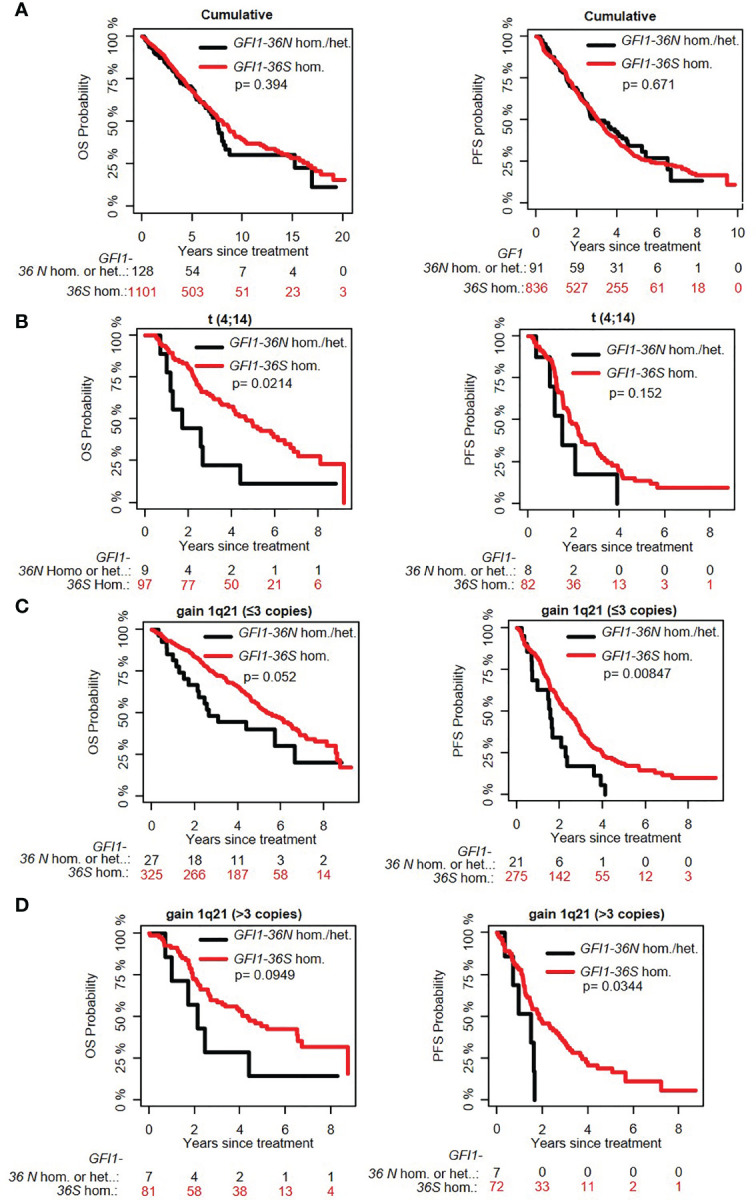
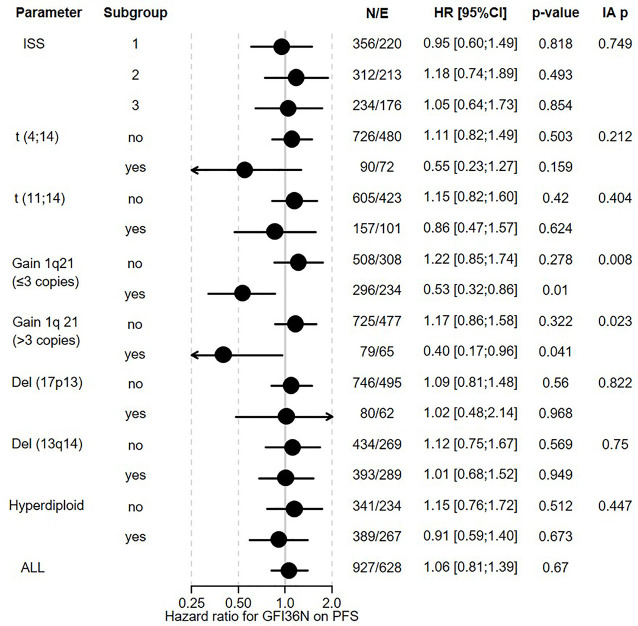
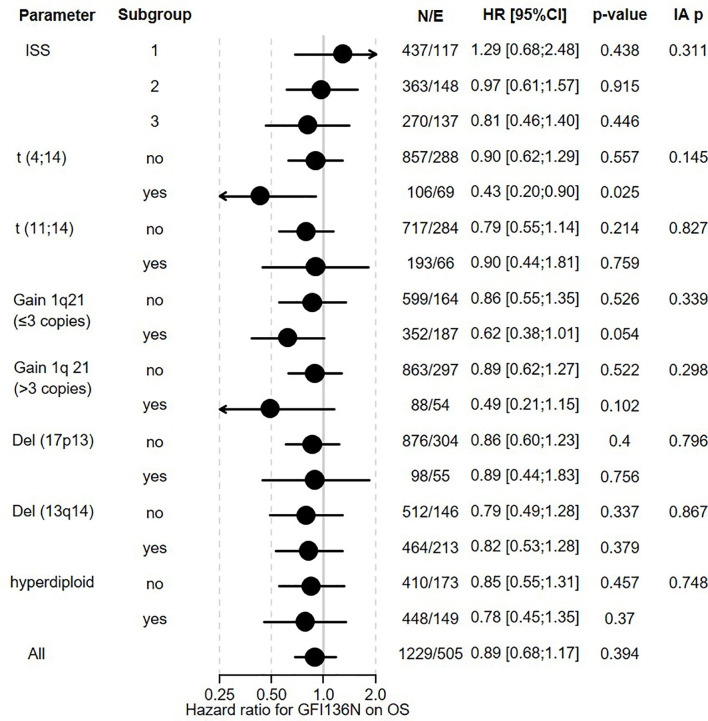
Transcription factor Growth Factor Independence 1 (GFI1) regulates the expression of genes important for survival, proliferation and differentiation of hematopoietic cells. A single nucleotide polymorphism (SNP) variant of GFI1 (GFI1-36N: serine replaced by asparagine at position 36), has a prevalence of 5-7% among healthy Caucasians and 10-15% in patients with myelodysplastic syndrome (MDS) and acute myeloid leukaemia (AML) predisposing GFI-36N carriers to these diseases. Since GFI1 is implicated in B cell maturation and plasma cell (PC) development, we examined its prevalence in patients with multiple myeloma (MM), a haematological malignancy characterized by expansion of clonal PCs. Strikingly, as in MDS and AML, we found that the GFI1-36N had a higher prevalence among MM patients compared to the controls. In subgroup analyses, GFI1-36N correlates to a shorter overall survival of MM patients characterized by the presence of t(4;14) translocation and gain of 1q21 (≤3 copies). MM patients carrying gain of 1q21 (≥3 copies) demonstrated poor progression free survival. Furthermore, gene expression analysis implicated a role for GFI1-36N in epigenetic regulation and metabolism, potentially promoting the initiation and progression of MM.
转录因子生长因子独立性1(GFI1)调节对造血细胞的存活、增殖和分化至关重要的基因的表达。GFI1的一个单核苷酸多态性(SNP)变体(GFI1-36N:第36位丝氨酸被天冬酰胺取代)在健康白种人中的患病率为5%-7%,在骨髓增生异常综合征(MDS)和急性髓系白血病(AML)患者中的患病率为10%-15%,使GFI-36N携带者易患这些疾病。由于GFI1与B细胞成熟和浆细胞(PC)发育有关,我们研究了其在多发性骨髓瘤(MM)患者中的患病率,MM是一种以克隆性PC扩增为特征的血液系统恶性肿瘤。令人惊讶的是,与MDS和AML一样,我们发现MM患者中GFI1-36N的患病率高于对照组。在亚组分析中,GFI1-36N与以t(4;14)易位和1q21增益(≤3个拷贝)为特征的MM患者较短的总生存期相关。携带1q21增益(≥3个拷贝)的MM患者无进展生存期较差。此外,基因表达分析表明GFI1-36N在表观遗传调控和代谢中起作用,可能促进MM的发生和发展。