Department of Cardiology, Cardiovascular Center, Military Hospital 103, Hanoi, Vietnam.
Director Office, Military Hospital 103, Hanoi, Vietnam.
Ann Med. 2021 Dec;53(1):2120-2131. doi: 10.1080/07853890.2021.2001044.
The COVID-19 pandemic has been influencing people's psychological health, especially in pregnant women. We aimed to examine associated factors of fear of COVID-19, anxiety and depression among pregnant women during the pandemic where the impacts of healthy eating behaviour (HES) and health literacy (HL) were emphasized.
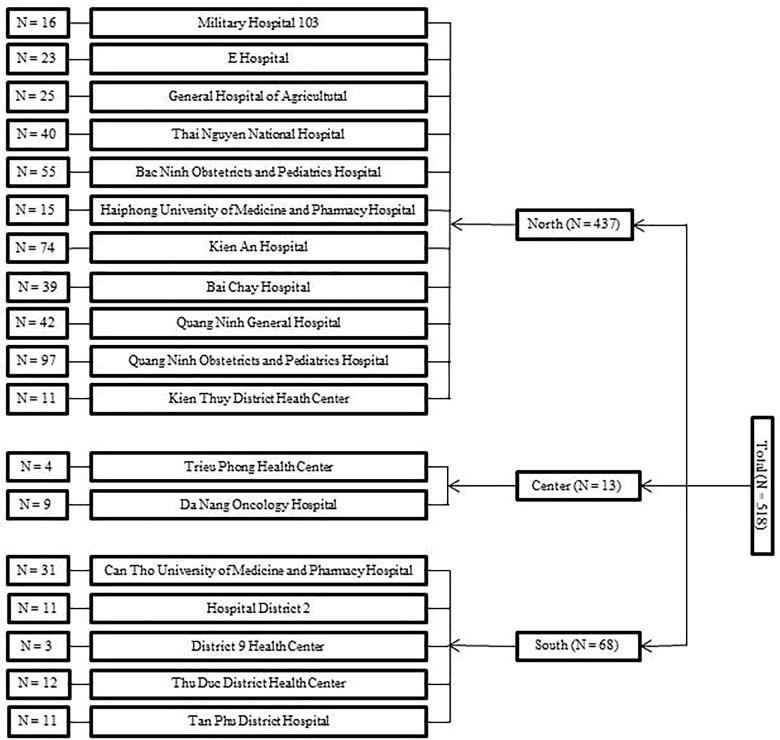
A cross-sectional study was conducted between 14 February 2020 and 31 May 2020 in 18 health centres and hospitals across Vietnam. Data of 518 pregnant women were analysed, including socio-demographics, pregnant-related factors, HES, HL, health-related behaviours, fear of COVID-19 scale (FCoV-19S), anxiety (using the generalized anxiety disorder (GAD-7)) and depression (using the patient health questionnaire with 9 items (PHQ-9)). Regression analysis was utilized to explore the associations.
Pregnant women with higher scores of HES and HL had lower likelihood of anxiety (odds ratio, OR, 0.79; 95% confidence interval (95%CI), 0.73, 0.87; < .001; and OR, 0.94; 95%CI, 0.90, 0.99; = .018) and depression (OR, 0.84; 95%CI, 0.78, 0.91; < .001; and OR, 0.96; 95%CI, 0.91, 0.99; = .044), respectively. Pregnant women being employed had a lower FCoV-19S score (regression coefficient, , -1.46; 95%CI, -2.51, -0.40; = .007). Besides, other significant predictors of anxiety were eating healthier during the pandemic, unchanged or more physical activity, elevated gestational age and smoking. Other significant predictors of depression were eating healthier during the pandemic, elevated gestational age and smoking.
Among others, HES and HL had positive impacts on protecting pregnant women against anxiety and depression. Improving HES and HL should be addressed as a strategic approach to improve reproductive health during the pandemic.KEY MESSAGEThe COVID-19 pandemic influences antenatal mental disorders with the higher level as opposed to that before the pandemic.Healthy eating behaviour and better health literacy (HL) had critical roles in lowering prenatal anxiety and depression during the COVID-19 crisis.Strategic approaches for improving healthy eating and HL should be recommended for protecting pregnant women from mental health problems during the pandemic.
COVID-19 大流行一直影响着人们的心理健康,尤其是孕妇。我们旨在研究 COVID-19 大流行期间孕妇对 COVID-19 的恐惧、焦虑和抑郁的相关因素,在此期间强调了健康饮食行为(HES)和健康素养(HL)的影响。
这是一项在 2020 年 2 月 14 日至 2020 年 5 月 31 日期间在越南 18 个卫生中心和医院进行的横断面研究。分析了 518 名孕妇的数据,包括社会人口统计学、与怀孕相关的因素、HES、HL、健康相关行为、对 COVID-19 的恐惧量表(FCoV-19S)、焦虑(使用广泛性焦虑障碍(GAD-7))和抑郁(使用包含 9 个项目的患者健康问卷(PHQ-9))。回归分析用于探索关联。
HES 和 HL 得分较高的孕妇焦虑(比值比,OR,0.79;95%置信区间(95%CI),0.73,0.87; < .001;和 OR,0.94;95%CI,0.90,0.99; = .018)和抑郁(OR,0.84;95%CI,0.78,0.91; < .001;和 OR,0.96;95%CI,0.91,0.99; = .044)的可能性较低。有工作的孕妇 FCoV-19S 评分较低(回归系数, ,-1.46;95%CI,-2.51,-0.40; = .007)。此外,焦虑的其他显著预测因素是在大流行期间更健康地饮食、保持或增加体力活动、更高的胎龄和吸烟。抑郁的其他显著预测因素是在大流行期间更健康地饮食、更高的胎龄和吸烟。
除其他外,HES 和 HL 对保护孕妇免受焦虑和抑郁有积极影响。在大流行期间,应重视改善 HES 和 HL,将其作为改善生殖健康的战略方法。
COVID-19 大流行对产前精神障碍产生影响,其程度高于大流行前。
健康饮食行为和更好的健康素养(HL)在降低 COVID-19 危机期间产前焦虑和抑郁方面发挥着关键作用。
在大流行期间,应推荐改善健康饮食和 HL 的战略方法,以保护孕妇免受心理健康问题的影响。