Langer Henning T, Avey Alec, Baar Keith
Department of Physiology and Membrane Biology, Physiology and Behavior, University of California, Davis, California, USA.
Department of Neurobiology, Physiology and Behavior, University of California, Davis, California, USA.
Cannabis Cannabinoid Res. 2022 Oct;7(5):628-636. doi: 10.1089/can.2021.0132. Epub 2021 Nov 11.
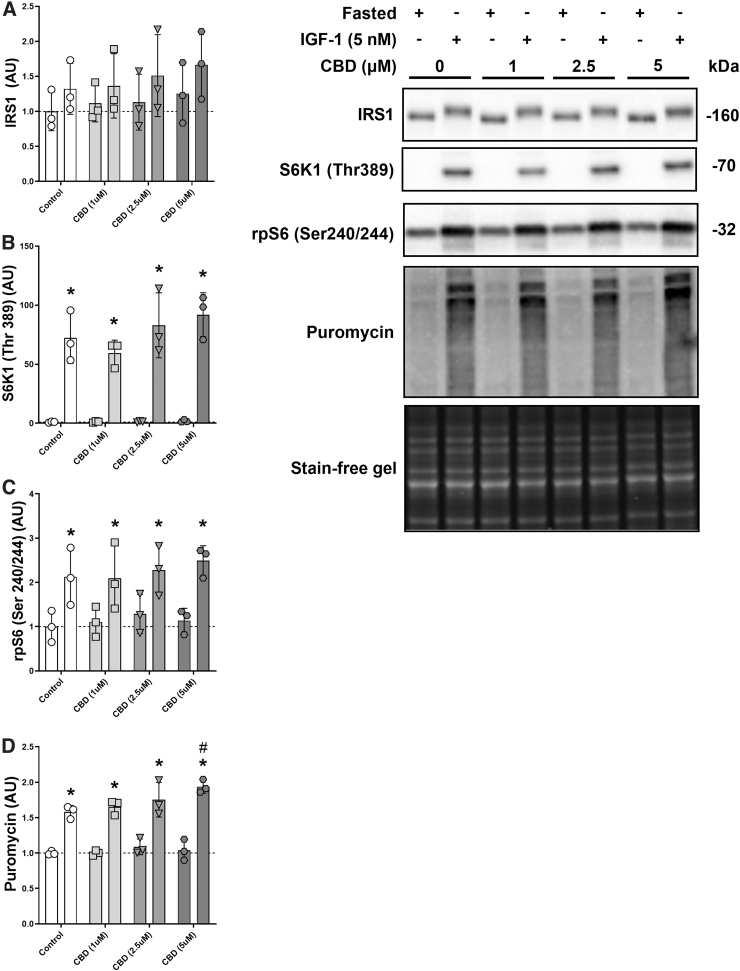
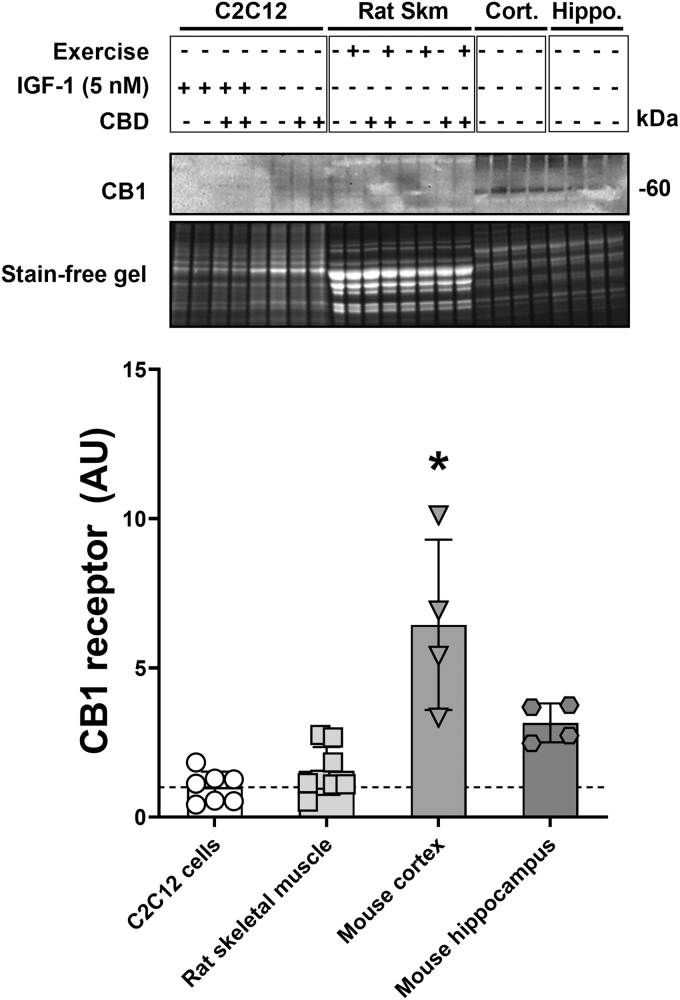
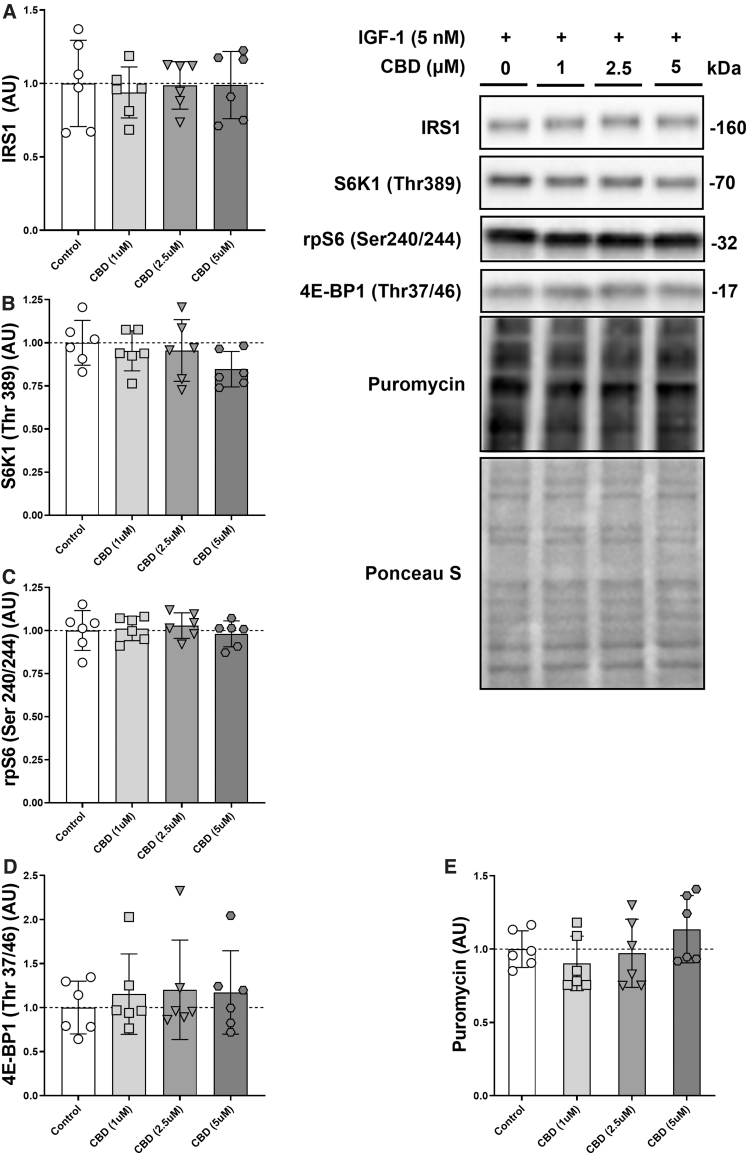
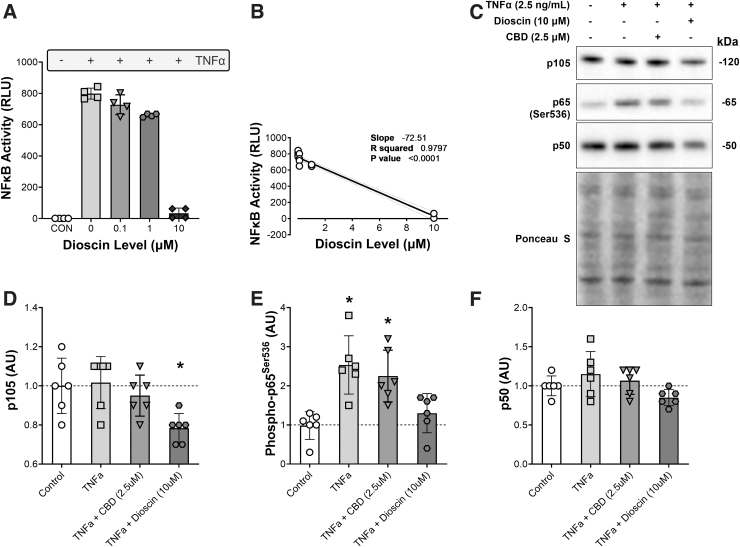
Cannabidiol (CBD) is becoming increasingly popular for the treatment of clinical conditions including as an aid for muscle recovery. Previous work demonstrated that CBD exhibited mild effects on skeletal muscle, with a tendency to increase anabolic signaling and decrease inflammatory signaling. To gain mechanistic insight and extend these findings, we conducted a set of experiments using C2C12 myotubes. Increasing the dose of CBD (1-5 μM) provided with insulin-like growth factor 1 (IGF-1) showed no effect on anabolic signaling through mTORC1 (S6K1 [Thr389], =0.27; rpS6 [Ser240/244], =0.81; or 4E-BP1 [Thr37/46], =0.87). Similarly, inflammatory signaling through nuclear factor kappa B (NF-κB) (p105, =0.88; p50, =0.93; or phosphorylated p65 [Ser536], =0.84) in response to tumor necrosis factor α (TNFα) was unaffected by CBD (2.5 μM), whereas dioscin, a natural product that blocks NF-κB signaling, reduced p105 and phosphorylated p65 (Ser536) compared with the TNFα and the TNFα + CBD condition (<0.01 and <0.05, respectively). Finally, cannabinoid receptor type 1 (CB1) receptor levels were measured in C2C12 cells, murine skeletal muscle, cortex, and hippocampus. Although CB1 was not detectable in muscle cells or muscle tissue, high levels were observed in brain tissue. In conclusion, CBD does not directly modulate anabolic or inflammatory signaling in myotubes , which can likely be explained by the lack of functional receptors.
大麻二酚(CBD)在治疗包括辅助肌肉恢复在内的临床病症方面越来越受欢迎。先前的研究表明,CBD对骨骼肌有轻微影响,有增加合成代谢信号和减少炎症信号的趋势。为了深入了解其作用机制并扩展这些发现,我们使用C2C12肌管进行了一系列实验。增加与胰岛素样生长因子1(IGF-1)一起使用的CBD剂量(1-5μM)对通过mTORC1的合成代谢信号没有影响(S6K1 [Thr389],=0.27;rpS6 [Ser240/244],=0.81;或4E-BP1 [Thr37/46],=0.87)。同样,响应肿瘤坏死因子α(TNFα)通过核因子κB(NF-κB)的炎症信号(p105,=0.88;p50,=0.93;或磷酸化p65 [Ser536],=0.84)不受CBD(2.5μM)影响,而薯蓣皂苷,一种阻断NF-κB信号的天然产物,与TNFα和TNFα + CBD条件相比,降低了p105和磷酸化p65(Ser536)(分别<0.01和<0.05)。最后,在C2C12细胞、小鼠骨骼肌、皮质和海马体中测量了1型大麻素受体(CB1)的水平。虽然在肌肉细胞或肌肉组织中未检测到CB1,但在脑组织中观察到高水平。总之,CBD不会直接调节肌管中的合成代谢或炎症信号,这可能可以通过缺乏功能性受体来解释。