Programa de Pós-graduação em Nutrição, Escola Paulista de Medicina, Universidade Federal de São Paulo, São Paulo, SP, Brasil,
Programa de Pós-graduação em Nutrição, Escola Paulista de Medicina, Universidade Federal de São Paulo, São Paulo, SP, Brasil.
Arch Endocrinol Metab. 2021 Nov 24;65(6):821-831. doi: 10.20945/2359-3997000000419. Epub 2021 Nov 11.
To investigate the effects of an interdisciplinary intervention on biomarkers of inflammation and their relationship with fibroblast growth factor 21 (FGF21) concentrations in women with overweight and obesity.
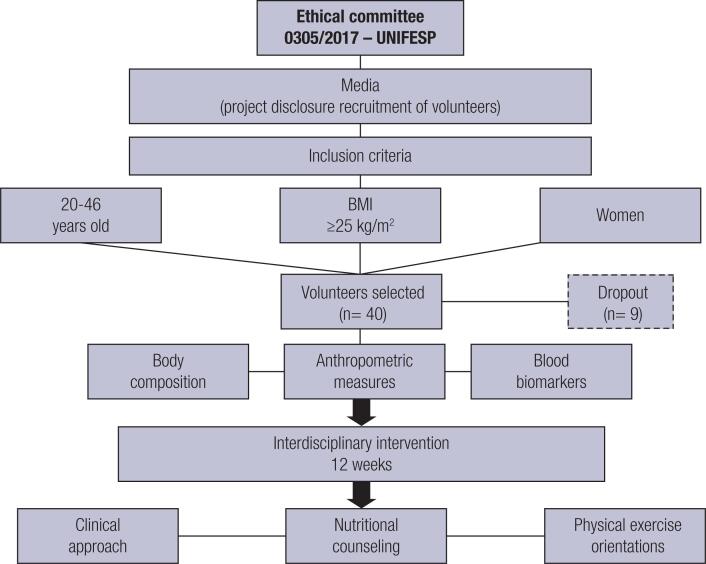
Thirty-one women were enrolled in a 12-week interdisciplinary weight loss program delivered by a team comprising an endocrinologist, nutritionist and exercise physiologist. Body composition; anthropometric measures; metabolic and inflammatory markers including adiponectin, leptin, and atrial natriuretic peptide (ANP) were assessed at baseline and post-therapy. The homeostasis model assessment of insulin resistance (HOMA-IR) and the homeostasis model assessment of adiponectin (HOMA-AD) were calculated. The participants were divided into two groups: those with increased FGF21, and those with decreased FGF21.
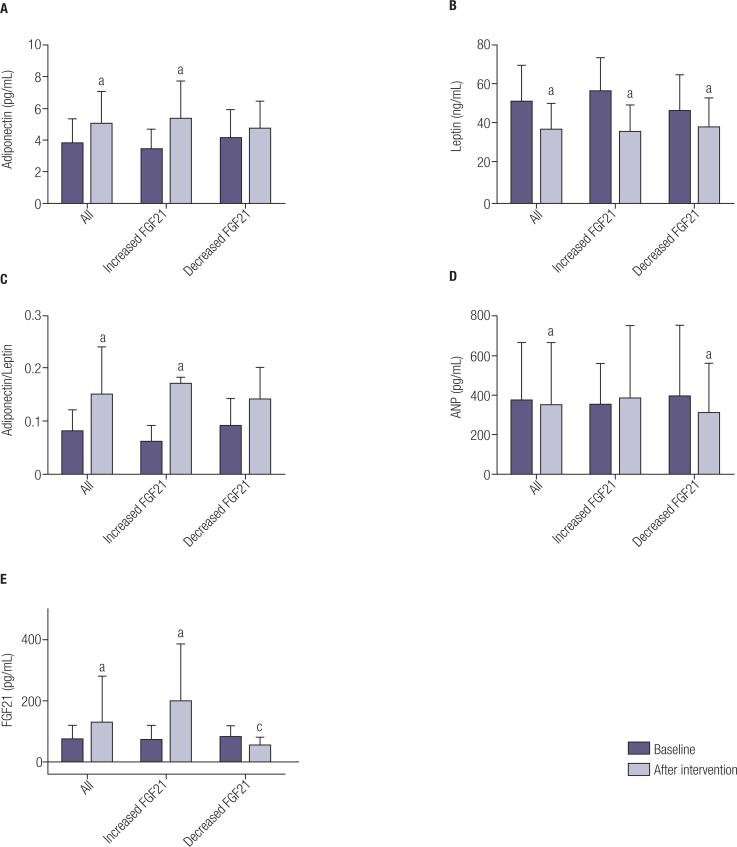
The sample comprised women aged 32 ± 5 years with a body mass index of 33.64 ± 3.49 kg/m. Body weight, waist circumference and leptin concentration were decreased in the whole sample after therapy. However, only the group with an increase in FGF21 concentration presented significant improvements in adiponectin concentration and adiponectin/leptin ratio. Moreover, although there was a reduction of leptin in both groups, it was greater in the increased FGF21 groups. There was a reduction in ANP in the decreased FGF21 group.
Changes in FGF21 concentrations were different among the women participating in the weight loss program, with some having increased levels and some reduced levels. Furthermore, improvements in adiponectin and the adiponectin/leptin ratio were found only in the group with increased FGF21 concentration.
研究跨学科干预对超重和肥胖女性炎症生物标志物及其与成纤维细胞生长因子 21(FGF21)浓度的关系的影响。
31 名女性参加了为期 12 周的跨学科减肥计划,该计划由内分泌学家、营养师和运动生理学家组成的团队提供。在基线和治疗后评估身体成分;人体测量指标;代谢和炎症标志物,包括脂联素、瘦素和心钠肽(ANP)。计算胰岛素抵抗的稳态模型评估(HOMA-IR)和脂联素的稳态模型评估(HOMA-AD)。将参与者分为两组:FGF21 升高组和 FGF21 降低组。
样本包括年龄 32 ± 5 岁、体重指数 33.64 ± 3.49 kg/m 的女性。治疗后,整个样本的体重、腰围和瘦素浓度均降低。然而,只有 FGF21 浓度增加组的脂联素浓度和脂联素/瘦素比值显著改善。此外,尽管两组的瘦素均有所下降,但 FGF21 浓度增加组的下降幅度更大。FGF21 浓度降低组的 ANP 减少。
参加减肥计划的女性的 FGF21 浓度变化不同,有些升高,有些降低。此外,仅在 FGF21 浓度增加组中发现脂联素和脂联素/瘦素比值的改善。