Cardiovascular Epidemiology Unit, University of Cambridge Department of Public Health and Primary Care, Cambridge, UK.
Department of Public Health and Primary Care, University of Cambridge, Cambridge, UK.
BMJ Open. 2021 Nov 11;11(11):e053392. doi: 10.1136/bmjopen-2021-053392.
The purpose of this systematic review is to explore whether health equity audits (HEAs) are effective in improving the equity of service provision and reducing health inequalities.
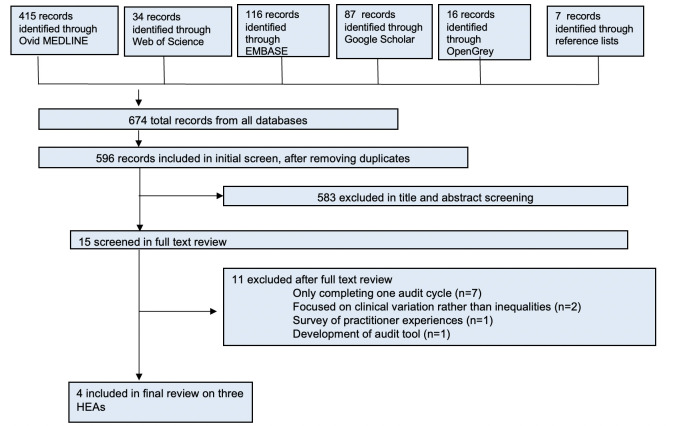
Three databases (Ovid Medline, Embase, Web of Science) and grey literature (Opengrey, Google Scholar) were systematically searched for articles published after 2000, reporting on the effectiveness of HEA. Title and abstracts were screened according to an eligibility criteria to identify studies which included a full audit cycle (eg, initial equity analysis, service changes and review). Data were extracted from studies meeting the eligibility criteria after full text review and risk of bias assessed using the ROBINS-I tool.
The search strategy identified 596 articles. Fifteen records were reviewed in full text and three records were included in final review. An additional HEA report was identified through contact with an author. Three different HEAs were included from one peer-reviewed journal article, two published reports and one unpublished report (n=4 records on n=3 HEAs). This included 102 851 participants and over 148 practices/pharmacies (information was not recorded for all records). One study reviewed health equity impacts of HEA implementation in key indicators for coronary heart disease, type 2 diabetes and chronic obstructive pulmonary disease. Two HEAs explored Stop Smoking Services on programme access and equity. All reported some degree of reduction in health inequalities compared with prior HEA implementation. However, impact of HEA implementation compared with other concurrent programmes and initiatives was unclear. All included studies were judged to have moderate to serious risk of bias.
There is an urgent need to identify effective interventions to address health inequalities. While HEAs are recommended, we only identified limited weak evidence to support their use. More evidence is needed to explore whether HEA implementation can reduce inequalities and which factors are influencing effectiveness.
The study was registered prior to its conduction in PROSPERO (CRD 42020218642).
本系统评价旨在探讨健康公平审计(HEA)是否能有效提高服务提供的公平性,减少健康不平等。
系统检索了 Ovid Medline、Embase 和 Web of Science 三个数据库以及灰色文献(Opengrey、Google Scholar),以寻找 2000 年后发表的报告 HEA 有效性的文章。根据入选标准筛选标题和摘要,以确定包括完整审计周期(如初始公平性分析、服务变更和审查)的研究。在全文审查后,从符合入选标准的研究中提取数据,并使用 ROBINS-I 工具评估偏倚风险。
搜索策略确定了 596 篇文章。15 篇记录进行了全文审查,3 篇记录纳入最终审查。通过与作者联系,确定了另外 1 篇 HEA 报告。从 1 篇同行评议期刊文章、2 篇发表报告和 1 篇未发表报告中纳入了 3 项不同的 HEA(共 4 项记录,涉及 3 项 HEA),共纳入了 102851 名参与者和超过 148 个实践/药房(并非所有记录都记录了相关信息)。其中 1 项研究审查了 HEA 实施对冠心病、2 型糖尿病和慢性阻塞性肺疾病关键指标的健康公平影响。2 项 HEA 探索了戒烟服务对项目准入和公平性的影响。所有报告均显示与之前的 HEA 实施相比,健康不平等程度有所降低。然而,与其他同期方案和举措相比,HEA 实施的影响尚不清楚。所有纳入的研究均被判定为存在中度至严重偏倚风险。
迫切需要确定有效的干预措施来解决健康不平等问题。虽然推荐使用 HEA,但我们只发现了有限的支持其使用的微弱证据。需要更多的证据来探索 HEA 实施是否可以减少不平等,以及哪些因素在影响有效性。
本研究在进行之前已在 PROSPERO(CRD42020218642)注册。