Li Ran, Zhu Xiaoyi, Zhang Mengxi, Zong Guannan, Zhang Keqin
Department of Endocrinology and Metabolism, Tongji Hospital, School of Medicine, Tongji University, Shanghai, 200065, People's Republic of China.
Institute of Osteoporosis and Metabolic Bone Diseases, School of Medicine, Tongji University, Shanghai, 200065, People's Republic of China.
Int J Gen Med. 2021 Nov 3;14:7639-7646. doi: 10.2147/IJGM.S335296. eCollection 2021.
It has been reported that serum periostin levels are significantly higher in postmenopausal patients with osteoporotic fractures. Nonetheless, the levels of serum periostin in postmenopausal women with different bone mass remain unclear.
The objective of the study was to identify the levels of serum periostin in Chinese postmenopausal women with different bone mass, and the correlations between the periostin levels and the classical bone turnover markers (BTMs), and bone mineral densities (BMDs) at different sites.
This study enrolled 331 Chinese postmenopausal women in Shanghai; their clinical features were collected; their levels of serum periostin and traditional BTMs were measured by ELISA or the fully automated immunoassay analyzer; their BMDs at different sites were measured by dual-energy X-ray absorptiometry (DXA).
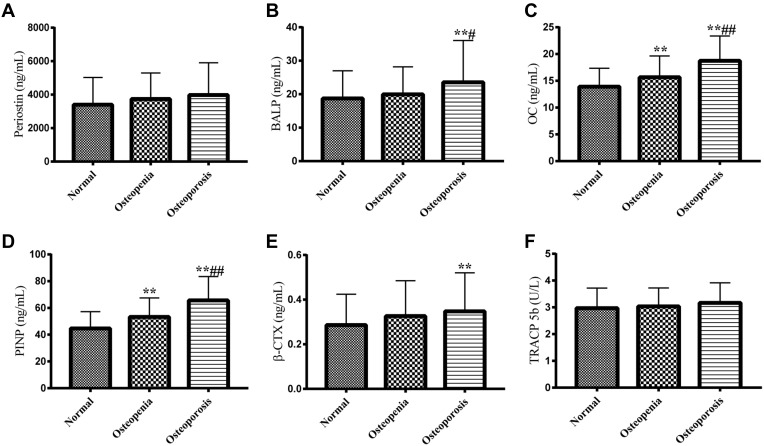
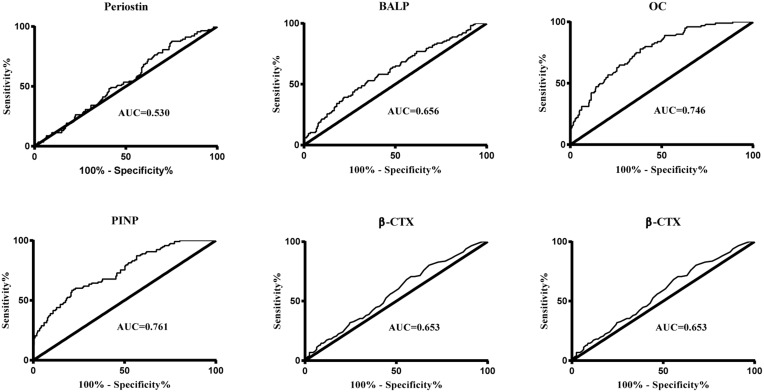
According to the -value of bone mineral density (BMD), these postmenopausal women were divided into normal group (n=84), osteopenia group (n=126) and osteoporosis group (n=121). There was no significant difference in the serum periostin levels among the above three groups of subjects. In addition, Spearman correlation analysis also revealed that no correlation was observed between the value of serum periostin and those of traditional BTMs, and BMDs at different sites, respectively. The values of traditional BTMs were negatively correlated with those of BMDs at all measured sites. Furthermore, the receiver-operating characteristic (ROC) curves analysis indicated that among the periostin and traditional BTMs mentioned above, the best predictors for postmenopausal osteoporosis in Shanghai Chinese postmenopausal women were osteocalcin (OC) and procollagen type 1 N-terminal propeptide (P1NP) [the areas under the ROC curve (AUC)=0.746 and 0.761, respectively].
Serum periostin may not be used as a marker of systemic bone metabolism in Shanghai Chinese postmenopausal women without prior fracture. In addition, serum P1NP and OC levels may be the predictors of osteoporosis occurrence in Chinese postmenopausal women.
据报道,绝经后骨质疏松性骨折患者的血清骨膜蛋白水平显著升高。然而,不同骨量的绝经后女性血清骨膜蛋白水平尚不清楚。
本研究旨在确定不同骨量的中国绝经后女性血清骨膜蛋白水平,以及骨膜蛋白水平与经典骨转换标志物(BTMs)和不同部位骨密度(BMDs)之间的相关性。
本研究纳入了331名上海的中国绝经后女性;收集了她们的临床特征;通过酶联免疫吸附测定(ELISA)或全自动免疫分析仪测量她们的血清骨膜蛋白和传统BTMs水平;通过双能X线吸收法(DXA)测量她们不同部位的骨密度。
根据骨密度(BMD)的T值,这些绝经后女性被分为正常组(n=84)、骨量减少组(n=126)和骨质疏松组(n=121)。上述三组受试者的血清骨膜蛋白水平无显著差异。此外,Spearman相关性分析还显示,血清骨膜蛋白值与传统BTMs值以及不同部位的BMD值之间均未观察到相关性。传统BTMs值与所有测量部位的BMD值呈负相关。此外,受试者工作特征(ROC)曲线分析表明,在上述骨膜蛋白和传统BTMs中,上海中国绝经后女性绝经后骨质疏松的最佳预测指标是骨钙素(OC)和I型前胶原N端前肽(P1NP)[ROC曲线下面积(AUC)分别为0.746和0.761]。
血清骨膜蛋白可能不能作为未发生过骨折且居住在上海的中国绝经后女性全身骨代谢的标志物。此外,血清P1NP和OC水平可能是中国绝经后女性骨质疏松发生的预测指标。