Saccaro Luigi F, Aimo Alberto, Emdin Michele, Pico Fernando
Neurology and Stroke Care Unit, Versailles Hospital, Le Chesnay, France.
Institute of Life Sciences, Scuola Superiore Sant'Anna, Pisa, Italy.
Front Neurol. 2021 Oct 26;12:716316. doi: 10.3389/fneur.2021.716316. eCollection 2021.
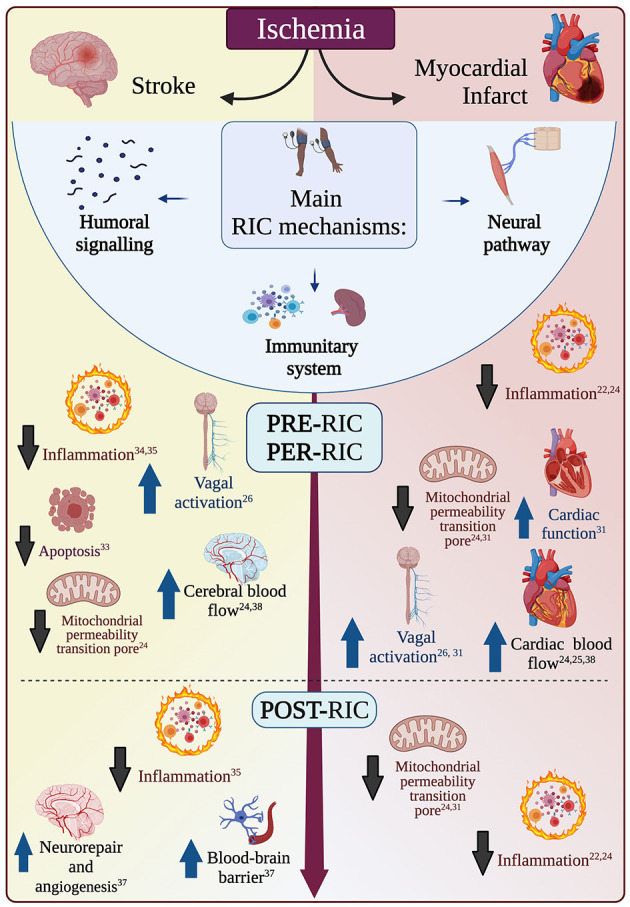
Acute myocardial infarction and ischemic stroke are leading causes of morbidity and mortality worldwide. Although reperfusion therapies have greatly improved the outcomes of patients with these conditions, many patients die or are severely disabled despite complete reperfusion. It is therefore important to identify interventions that can prevent progression to ischemic necrosis and limit ischemia-reperfusion injury. A possible strategy is ischemic conditioning, which consists of inducing ischemia - either in the ischemic organ or in another body site [i.e., remote ischemic conditioning (RIC), e.g., by inflating a cuff around the patient's arm or leg]. The effects of ischemic conditioning have been studied, alone or in combination with revascularization techniques. Based on the timing (before, during, or after ischemia), RIC is classified as pre-, per-/peri-, or post-conditioning, respectively. In this review, we first highlight some pathophysiological and clinical similarities and differences between cardiac and cerebral ischemia. We report evidence that RIC reduces circulating biomarkers of myocardial necrosis, infarct size, and edema, although this effect appears not to translate into a better prognosis. We then review cutting-edge applications of RIC for the treatment of ischemic stroke. We also highlight that, although RIC is a safe procedure that can easily be implemented in hospital and pre-hospital settings, its efficacy in patients with ischemic stroke remains to be proven. We then discuss possible methodological issues of previous studies. We finish by highlighting some perspectives for future research, aimed at increasing the efficacy of ischemic conditioning for improving tissue protection and clinical outcomes, and stratifying myocardial infarction and brain ischemia patients to enhance treatment feasibility.
急性心肌梗死和缺血性中风是全球发病和死亡的主要原因。尽管再灌注疗法极大地改善了患有这些疾病患者的预后,但许多患者尽管实现了完全再灌注,仍会死亡或严重致残。因此,确定能够预防进展为缺血性坏死并限制缺血再灌注损伤的干预措施非常重要。一种可能的策略是缺血预处理,它包括在缺血器官或身体其他部位诱导缺血(即远程缺血预处理(RIC),例如通过给患者的手臂或腿部戴上袖带充气)。已经对缺血预处理的效果进行了单独或与血管重建技术联合的研究。根据时间(缺血前、缺血期间或缺血后),RIC分别被分类为预处理、围/术中预处理或后处理。在本综述中,我们首先强调心脏和脑缺血之间在病理生理和临床方面的一些异同。我们报告了证据表明RIC可降低心肌坏死、梗死面积和水肿的循环生物标志物,尽管这种效果似乎并未转化为更好的预后。然后,我们综述了RIC在缺血性中风治疗中的前沿应用。我们还强调,尽管RIC是一种安全的程序,可以很容易地在医院和院前环境中实施,但其在缺血性中风患者中的疗效仍有待证实。接着,我们讨论了先前研究可能存在的方法学问题。最后,我们强调了未来研究的一些观点,旨在提高缺血预处理改善组织保护和临床结果的疗效,并对心肌梗死和脑缺血患者进行分层以提高治疗的可行性。