Qian Dawen, Li Qian, Fan Bo, Lan Yuting, Cao Guangmin
Key Laboratory of Cold Regions Restoration Ecology Qinghai Province Northwest Institute of Plateau Biology Chinese Academy of Sciences Xining China.
Ecol Evol. 2021 Oct 7;11(21):14905-14915. doi: 10.1002/ece3.8176. eCollection 2021 Nov.
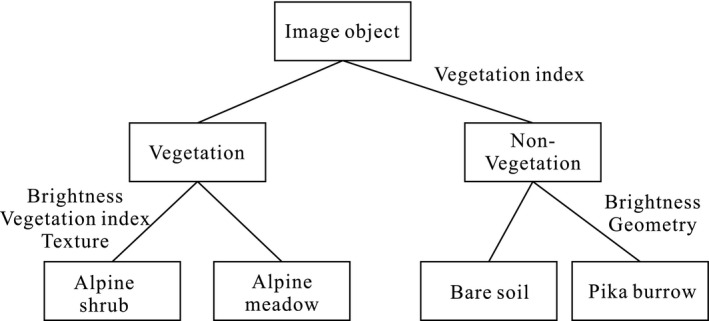
Plateau pika burrows are common feature of degraded grassland in the Qinghai-Tibet Plateau (QTP) and serve as an important indicator of pika activity and grassland degradation. However, the current understanding of the spatial pattern changes of pika burrows and their critical thresholds across a degradation gradient in alpine grassland is deficient. In this study, we investigated and quantified changes in the spatial pattern of plateau pika burrows under typical degraded alpine shrub meadows in the northeastern QTP using an unmanned aerial vehicle and landscape pattern metrics. The degradation of the alpine shrub meadow leads to a change in landscape pattern from a two-layered structure of alpine shrub and alpine meadow to a mosaic of alpine meadow and bare soil, with plateau pika burrows scattered throughout. Moderate degradation is the tipping point for changes in surface landscape patterns, followed by the disappearance of alpine shrub, the retreat of alpine meadows and the encroachment of bare soil, and the increasing density and size of pika burrows. The area characteristics of alpine meadows have influenced changes in the spatial pattern of pika burrow, and maintaining its proportional area is a vital measure to control the threat of pika burrows to pastures. The results of this paper provide a methodological reference and guidance for the sustainable utilization of grassland on the QTP.
高原鼠兔洞穴是青藏高原退化草地的常见特征,是鼠兔活动和草地退化的重要指示。然而,目前对于高寒草地退化梯度上鼠兔洞穴空间格局变化及其临界阈值的认识不足。本研究利用无人机和景观格局指标,对青藏高原东北部典型退化高寒灌丛草甸下高原鼠兔洞穴的空间格局变化进行了调查和量化。高寒灌丛草甸的退化导致景观格局从高寒灌丛和高寒草甸的两层结构转变为高寒草甸和裸土的镶嵌体,高原鼠兔洞穴散落其中。中度退化是地表景观格局变化的临界点,随后高寒灌丛消失,高寒草甸退缩,裸土侵入,鼠兔洞穴密度和规模增加。高寒草甸的面积特征影响了鼠兔洞穴空间格局的变化,保持其比例面积是控制鼠兔洞穴对牧场威胁的关键措施。本文结果为青藏高原草地的可持续利用提供了方法参考和指导。