Bujo Chie, Amiya Eisuke, Hatano Masaru, Ishida Junichi, Tsuji Masaki, Kakuda Nobutaka, Narita Koichi, Saito Akihito, Yagi Hiroki, Ando Masahiko, Shimada Shogo, Kimura Mitsutoshi, Kinoshita Osamu, Ono Minoru, Komuro Issei
Department of Cardiovascular Medicine, Graduate School of Medicine, The University of Tokyo, Hongo 7-3-1, Bunkyo-ku, Tokyo 113-8655, Japan.
Department of Therapeutic Strategy for Heart Failure, The University of Tokyo, Hongo 7-3-1, Bunkyo-ku, Tokyo 113-8655, Japan.
Int J Cardiol Heart Vasc. 2021 Nov 1;37:100907. doi: 10.1016/j.ijcha.2021.100907. eCollection 2021 Dec.
Implantable continuous-flow left ventricular assist device (LVAD) improve renal function in advanced heart failure. However, the long-term effects of LVAD on renal function have not been investigated thoroughly. We aimed to assess long-term renal function in patients with LVAD support and to identify predictors for late deterioration in renal function (LDRF).
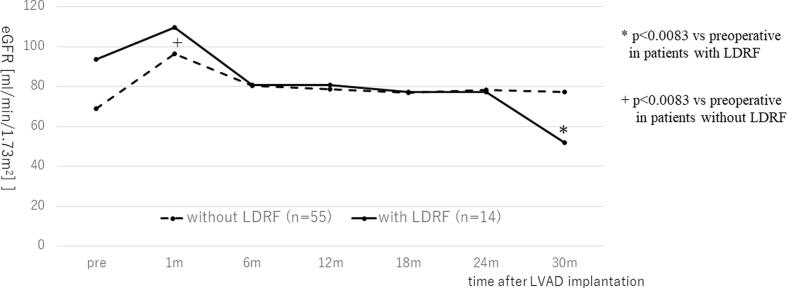
One hundred patients underwent LVAD implantation as a bridge to transplant at the University of Tokyo Hospital between May 2011 and December 2018. We assessed renal function at intervals (preoperative, 1, 6, 12, 18, 24 and 30 months after LVAD implantation). We divided patients into two groups: "with LDRF," whose renal function at 30 months had decreased by >25% compared with preoperatively (n = 14), and "without LDRF" (n = 55).
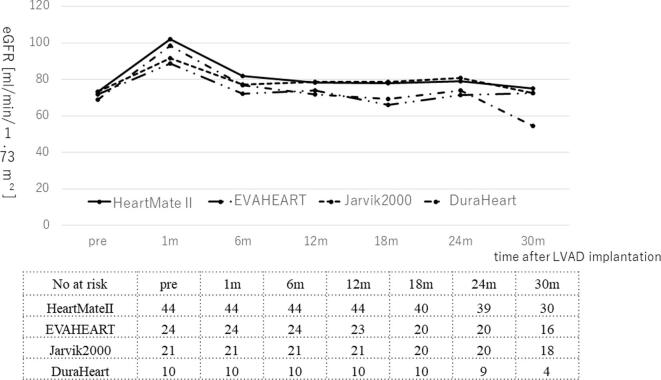
Renal function improved at 1 month, returned to preoperative levels at 6 months, and remained there up to 30 months after LVAD implantation. However, renal function impairment became evident in patients with LDRF 18 months after LVAD implantation. A ratio of right atrial pressure/pulmonary artery wedge pressure > 0.57 and left ventricular dimension diastole ≤ 67 mm were preoperative independent risk factors for LDRF. In addition, the incidence of perioperative acute kidney injury, ventricular arrhythmia, aortic insufficiency, and late right ventricular failure was significantly higher in patients with LDRF.
LDRF after LVAD implantation corresponded to several risk factors, including a small left ventricle and LVAD-related complications, such as right ventricular failure.
植入式连续流左心室辅助装置(LVAD)可改善晚期心力衰竭患者的肾功能。然而,LVAD对肾功能的长期影响尚未得到充分研究。我们旨在评估接受LVAD支持患者的长期肾功能,并确定肾功能晚期恶化(LDRF)的预测因素。
2011年5月至2018年12月期间,100例患者在东京大学医院接受LVAD植入作为移植过渡治疗。我们在不同时间点(术前、LVAD植入后1、6、12、18、24和30个月)评估肾功能。我们将患者分为两组:“发生LDRF组”,其30个月时的肾功能较术前下降>25%(n = 14),以及“未发生LDRF组”(n = 55)。
LVAD植入后1个月肾功能改善,6个月恢复到术前水平,并维持至30个月。然而,发生LDRF的患者在LVAD植入后18个月肾功能损害变得明显。右心房压力/肺动脉楔压比值>0.57和左心室舒张内径≤67 mm是术前LDRF的独立危险因素。此外,发生LDRF的患者围手术期急性肾损伤、室性心律失常、主动脉瓣关闭不全和晚期右心室衰竭的发生率显著更高。
LVAD植入后发生LDRF与多种危险因素相关,包括左心室较小以及LVAD相关并发症,如右心室衰竭。