Delombaerde Laurence, Petillion Saskia, Weltens Caroline, Depuydt Tom
Department of Oncology, KU Leuven, Herestraat 49, Leuven 3000, Belgium.
Department of Radiation Oncology, University Hospitals Leuven, Herestraat 49, Leuven 3000, Belgium.
Phys Imaging Radiat Oncol. 2021 Oct 30;20:51-55. doi: 10.1016/j.phro.2021.10.005. eCollection 2021 Oct.
New closed-bore linacs allow for highly streamlined workflows and fast treatment delivery resulting in brief treatment sessions. Motion management technology has only recently been integrated inside the bore, yet is required in future online adaptive workflows. We measured patient motion during every step of the workflow: image acquisition, evaluation and treatment delivery using surface scanning.
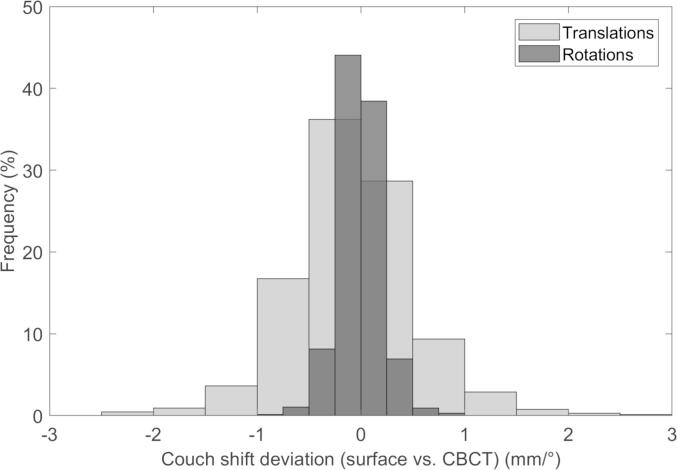
Nineteen patients treated for breast, lung or esophageal cancer were prospectively monitored from the end of setup to the end of treatment delivery in the Halcyon linac (Varian Medical Systems). Motion of the chest was tracked by way of 6 degrees-of-freedom surface tracking. Baseline drift and rate of drift were determined. The influence of fraction number, patient and fraction duration were analyzed with multi-way ANOVA.
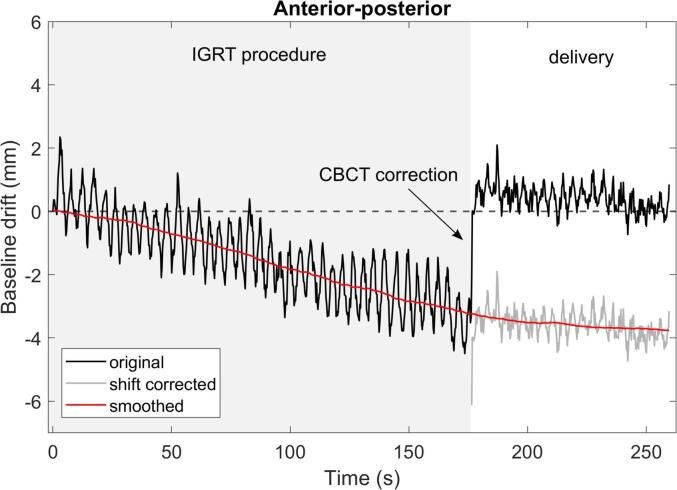
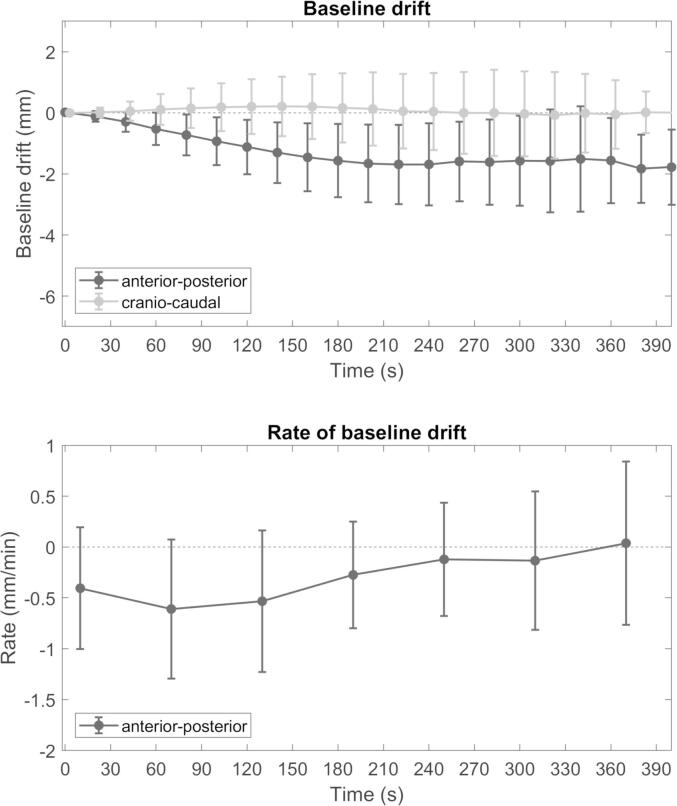
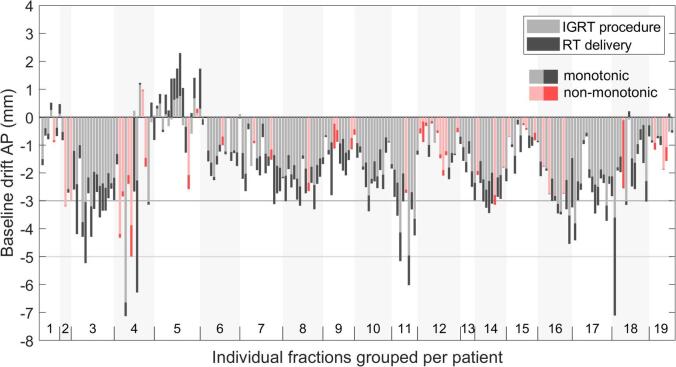
Median fraction duration was 4 min 48 s including the IGRT procedure (kV-CBCT acquisition and evaluation) (N = 221). Baseline drift at the end of the fraction was -1.8 ± 1.5 mm in the anterior-posterior, -0.0 ± 1.7 mm in the cranio-caudal direction and 0.1 ± 1.8 mm in the medio-lateral direction of which 75% occurred during the IGRT procedure. The highest rate of baseline drift was observed between 1 and 2 min after the end of patient setup (-0.62 mm/min). Baseline drift was patient and fraction duration dependent (p < 0.001), but fraction number was not significant (p = 0.33).
Even during short treatment sessions, patient baseline drift is not negligible. Drift is largest during the initial minutes after completion of patient setup, during verification imaging and evaluation. Patients will need to be monitored during extended contouring and re-planning procedures in online adaptive workflows.
新型封闭式直线加速器可实现高度简化的工作流程和快速的治疗交付,从而缩短治疗时间。运动管理技术直到最近才被集成到加速器腔内,但在未来的在线自适应工作流程中是必需的。我们使用表面扫描技术在工作流程的每一步测量患者的运动:图像采集、评估和治疗交付。
前瞻性监测了19例接受乳腺癌、肺癌或食管癌治疗的患者,从在Halcyon直线加速器(瓦里安医疗系统公司)中设置结束到治疗交付结束。通过六自由度表面跟踪来追踪胸部的运动。确定基线漂移和漂移率。采用多因素方差分析来分析分次次数、患者和分次持续时间的影响。
包括IGRT程序(千伏锥形束CT采集和评估)在内,中位分次持续时间为4分48秒(N = 221)。分次结束时的基线漂移在前-后方向为-1.8±1.5毫米,头-尾方向为-0.0±1.7毫米,中-侧方向为0.1±1.8毫米,其中75%发生在IGRT程序期间。在患者设置结束后1至2分钟之间观察到最高的基线漂移率(-0.62毫米/分钟)。基线漂移取决于患者和分次持续时间(p < 0.001),但分次次数不显著(p = 0.33)。
即使在短时间的治疗过程中,患者的基线漂移也不可忽略。漂移在患者设置完成后的最初几分钟内最大,即在验证成像和评估期间。在在线自适应工作流程中的扩展轮廓勾画和重新计划程序期间需要对患者进行监测。