Department of Ophthalmology, University of Lausanne, Jules-Gonin Eye Hospital, Fondation Asile des Aveugles, Lausanne, Switzerland.
RetinAI Medical AG, Bern, Switzerland.
Transl Vis Sci Technol. 2021 Nov 1;10(13):18. doi: 10.1167/tvst.10.13.18.
To develop and validate an automatic retinal pigment epithelial and outer retinal atrophy (RORA) progression prediction model for nonexudative age-related macular degeneration (AMD) cases in optical coherence tomography (OCT) scans.
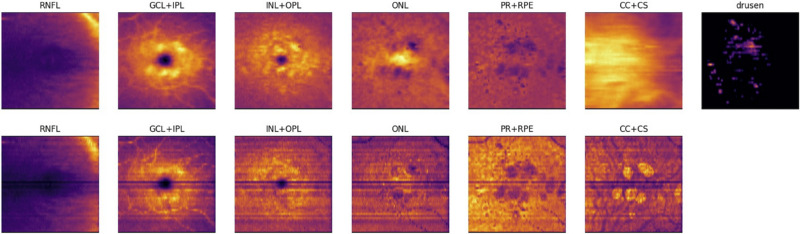
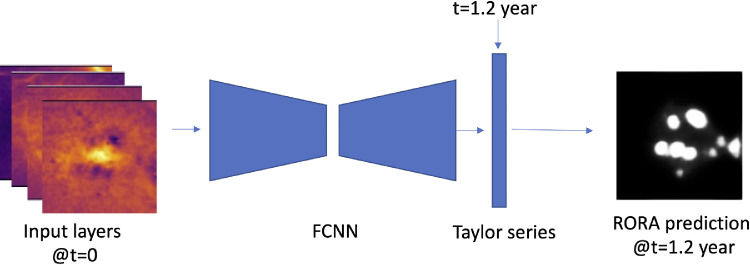
Longitudinal OCT data from 129 eyes/119 patients with RORA was collected and separated into training and testing groups. RORA was automatically segmented in all scans and additionally manually annotated in the test scans. OCT-based features such as layers thicknesses, mean reflectivity, and a drusen height map served as an input to the deep neural network. Based on the baseline OCT scan or the previous visit OCT, en face RORA predictions were calculated for future patient visits. The performance was quantified over time with the means of Dice scores and square root area errors.
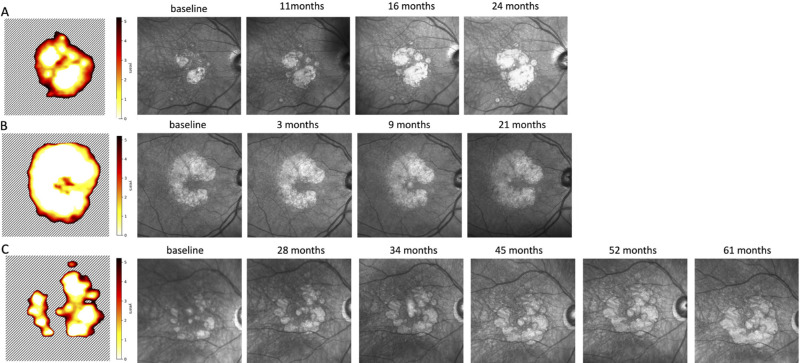
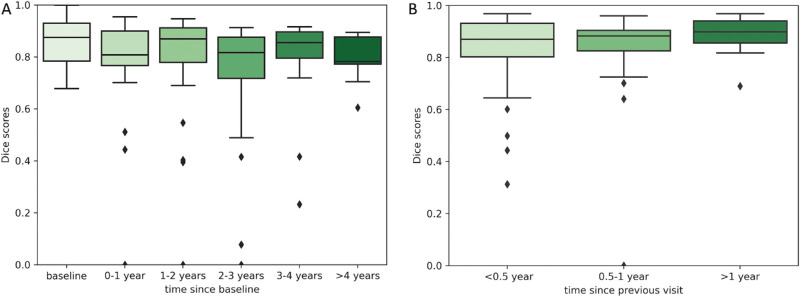
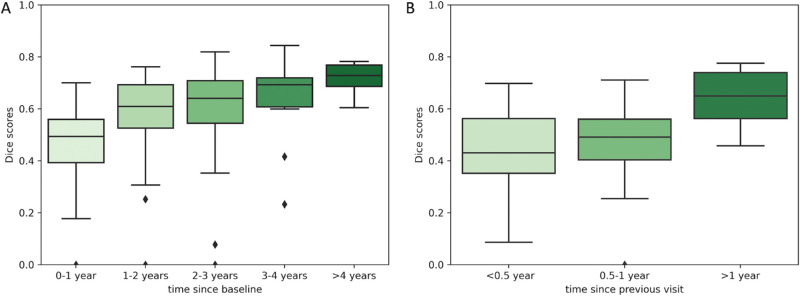
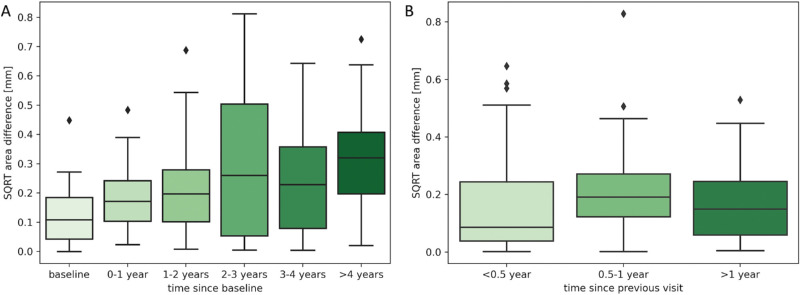
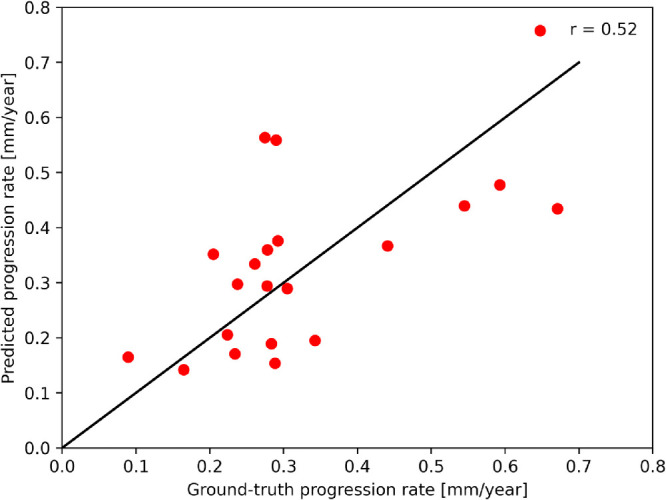
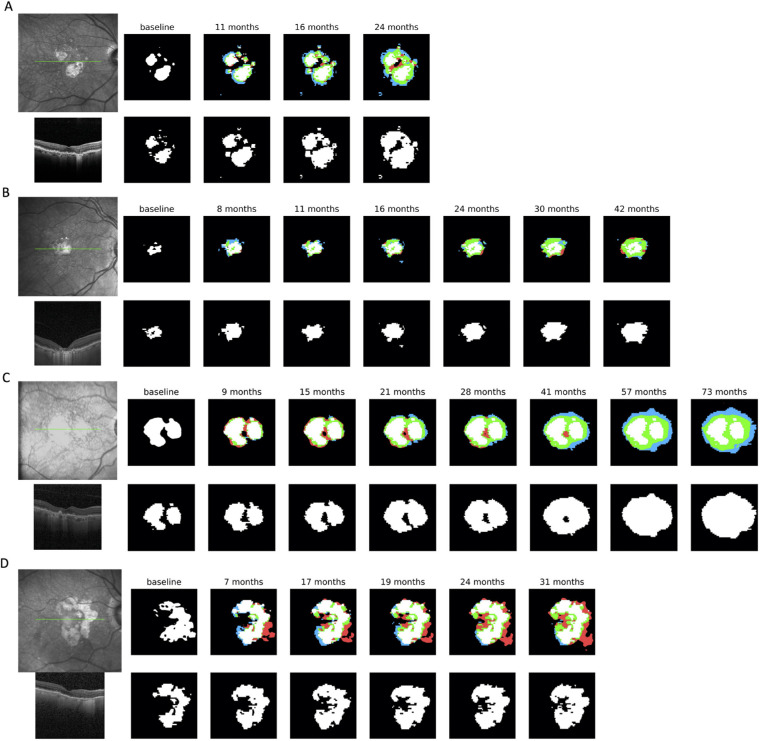
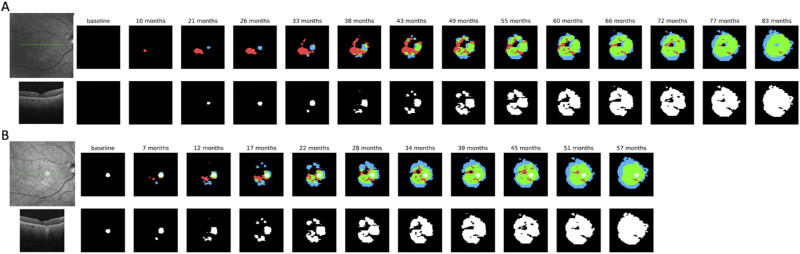
The average Dice score for segmentations at baseline was 0.85. When predicting progression from baseline OCTs, the Dice scores ranged from 0.73 to 0.80 for total RORA area and from 0.46 to 0.72 for RORA growth region. The square root area error ranged from 0.13 mm to 0.33 mm. By providing continuous time output, the model enabled creation of a patient-specific atrophy risk map.
We developed a machine learning method for RORA progression prediction, which provides continuous-time output. It was used to compute atrophy risk maps, which indicate time-to-RORA-conversion, a novel and clinically relevant way of representing disease progression.
Application of recent advances in artificial intelligence to predict patient-specific progression of atrophic AMD.
开发和验证一种用于光学相干断层扫描(OCT)扫描中渗出性年龄相关性黄斑变性(AMD)病例的自动视网膜色素上皮和外层视网膜萎缩(RORA)进展预测模型。
收集了 129 只眼/119 例 RORA 的纵向 OCT 数据,并将其分为训练组和测试组。在所有扫描中自动分割 RORA,并在测试扫描中手动注释。OCT 为基础的特征,如层厚度、平均反射率和一个玻璃膜疣高度图,作为深度神经网络的输入。基于基线 OCT 扫描或前一次就诊的 OCT,为未来的患者就诊计算了 RORA 的即时预测。通过 Dice 分数和平方根误差的平均值来定量评估随时间的性能。
基线分割的平均 Dice 分数为 0.85。当从基线 OCT 预测进展时,总 RORA 面积的 Dice 分数范围为 0.73 至 0.80,RORA 增长区域的 Dice 分数范围为 0.46 至 0.72。平方根误差范围为 0.13 毫米至 0.33 毫米。通过提供连续的时间输出,该模型能够创建患者特定的萎缩风险图。
我们开发了一种用于 RORA 进展预测的机器学习方法,它提供了连续时间的输出。它被用来计算萎缩风险图,这是一种表示疾病进展的新的、临床相关的方法,表明 RORA 转化的时间。
翻译是否准确?