Helsinki University, Division of Anesthesiology, Department of Anesthesiology, Intensive Care and Pain Medicine, University of Helsinki and Helsinki University Hospital, Helsinki, Finland; Clinical Research Institute Helsinki University Hospital, Helsinki, Finland.
Clinical Research Institute Helsinki University Hospital, Helsinki, Finland.
Thromb Res. 2021 Dec;208:129-137. doi: 10.1016/j.thromres.2021.10.027. Epub 2021 Nov 6.
Vaccine-induced thrombotic thrombocytopenia (VITT) is a rare coagulation disorder reported after administration of COVID-19 adenovirus-vectored vaccines. VITT is mediated by anti-platelet factor 4 (PF4) antibodies activating platelets through the Fcγ-receptor II (FcγRII), and it is associated with strong fibrin turnover. The complement system is involved in several other immunothrombotic entities, but its impact on VITT is not established.
To assess antibodies in interaction with the activation of platelets and complement triggered by VITT.
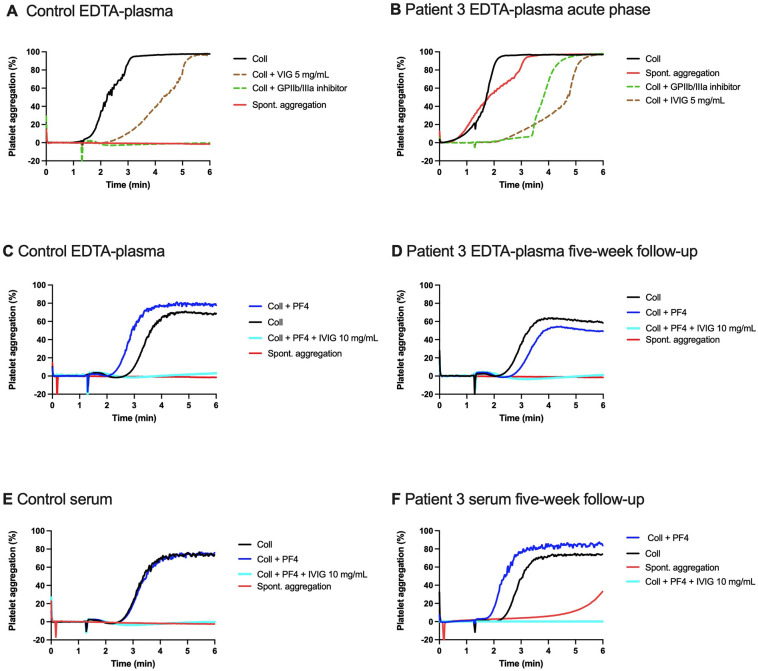
Antibodies against adenovirus type 2 hexon protein, ChAdOx1 adenoviral vector-specific IgG and PF4 were analyzed by enzyme immunoassays from VITT patients (n = 5). The EDTA plasma samples of the patients and controls were used to measure both terminal complement complexes (TCC) by ELISA and aggregation of healthy donor platelets. We studied the effects of human immunoglobulin (IVIG) and glycoprotein IIb/IIIa inhibitor (GPIIb/IIIa) on spontaneous and collagen-induced platelet aggregation supplemented with VITT plasma.
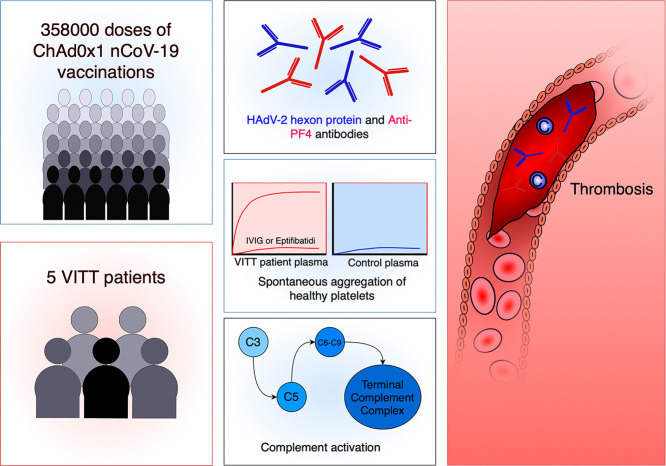
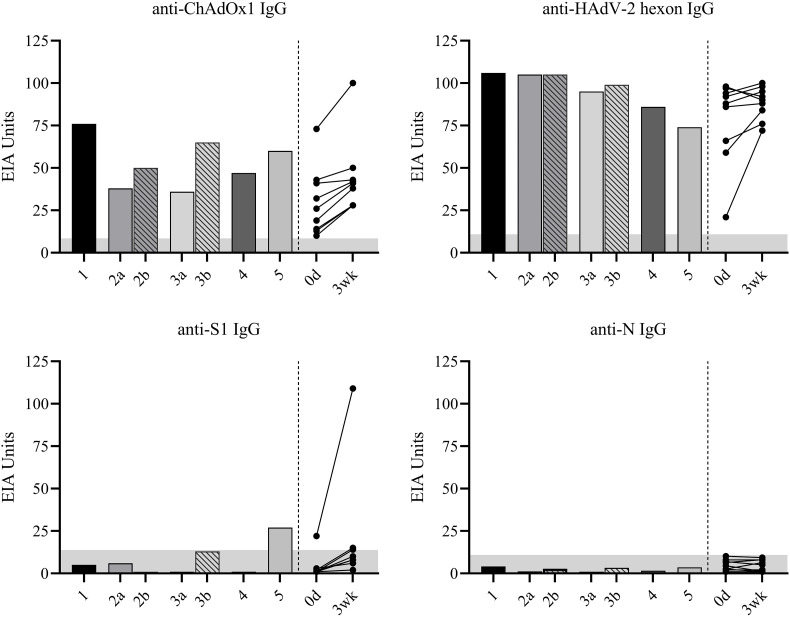
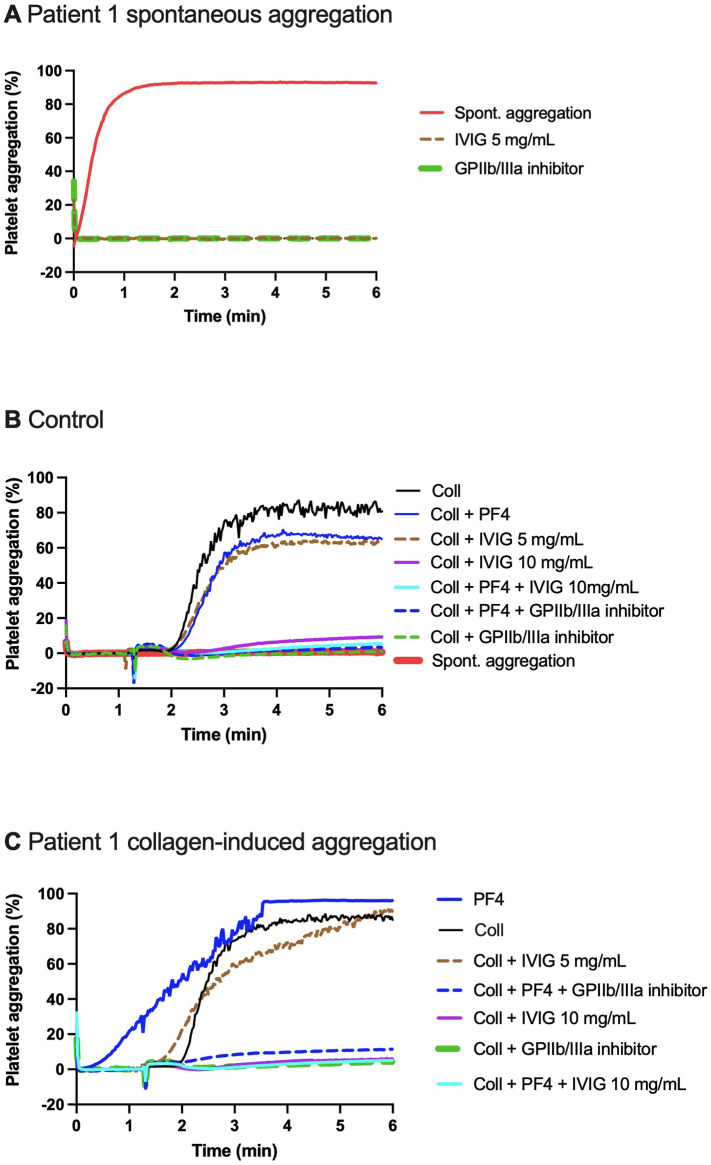
None of the patients had experienced a COVID-19 infection. Antibody analyses confirmed the immunogenicity of the adenovirus-vectored ChAdOx1 vaccine. Moreover, VITT plasma had anti-PF4 antibodies and elevated TCC levels as a sign of complement activation. In isolated healthy donor platelets, VITT patient plasma caused marked, spontaneous aggregation of platelets, which was abolished by eptifibatide and high-dose therapeutic IVIG.
Our findings suggest that VITT is triggered by antibodies against adenovirus vector and PF4-polyanion complexes which strongly co-activate complement and platelets. The spontaneous platelet aggregation was suppressed by IVIG or eptifibatide, indicating that besides FcγRII, also GPIIb/IIIa receptor exerts platelet procoagulant role in VITT.
COVID-19 腺病毒载体疫苗接种后发生的疫苗诱导的血栓性血小板减少症(VITT)是一种罕见的凝血障碍。VITT 是由抗血小板因子 4(PF4)抗体通过 Fcγ 受体 II(FcγRII)激活血小板介导的,并且与强烈的纤维蛋白转换有关。补体系统参与了其他几种免疫血栓实体,但它对 VITT 的影响尚未确定。
评估与 VITT 引发的血小板和补体激活相互作用的抗体。
通过酶联免疫吸附试验(ELISA)分析 VITT 患者(n=5)的针对腺病毒 2 六邻体蛋白、ChAdOx1 腺病毒载体特异性 IgG 和 PF4 的抗体。使用 EDTA 血浆样本测量患者和对照者的末端补体复合物(TCC)和健康供体血小板的聚集。我们研究了人免疫球蛋白(IVIG)和糖蛋白 IIb/IIIa 抑制剂(GPIIb/IIIa)对补充 VITT 血浆的自发性和胶原诱导的血小板聚集的影响。
患者均未发生 COVID-19 感染。抗体分析证实了腺病毒载体 ChAdOx1 疫苗的免疫原性。此外,VITT 血浆具有抗 PF4 抗体和升高的 TCC 水平,表明补体激活。在分离的健康供体血小板中,VITT 患者血浆引起血小板明显的自发性聚集,该聚集被 eptifibatide 和高剂量治疗性 IVIG 所消除。
我们的研究结果表明,VITT 是由针对腺病毒载体和 PF4-聚阴离子复合物的抗体触发的,这些抗体强烈共同激活补体和血小板。自发性血小板聚集被 IVIG 或 eptifibatide 抑制,表明除 FcγRII 外,GPIIb/IIIa 受体在 VITT 中也发挥血小板促凝作用。