Tufano Antonella, Rendina Domenico, Abate Veronica, Casoria Aniello, Marra Annachiara, Buonanno Pasquale, Galletti Ferruccio, Di Minno Giovanni, Servillo Giuseppe, Vargas Maria
Department of Clinical Medicine and Surgery, University of Naples "Federico II", 80131 Naples, Italy.
Department of Neurosciences, Reproductive and Odontostomatological Sciences, University of Naples "Federico II", 80131 Naples, Italy.
J Clin Med. 2021 Oct 25;10(21):4925. doi: 10.3390/jcm10214925.
A high incidence of venous thromboembolism (VTE) is reported in hospitalized COVID-19 patients, in particular in patients admitted to the intensive care unit (ICU). In patients with respiratory tract infections, including influenza A (H1N1), many studies have demonstrated an increased incidence of thromboses, but evidence is lacking regarding the risk difference (RD) of the occurrence of VTE between COVID-19 and non-COVID-19 patients.
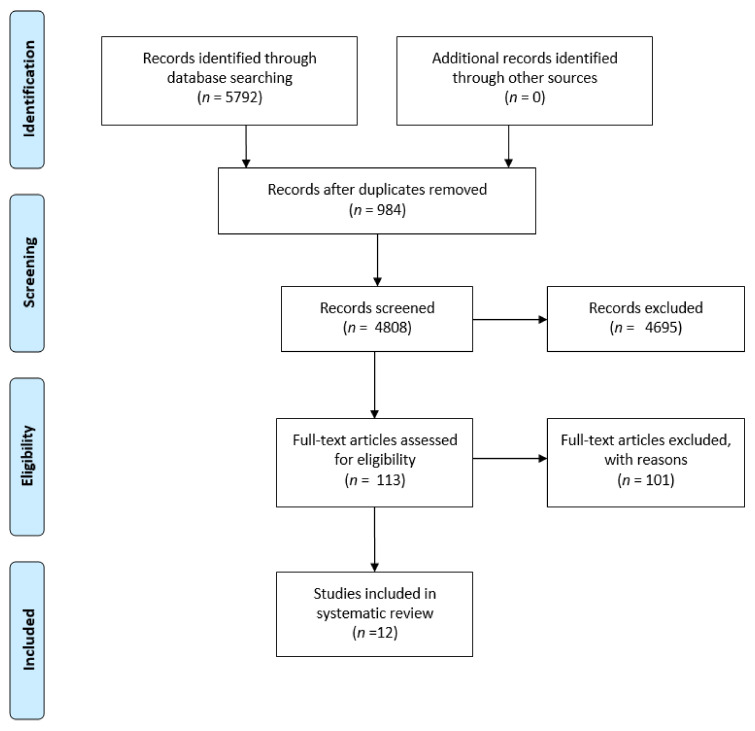
In this systematic review with meta-analysis, we evaluated the RD of the occurrence of VTE, pulmonary embolism (PE), and deep venous thrombosis (DVT) between COVID-19 and other pulmonary infection cohorts, in particular H1N1, and in an ICU setting. We searched for all studies comparing COVID-19 vs. non-COVID-19 regarding VTE, PE, and DVT.
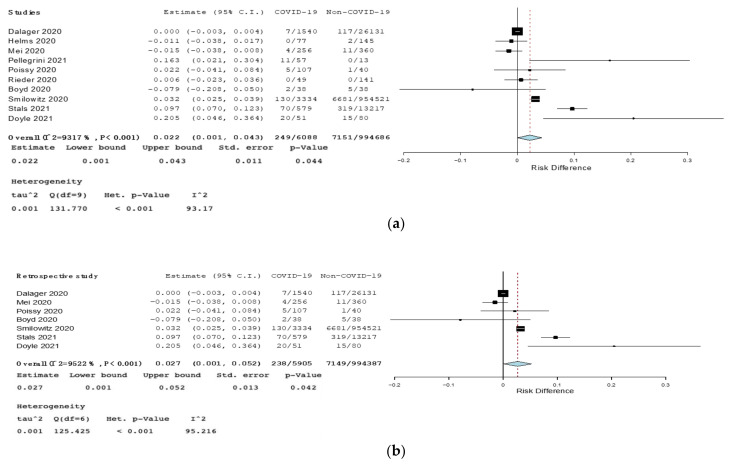
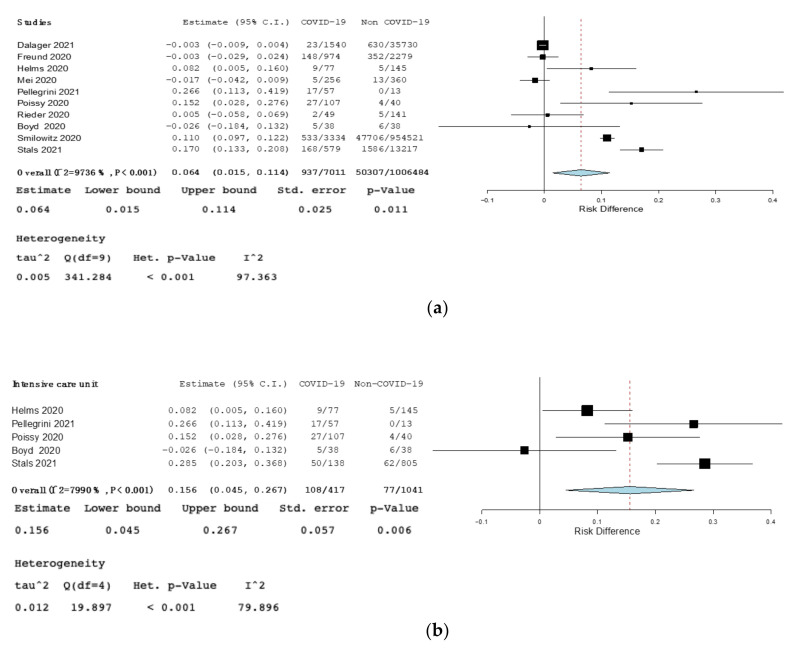
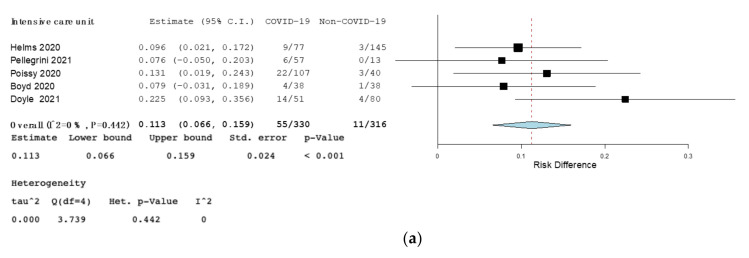
The systematic review included 12 studies and 1,013,495 patients. The RD for VTE in COVID-19 compared to non-COVID-19 patients was 0.06 (95% CI 0.11-0.25, = 0.011, I = 97%), and 0.16 in ICU (95% CI 0.045-0.27, = 0.006, I = 80%). The RD for PE between COVID-19 and non-COVID-19 patients was 0.03 (95% CI, 0.006-0.045, = 0.01, I = 89%). The RD for PE between COVID-19 and non-COVID-19 patients was 0.021 in retrospective studies (95% CI 0.00-0.04, = 0.048, I = 92%) and 0.11 in ICU studies (95% CI 0.06-0.16, < 0.001, I = 0%).
The growing awareness and understanding of a massive inflammatory response combined with a hypercoagulable state that predisposes patients to thrombosis in COVID-19, in particular in the ICU, may contribute to a more appropriate strategy of prevention and earlier detection of the thrombotic events.
据报道,住院的新型冠状病毒肺炎(COVID-19)患者中静脉血栓栓塞症(VTE)的发生率很高,尤其是入住重症监护病房(ICU)的患者。在包括甲型流感(H1N1)在内的呼吸道感染患者中,许多研究表明血栓形成的发生率增加,但缺乏关于COVID-19患者与非COVID-19患者发生VTE的风险差异(RD)的证据。
在这项进行荟萃分析的系统评价中,我们评估了COVID-19与其他肺部感染队列(尤其是H1N1)以及在ICU环境中发生VTE、肺栓塞(PE)和深静脉血栓形成(DVT)的RD。我们检索了所有比较COVID-19与非COVID-19在VTE、PE和DVT方面的研究。
该系统评价纳入了12项研究和1,013,495例患者。与非COVID-19患者相比,COVID-19患者发生VTE的RD为0.06(95%CI 0.11-0.25,P = 0.011,I² = 97%),在ICU中为0.16(95%CI 0.045-0.27,P = 0.006,I² = 80%)。COVID-19与非COVID-19患者之间PE的RD为0.03(95%CI,0.006-0.045,P = 0.01,I² = 89%)。在回顾性研究中,COVID-19与非COVID-19患者之间PE的RD为0.021(95%CI 0.00-0.04,P = 0.048,I² = 92%),在ICU研究中为0.11(95%CI 0.06-0.16,P < 0.001,I² = 0%)。
对大规模炎症反应以及高凝状态(使COVID-19患者,尤其是ICU患者易发生血栓形成)的认识和理解不断提高,可能有助于制定更合适的预防策略并更早发现血栓事件。