Department of Vascular Surgery, Peking Union Medical College Hospital, Chinese Academy of Medical Sciences and Peking Union Medical College, Beijing, China.
Department of Vascular Surgery, Peking Union Medical College Hospital, Chinese Academy of Medical Sciences and Peking Union Medical College, Beijing, China.
J Vasc Surg Venous Lymphat Disord. 2021 Mar;9(2):289-298.e5. doi: 10.1016/j.jvsv.2020.11.023. Epub 2020 Dec 9.
Emerging clinical evidence has shown that patients with the novel coronavirus disease-2019 (COVID-19) have complications that include venous thromboembolism (VTE), consisting of deep vein thrombosis (DVT) and pulmonary embolism (PE). The prevalence of VTE in patients hospitalized with COVID-19 is unclear.
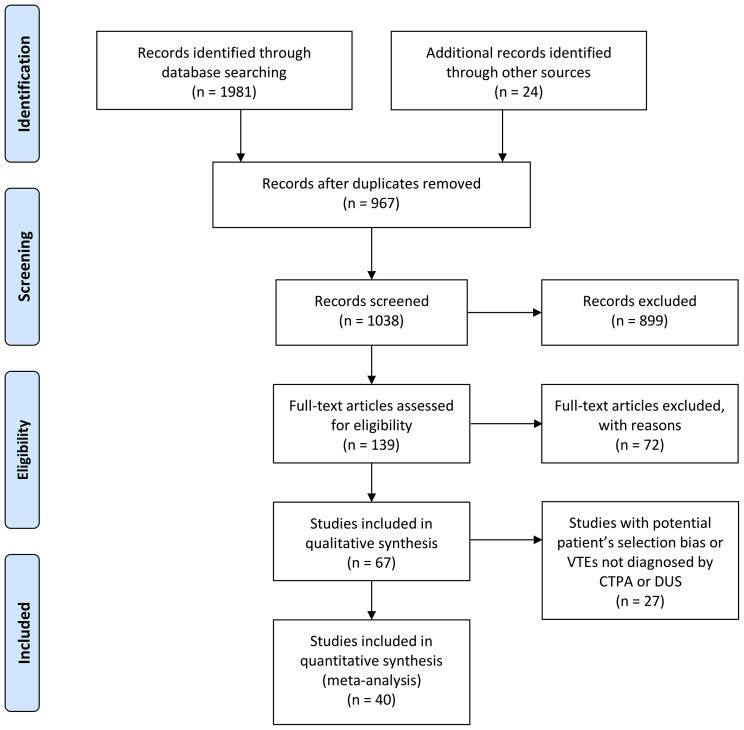
Eligible studies on COVID-19 were collected from PubMed, Web of Science, and Embase. Patient characteristics and information were extracted for three categories of patients: consecutive, ICU, and non-ICU group. All PEs and DVTs were diagnosed by computed tomographic pulmonary arteriography and duplex ultrasound examination, respectively. A subgroup analysis of testing strategies in ICU and non-ICU patients for PE and DVT was also performed.
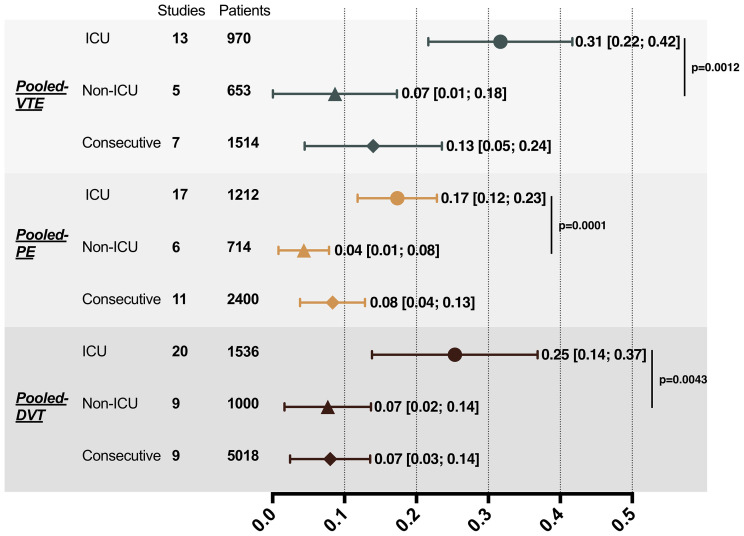
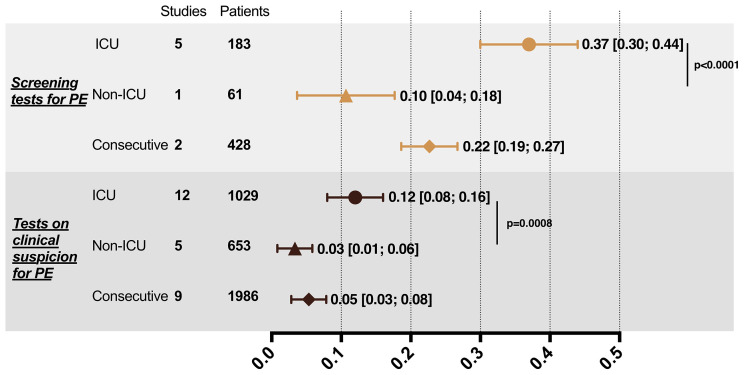
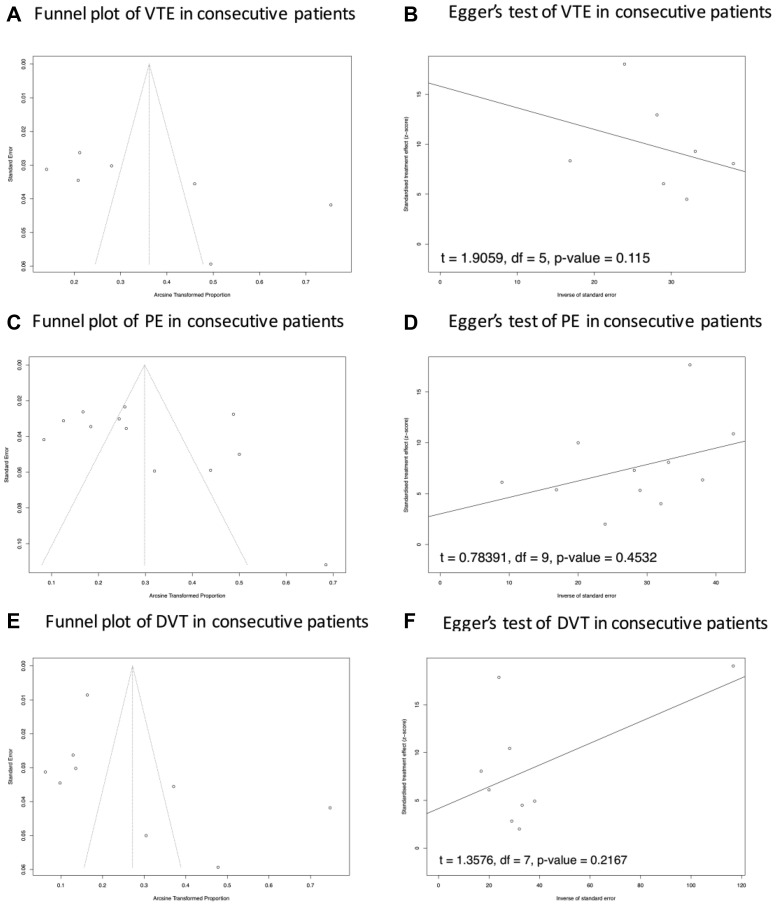
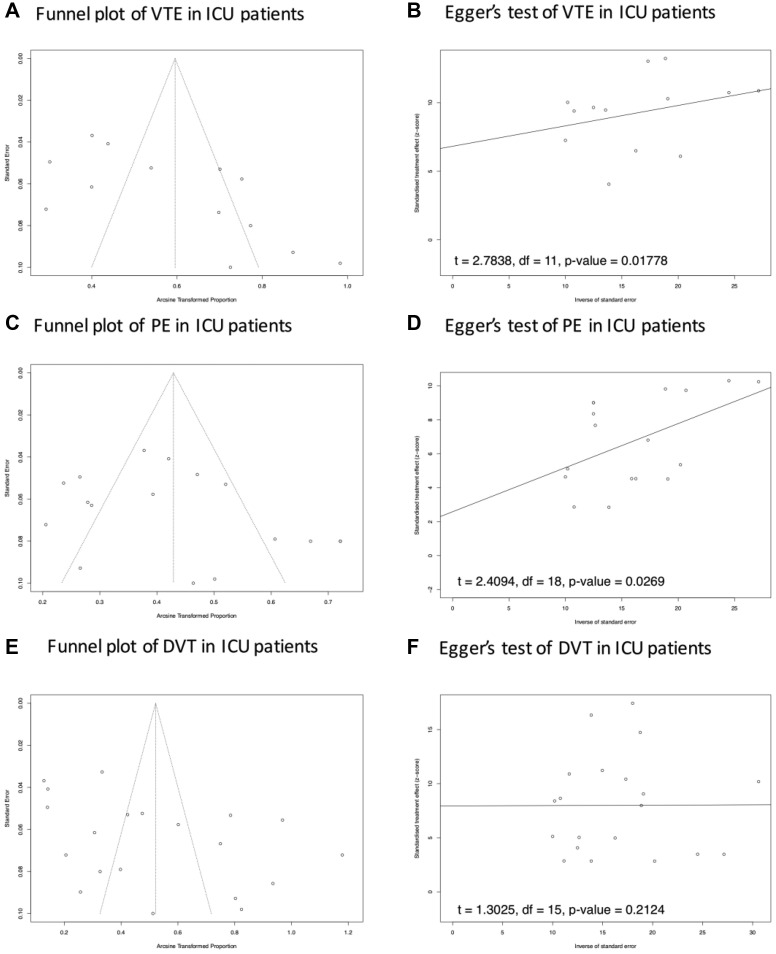
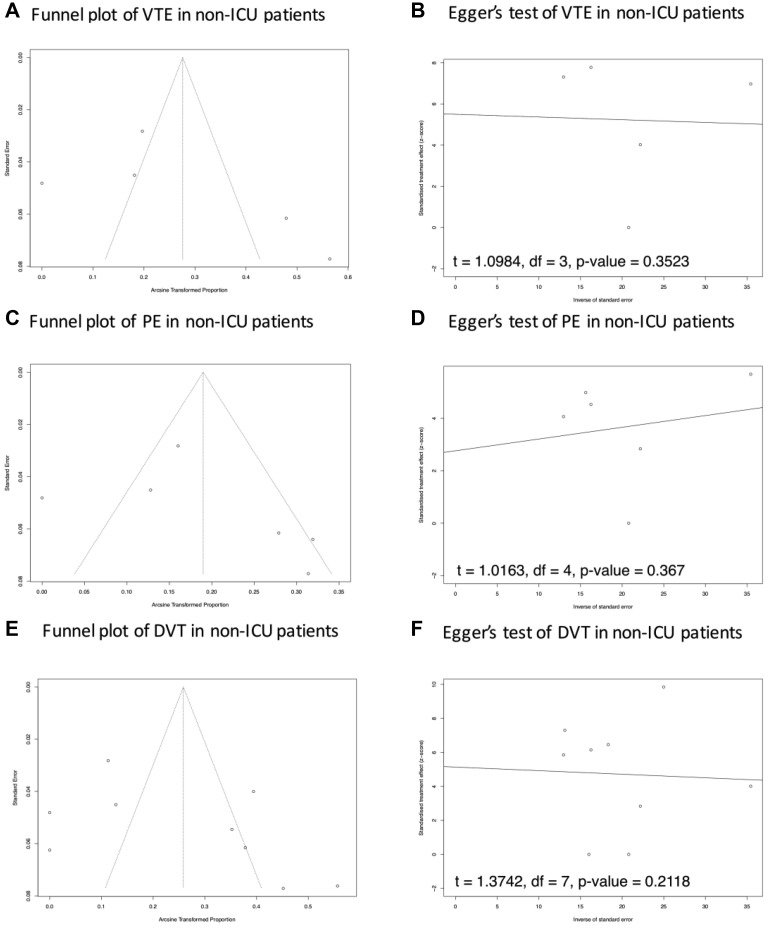
Forty clinical studies involving 7966 patients hospitalized with COVID-19 were included. Pooled VTE prevalence was 13% in consecutive patients (95% confidence interval [CI], 0.05-0.24; I = 97%), 7% in non-ICU patients (95% CI, 0.01-0.18; I = 93%), and 31% in ICU patients (95% CI, 0.22-0.42; I = 91%). ICU patients had the highest prevalence of PE among the three groups (17% [95% CI, 0.12-0.23] vs 8% in consecutive patients [95% CI, 0.04-0.13], 4% in non-ICU patients [95% CI, 0.01-0.08]). ICU patients also had the highest DVT prevalence (25% [95% CI, 0.14-0.37] vs 7% in consecutive patients [95% CI, 0.03-0.14], and 7% in non-ICU [95% CI, 0.02-0.14]). The subgroup analysis showed a three-fold improvement in the PE and DVT detection rates in both ICU and non-ICU patients with COVID-19 when the screening test for VTE was applied. In the settings of screening tests for VTE, ICU patients have a significantly higher prevalence of PE (37% vs 10%; P < .0001) and DVT (40% vs 12%; P = .0065) compared with non-ICU patients.
VTE is common in patients hospitalized with COVID-19, especially among ICU patients. Screening tests for PE and DVT may significantly improve detection rates in both ICU and non-ICU patients with COVID-19 than tests based on clinical suspicion.
新出现的临床证据表明,新型冠状病毒病 2019(COVID-19)患者存在静脉血栓栓塞症(VTE)并发症,包括深静脉血栓形成(DVT)和肺栓塞(PE)。COVID-19 住院患者中 VTE 的患病率尚不清楚。
从 PubMed、Web of Science 和 Embase 中收集 COVID-19 的合格研究。提取连续、ICU 和非 ICU 组三种患者类型的患者特征和信息。所有的 PE 和 DVT 均通过计算机断层肺动脉造影和双功超声检查诊断。还对 ICU 和非 ICU 患者中用于 PE 和 DVT 的检测策略进行了亚组分析。
共纳入 7966 例 COVID-19 住院患者的 40 项临床研究。连续患者的 VTE 患病率为 13%(95%置信区间 [CI],0.05-0.24;I = 97%),非 ICU 患者为 7%(95%CI,0.01-0.18;I = 93%),ICU 患者为 31%(95%CI,0.22-0.42;I = 91%)。三组患者中,ICU 患者的 PE 患病率最高(17%[95%CI,0.12-0.23] vs 连续患者中的 8%[95%CI,0.04-0.13],非 ICU 患者中的 4%[95%CI,0.01-0.08])。ICU 患者的 DVT 患病率也最高(25%[95%CI,0.14-0.37] vs 连续患者中的 7%[95%CI,0.03-0.14],非 ICU 患者中的 7%[95%CI,0.02-0.14])。亚组分析显示,在 COVID-19 患者中应用 VTE 筛查试验可使 ICU 和非 ICU 患者的 PE 和 DVT 检出率提高三倍。在 VTE 筛查试验的背景下,与非 ICU 患者相比,ICU 患者的 PE(37% vs 10%;P <.0001)和 DVT(40% vs 12%;P =.0065)患病率明显更高。
VTE 在 COVID-19 住院患者中很常见,尤其是 ICU 患者。与基于临床怀疑的检测相比,PE 和 DVT 的筛查检测可能会显著提高 COVID-19 患者中 ICU 和非 ICU 患者的检测率。