Department of Internal Medicine, Division of Pulmonology, Medical University of Graz, 8036 Graz, Austria.
Otto Loewi Research Center, Division of Immunology and Pathophysiology, Medical University of Graz, 8010 Graz, Austria.
Int J Mol Sci. 2021 Oct 29;22(21):11760. doi: 10.3390/ijms222111760.
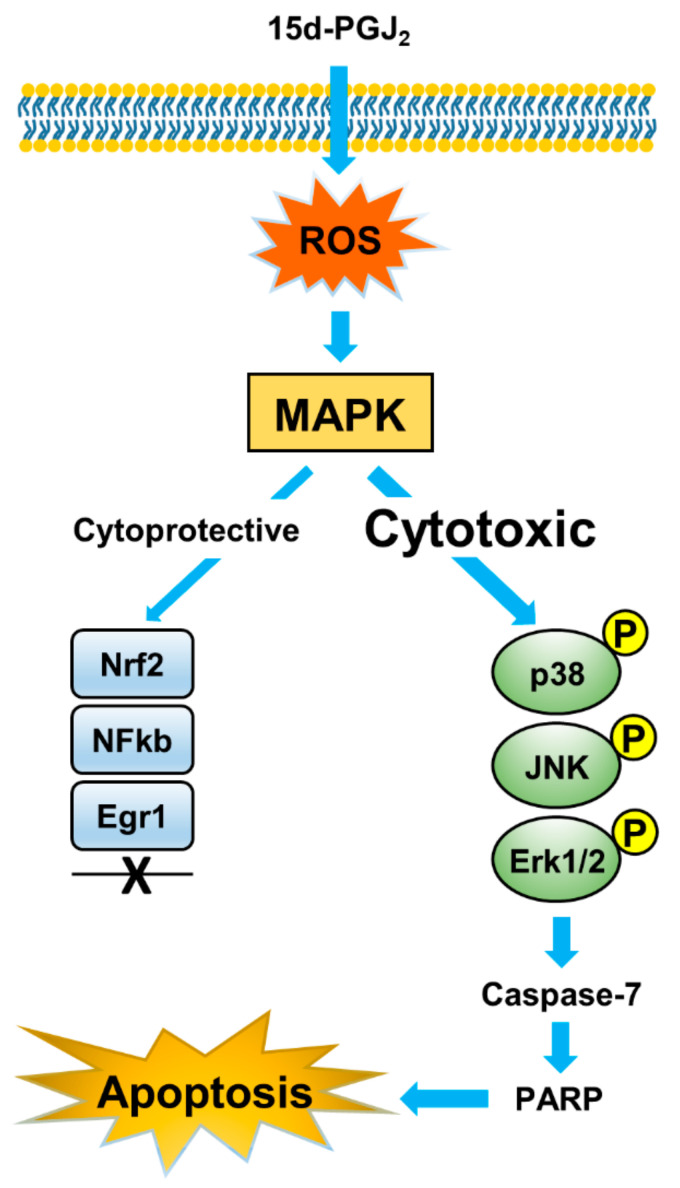
Osteosarcoma (OS) is the most common type of bone tumor, and has limited therapy options. 15-Deoxy-Δ-prostaglandin J (15d-PGJ) has striking anti-tumor effects in various tumors. Here, we investigated molecular mechanisms that mediate anti-tumor effects of 15d-PGJ in different OS cell lines. Human U2-OS and Saos-2 cells were treated with 15d-PGJ and cell survival was measured by MTT assay. Cell proliferation and motility were investigated by scratch assay, the tumorigenic capacity by colony forming assay. Intracellular ROS was estimated by HDCFDA. Activation of MAPKs and cytoprotective proteins was detected by immunoblotting. Apoptosis was detected by immunoblotting and Annexin V/PI staining. The ex ovo CAM model was used to study growth capability of grafted 15d-PGJ-treated OS cells, followed by immunohistochemistry with hematoxylin/eosin and Ki-67. 15d-PGJ substantially decreased cell viability, colony formation and wound closure capability of OS cells. Non-malignant human osteoblast was less affected by 15d-PGJ. 15d-PGJ induced rapid intracellular ROS production and time-dependent activation of MAPKs (pERK1/2, pJNK and pp38). Tempol efficiently inhibited 15d-PGJ-induced ERK1/2 activation, while N-acetylcystein and pyrrolidine dithiocarbamate were less effective. Early but weak activation of cytoprotective proteins was overrun by induction of apoptosis. A structural analogue, 9,10-dihydro-15d-PGJ, did not show toxic effects in OS cells. In the CAM model, we grafted OS tumors with U2-OS, Saos-2 and MG-63 cells. 15d-PGJ treatment resulted in significant growth inhibition, diminished tumor tissue density, and reduced tumor cell proliferation for all cell lines. Our in vitro and CAM data suggest 15d-PGJ as a promising natural compound to interfere with OS tumor growth.
骨肉瘤(OS)是最常见的骨肿瘤类型,治疗选择有限。15-脱氧-Δ-前列腺素 J(15d-PGJ)在各种肿瘤中具有显著的抗肿瘤作用。在这里,我们研究了介导 15d-PGJ 在不同 OS 细胞系中抗肿瘤作用的分子机制。用人 U2-OS 和 Saos-2 细胞进行 15d-PGJ 处理,并通过 MTT 测定法测量细胞存活。通过划痕试验研究细胞增殖和迁移,通过集落形成试验研究致瘤能力。通过 HDCFDA 估计细胞内 ROS。通过免疫印迹检测 MAPK 和细胞保护蛋白的激活。通过免疫印迹和 Annexin V/PI 染色检测细胞凋亡。使用 ex ovo CAM 模型研究移植 15d-PGJ 处理的 OS 细胞的生长能力,然后用苏木精/伊红和 Ki-67 进行免疫组织化学染色。15d-PGJ 显著降低了 OS 细胞的细胞活力、集落形成和伤口闭合能力。非恶性人成骨细胞受 15d-PGJ 的影响较小。15d-PGJ 诱导快速的细胞内 ROS 产生和时间依赖性的 MAPK(pERK1/2、pJNK 和 pp38)激活。Tempol 有效抑制了 15d-PGJ 诱导的 ERK1/2 激活,而 N-乙酰半胱氨酸和吡咯烷二硫代氨基甲酸盐的效果较差。早期但较弱的细胞保护蛋白激活被诱导的细胞凋亡所超越。结构类似物 9,10-二氢-15d-PGJ 对 OS 细胞没有毒性作用。在 CAM 模型中,我们将 U2-OS、Saos-2 和 MG-63 细胞的骨肉瘤移植。15d-PGJ 处理导致所有细胞系的肿瘤生长显著抑制、肿瘤组织密度降低和肿瘤细胞增殖减少。我们的体外和 CAM 数据表明 15d-PGJ 是一种有前途的天然化合物,可以干扰骨肉瘤肿瘤的生长。