Department of Biomedicine and Prevention, University of Rome Tor Vergata, 00133 Rome, Italy.
Community of Sant'Egidio, "Long Live the Elderly" Program, 00153 Rome, Italy.
Int J Environ Res Public Health. 2021 Nov 4;18(21):11587. doi: 10.3390/ijerph182111587.
Heat waves are correlated with increased mortality in the aged population. Social isolation is known as a vulnerability factor. This study aims at evaluating the correlation between an intervention to reduce social isolation and the increase in mortality in the population over 80 during heat waves.
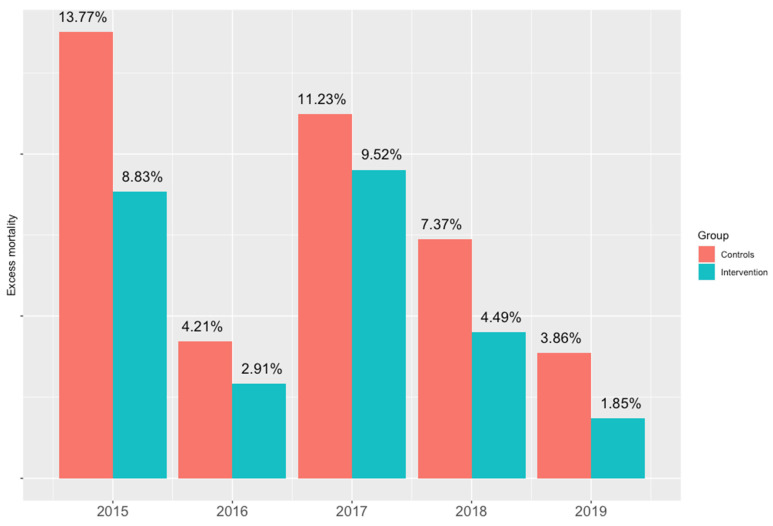
This study adopted a retrospective ecologic design. We compared the excess mortality rate (EMR) in the over-80 population during heat waves in urban areas of Rome (Italy) where a program to reduce social isolation was implemented, to others where it was not implemented. We measured the mortality of the summer periods from 2015 to 2019 compared with 2014 (a year without heat waves). Winter mortality, cadastral income, and the proportion of people over 90 were included in the multivariate Poisson regression.
The EMR in the intervention and controls was 2.70% and 3.81%, respectively. The rate ratio was 0.70 (c.i. 0.54-0.92, -value 0.01). The incidence rate ratio (IRR) of the interventions, with respect to the controls, was 0.76 (c.i. 0.59-0.98). After adjusting for other variables, the IRR was 0.44 (c.i. 0.32-0.60).
Reducing social isolation could limit the impact of heat waves on the mortality of the elderly population.
热浪与老年人群体死亡率的增加有关。社会隔离是一个脆弱性因素。本研究旨在评估减少社会隔离的干预措施与热浪期间 80 岁以上人群死亡率增加之间的相关性。
本研究采用回顾性生态设计。我们比较了在意大利罗马市区实施减少社会隔离计划的地区与未实施该计划的地区,80 岁以上人群在热浪期间的超额死亡率(EMR)。我们测量了 2015 年至 2019 年夏季与 2014 年(没有热浪的一年)相比的死亡率。冬季死亡率、地籍收入和 90 岁以上人口的比例被纳入多变量泊松回归。
干预组和对照组的 EMR 分别为 2.70%和 3.81%。率比为 0.70(95%置信区间为 0.54-0.92,-值为 0.01)。干预组的发病率比(IRR)相对于对照组为 0.76(95%置信区间为 0.59-0.98)。在调整其他变量后,IRR 为 0.44(95%置信区间为 0.32-0.60)。
减少社会隔离可能会限制热浪对老年人口死亡率的影响。