
通过分子动力学模拟揭示低pH对新型冠状病毒主要蛋白酶的影响
Unveiling the Effect of Low pH on the SARS-CoV-2 Main Protease by Molecular Dynamics Simulations.
作者信息
Barazorda-Ccahuana Haruna Luz, Nedyalkova Miroslava, Mas Francesc, Madurga Sergio
机构信息
Materials Science and Physical Chemistry Department & Research Institute of Theoretical and Computational Chemistry (IQTCUB), University of Barcelona, 08028 Barcelona, Spain.
Vicerrectorado de Investigación, Universidad Católica de Santa María, Arequipa 04000, Peru.
出版信息
Polymers (Basel). 2021 Nov 5;13(21):3823. doi: 10.3390/polym13213823.
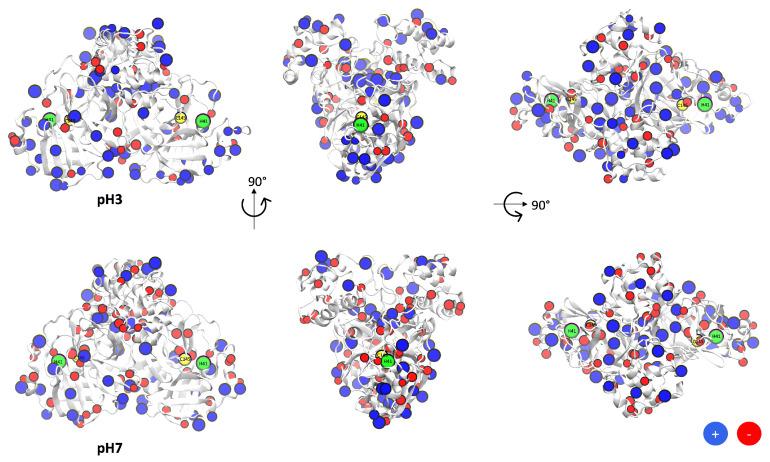
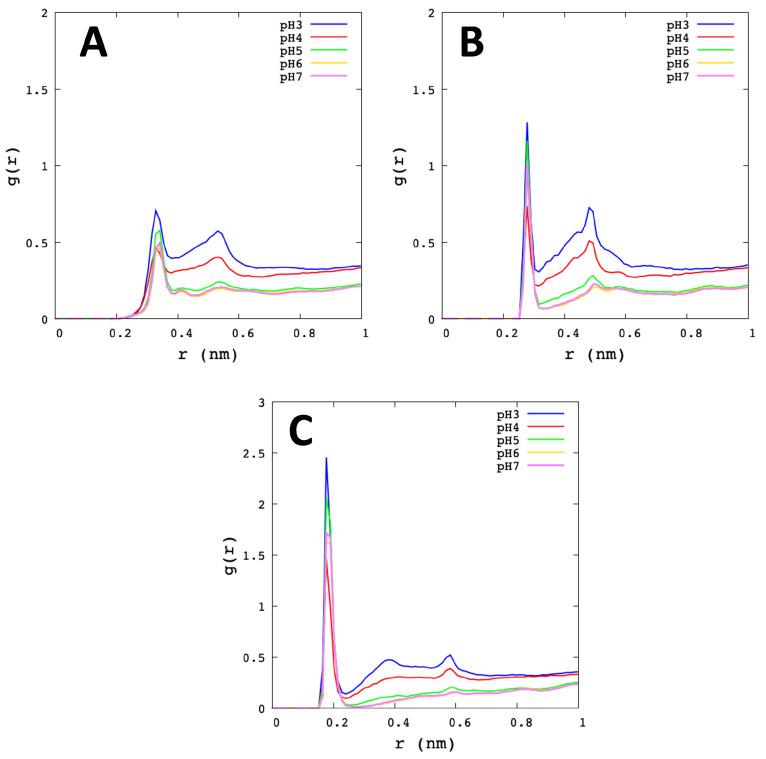
(1) Background: Main Protease (Mpro) is an attractive therapeutic target that acts in the replication and transcription of the SARS-CoV-2 coronavirus. Mpro is rich in residues exposed to protonation/deprotonation changes which could affect its enzymatic function. This work aimed to explore the effect of the protonation/deprotonation states of Mpro at different pHs using computational techniques. (2) Methods: The different distribution charges were obtained in all the evaluated pHs by the Semi-Grand Canonical Monte Carlo (SGCMC) method. A set of Molecular Dynamics (MD) simulations was performed to consider the different protonation/deprotonation during 250 ns, verifying the structural stability of Mpro at different pHs. (3) Results: The present findings demonstrate that active site residues and residues that allow Mpro dimerisation was not affected by pH changes. However, Mpro substrate-binding residues were altered at low pHs, allowing the increased pocket volume. Additionally, the results of the solvent distribution around Sγ, Hγ, Nδ1 and Hδ1 atoms of the catalytic residues Cys145 and His41 showed a low and high-water affinity at acidic pH, respectively. It which could be crucial in the catalytic mechanism of SARS-CoV-2 Mpro at low pHs. Moreover, we analysed the docking interactions of PF-00835231 from Pfizer in the preclinical phase, which shows excellent affinity with the Mpro at different pHs. (4) Conclusion: Overall, these findings indicate that SARS-CoV-2 Mpro is highly stable at acidic pH conditions, and this inhibitor could have a desirable function at this condition.
(1) 背景:主要蛋白酶(Mpro)是一个有吸引力的治疗靶点,在严重急性呼吸综合征冠状病毒2(SARS-CoV-2)的复制和转录过程中发挥作用。Mpro富含易受质子化/去质子化变化影响的残基,这可能会影响其酶功能。这项工作旨在使用计算技术探索不同pH值下Mpro的质子化/去质子化状态的影响。(2) 方法:通过半巨正则蒙特卡罗(SGCMC)方法在所有评估的pH值下获得不同的分布电荷。进行了一组分子动力学(MD)模拟,以考虑250纳秒内不同的质子化/去质子化情况,验证Mpro在不同pH值下的结构稳定性。(3) 结果:目前的研究结果表明,活性位点残基和允许Mpro二聚化的残基不受pH变化的影响。然而,Mpro底物结合残基在低pH值下发生了改变,导致口袋体积增加。此外,催化残基Cys145和His41的Sγ、Hγ、Nδ1和Hδ1原子周围的溶剂分布结果显示,在酸性pH值下,水亲和力分别较低和较高。这在SARS-CoV-2 Mpro在低pH值下的催化机制中可能至关重要。此外,我们分析了辉瑞公司临床前阶段的PF-00835231的对接相互作用,其在不同pH值下与Mpro表现出优异的亲和力。(4) 结论:总体而言,这些发现表明SARS-CoV-2 Mpro在酸性pH条件下高度稳定,并且这种抑制剂在这种条件下可能具有理想的功能。






 Zotero 插件